Sultan of Oman makes historic first visit to China
Trip seeks stronger engagement with China amid Mideast uncertainty
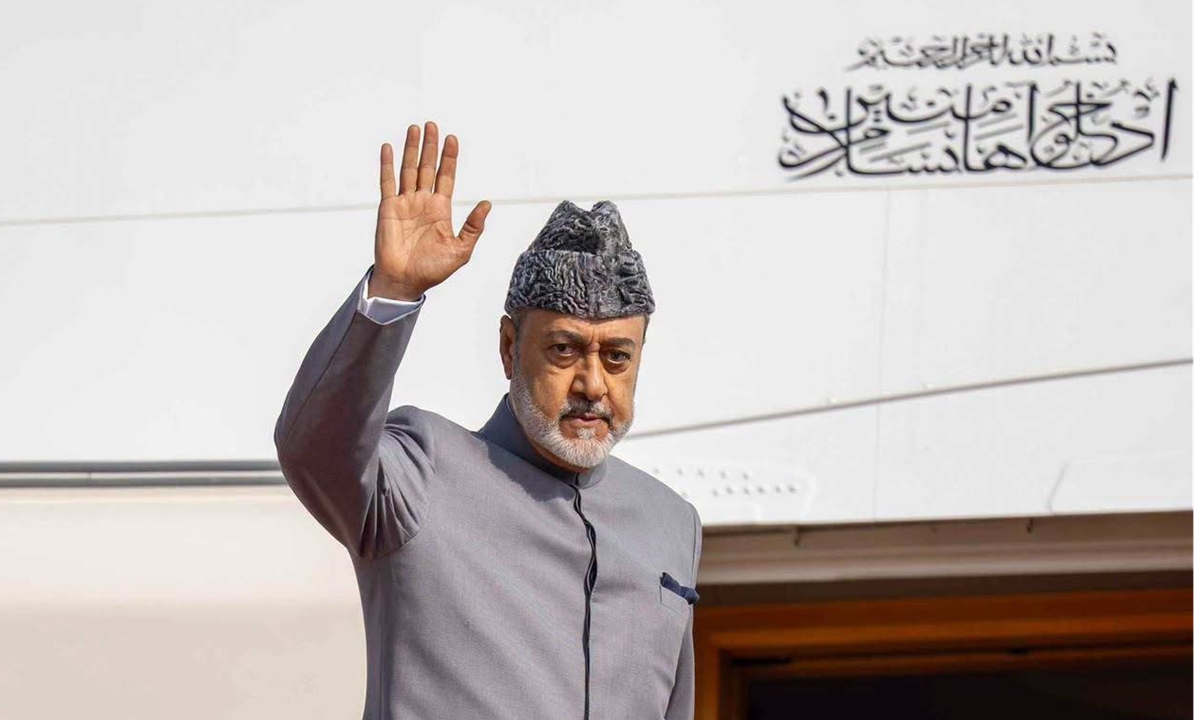
Sultan Haitham Bin Tarik Al Said of Oman departs for a China visit on November 1, 2026. Photo: IC
Sultan Haitham Bin Tarik Al Said of Oman arrived in Beijing on Sunday for his two-day state visit to China, media reported, which marks the first visit to China by an Omani head of state since diplomatic ties were established in 1978.
Chinese analysts said Oman seeks stronger Chinese engagement amid the evolving situation in the Middle East, and the trip could not only promote cooperation in trade but also set a positive example for regional cooperation.
This will be the first visit to China by Sultan Haitham since ascending to the throne and by an Omani head of state since diplomatic ties were established 48 years ago. As such, it is of great significance for advancing bilateral relations, Chinese Foreign Ministry spokesperson Guo Jiakun introduced during a press conference on Friday.
China and Oman enjoy a profound traditional friendship, Guo said. "We hope to work together with the Omani side to take the upcoming visit as an opportunity to bring our strategic partnership to new heights."
The visit is expected to strengthen bilateral relations and enhance cooperation between Oman and China across various fields, Times of Oman said in its report on Sunday.
The Oman Observer noted that the visit marks a landmark in Omani-Chinese relations. It carries a particular importance in light of the steady evolution of bilateral ties and the wider horizon it holds for deepening the strategic partnership, and it opens the way for closer cooperation across political, economic, investment, cultural and scientific fields, the media outlet said.
Sun Degang, director of the Center for Middle Eastern Studies at Fudan University, told the Global Times that the visit to China is to seek stronger Chinese engagement against the backdrop of the evolving situation in the Middle East, as tensions in the Gulf region have escalated sharply recently.
Oman hopes that China will play a greater role in actively promoting reconciliation and dialogue, thereby helping to maintain stability in the Middle East, Sun said.
Ding Long, a professor at the Middle East Studies Institute of Shanghai International Studies University said that Oman's Vision 2040 aims to diversify the economy and reduce its dependence on oil and gas, while China's strengths in renewable energy equipment, infrastructure development, digital technology and industrial supply chains offer the external support Oman needs for its economic transformation.
With tensions mounting in the Strait of Hormuz, and Oman, which has been a long-standing active mediator in regional disputes, coming under pressure as well, the visit reflects its efforts to strengthen strategic support and enhance diplomatic autonomy amid great-power rivalry, Ding told the Global Times, adding that the visit could further consolidate China-Oman trade and investment ties.
The steady development of relations between China and Oman is an important part of the broader growth of China-Arab cooperation, Sun noted. Since the beginning of this year, China has welcomed a succession of high-level visits from Arab countries, including Saudi Arabia, the United Arab Emirates and Jordan.
The expert added that Sultan Haitham's visit to China further underscores an important point that regardless of the challenges and uncertainties they may face, China's strategic partnerships with Arab countries and Gulf Cooperation Council (GCC) continue to deepen and deliver tangible results.
The visit would have a positive effect across the GCC, Ding added. As one of the few GCC members maintaining communication with the US, Iran and other states, Oman plays a unique role in regional dialogue. Deeper China-Oman ties will help sustain dialogue and inject fresh momentum into China's cooperation with the GCC and the wider Arab world, Sun said.
RELATED ARTICLES