China to launch 5-10 joint archaeological projects with foreign partners in next five years, deepen Belt and Road cooperation
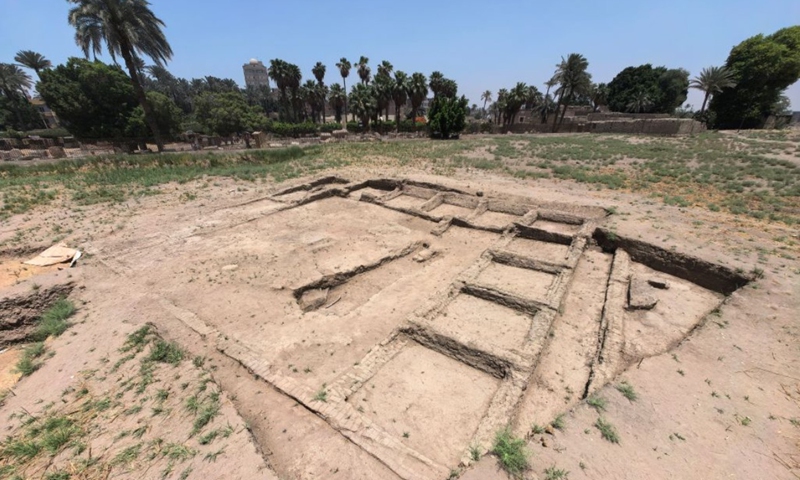
A mud-brick structure uncovered by a joint Chinese-Egyptian archaeological team at the Sekhmet Temple site in Egypt Photo: Courtesy of Shanghai Museum
China will step up international archaeological cooperation over the next five years, with plans to develop five to 10 joint archaeological projects with foreign partners, particularly those in countries participating in the Belt and Road Initiative. The projects will serve as models for international cooperation, the National Cultural Heritage Administration (NCHA) said Monday.
The measures are part of China's archaeological development plan for the 15th Five-Year Plan period (2026-30), which was outlined at an NCHA press conference on Monday.
The plan calls for improving the management system for joint archaeological projects and supporting Chinese archaeological institutions and universities in carrying out overseas excavations and engaging in academic exchanges.
It also proposes joint archaeological research in the Austronesian-speaking world, the Himalayan region, and areas along the Silk Road and Maritime Silk Road, as well as studies of ancient Egyptian, Greek and Maya civilizations, according to a notice published on the website of the NCHA on Saturday.
Ongoing fieldwork in Central Asia will remain an important part of the cooperation. Zhu Jiangsong, a member of the joint archaeological team from Northwest University's School of Cultural Heritage, told the Global Times that excavations at the Bandikhan II site in Uzbekistan would continue in the coming years.
The joint Chinese-Uzbek team has also uncovered a 3,000-year-old city in Uzbekistan, offering new insights into urban planning and construction during the early Iron Age, he said.
According to Zhu, the archaeological cooperation program includes training and fieldwork covering Chinese and Silk Road archaeology, cultural relics conservation, heritage management and archaeological science, bringing together scholars from both countries.
Northwest University will also support the development of the China-Central Asia Belt and Road Joint Laboratory for Human and Environmental Studies and provide professional training for Uzbek specialists, Zhu said.
The NCHA also announced that China will promote research into ancient Egyptian, Greek and Maya civilizations, and deepen cooperation with countries including Saudi Arabia, Tunisia, Egypt and Greece in underwater archaeology and cultural heritage protection, according to the notice.
A recent example of such cooperation is the discovery of two sacred lakes at the Montu Temple precinct in Luxor, Egypt, by a joint Chinese-Egyptian archaeological team. The discovery marks the first layout of double sacred lake within a single ancient Egyptian temple precinct, Xinhua reported, citing the NCHA.
During the 15th Five-Year Plan period, China will also strengthen its capacity for overseas joint archaeological research by promoting long-term partnerships between domestic archaeological institutions and universities and their foreign counterparts, according to the NCHA.
The plan also calls for strengthening Northwest University's Collaborative Research Center for Archaeology of the Silk Roads to support international academic cooperation, the NCHA notice said.
Fu Zengqi, a member of the Silk Road Archaeology Research Center, told the Global Times that ongoing projects include multiple excavations in Uzbekistan.
Other projects that have completed this year's fieldwork include excavations at the Shorobashat ancient city site in Kyrgyzstan and Pazyryk culture burial sites in Russia's Altai region, Fu said.
Wang Jianxin, director of Northwest University's Silk Road Archaeology Research Center, said his team began working with the Institute of Archaeology of the Uzbekistan Academy of Sciences in 2013, the year the Belt and Road Initiative was proposed. That partnership marked the start of a growing program of joint archaeological research between China and Uzbekistan.
In addition to cooperation with universities such as the National University of Uzbekistan, China's archaeological engagement in Central Asia has since expanded into a broader, multilateral framework, said Wang.
"Through the Belt and Road Initiative, Northwest University's archaeology program will continue to build on its long-standing academic tradition of Silk Road studies and play an active role in deepening understanding of the history and cultural traditions of countries and regions along the route, fostering mutual understanding between China and its partners, and promoting closer people-to-people ties," Wang said.
RELATED ARTICLES