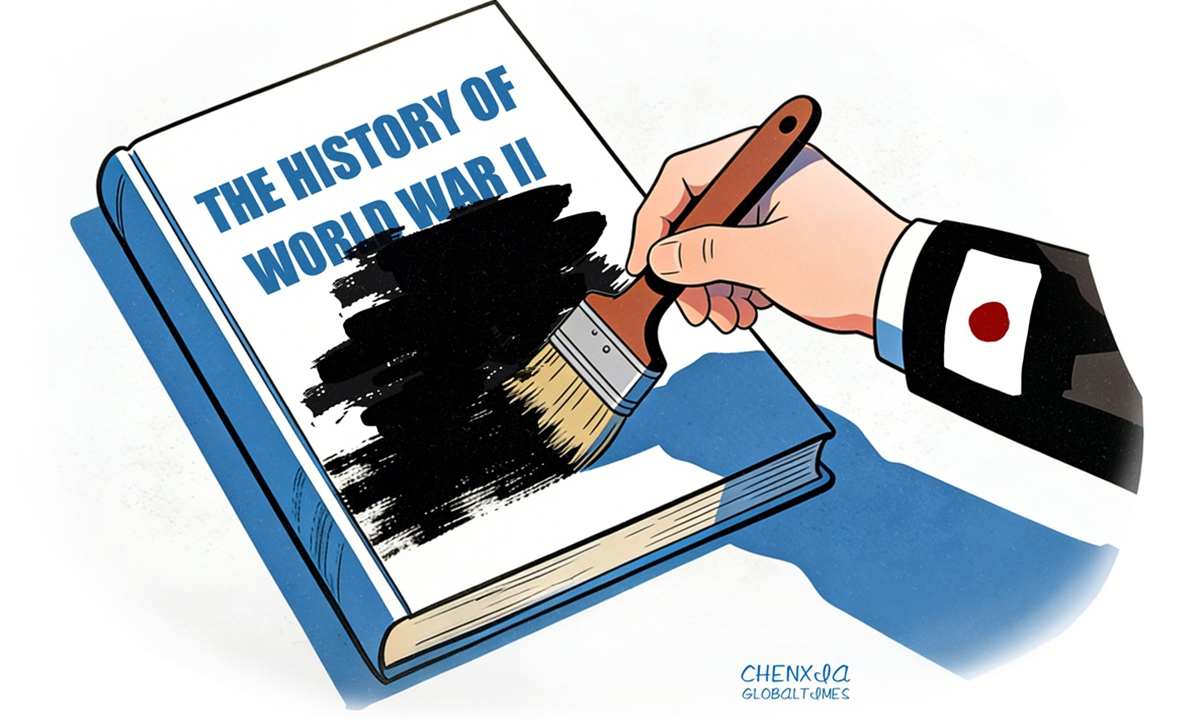
Illustration: Chen Xia/GT
Halloween is a time for dressing up, but not every symbol makes for a fun costume.
This year's Halloween in Japan brought the issue into focus. On Saturday evening, a post on the X platform drew widespread attention. The photos showed multiple Japanese participants displaying the Nazi swastika. The account was later temporarily suspended for violations of the platform's rules on hateful content. But the photos continued to circulate, drawing criticism from users around the world.
Some comments were blunt: "So this is what peace loving nation Japan looks like." Others pointed out: "Japan NEVER paid for its war crimes," "A lot of Japanese ppl dont learn modern history from schools. It is very hard to make them understand why what they are doing over there is wrong."
The situation points to a question: Why do such symbols seem to have lost much of their historical weight for some young Japanese people?
As early as 2014, The Guardian ran a report on two key politicians of then Japanese cabinet who had been photographed smiling with Kazunari Yamada, the leader of a Japanese neo-Nazi group. Sanae Takaichi, then internal affairs minister, was one of them. Although she later tried to distance herself from Yamada, the fact that such a photo could be taken at all, had already exposed how loosely the lines were drawn between Japan's right-wing political establishment and neo-Nazi circles.
The deeper problem lies in the state-led shaping of historical memory. The Japanese government has continued to revise history textbooks. This is no longer simply a matter of downplaying the past. It amounts to a systematic effort to erase the memory of wartime atrocities. In the latest high school textbooks, terms such as "comfort women" and "forced labor" have been replaced with expressions such as "recruited" and "mobilized." Descriptions of "aggression" are nowhere to be found, and relevant chapter titles have been changed to the so-called "The Manchurian Incident and the Rise of the Military." The history books children grow up reading are themselves designed to sidestep the central question: What did Japan actually do?
Outside the classroom, popular culture does something else: It turns historical symbols into entertainment. Anime, video games, films and television dramas pull symbols out of their bloody historical context and turn them into material that can be collected, worn and consumed. Once a symbol is reduced to a "cool-looking design" on a piece of clothing, its moral weight is stripped away.
In 2016, the Japanese idol group Keyakizaka46 faced international backlash after wearing outfits resembling Nazi uniforms. During the 2022 FIFA World Cup in Qatar, Japanese fans were stopped by security personnel from displaying Rising Sun flags in the stands. These incidents point to the same question: Why does Japanese society repeatedly find itself embroiled in similar controversies whenever symbols linked to its wartime past appear?
Germany offers a stark contrast. Under German law, publicly displaying symbols linked to Nazi organizations is a criminal offense. Violations can result in a fine or up to three years in prison.
Japan has no comparable legal boundary. And worse, many people, including high-level politicians, continue to worship at notorious Yasukuni Shrine, which enshrines Class-A war criminals from WWII. Over time, the next generation has grown increasingly detached from the idea that the bloody history must be remembered.
The real danger is not the mere appearance of these symbols, but the gradual loss among young Japanese people of any sense of the evil they represent. When Nazi symbols can be casually turned into Halloween props, what this reveals is not simply the ignorance of a few individuals, but a systemic distortion of historical understanding. In the minds of some young Japanese people, the gravity of aggression, genocide and responsibility for war has been hollowed out.
The swastika displayed in Japan during Halloween is merely one visible fragment of a much larger problem. And it's a warning that when distortions of historical memory are repeatedly tolerated, they eventually become a systematic erosion of our shared understanding of the past.
Japan has long sought to diminish the weight of its own wartime crimes. When it invaded and brutally ravaged Asia, it called its aggression "liberation." The world, especially Asia, has watched this script play out before. It must not pretend it does not recognize the script.
RELATED ARTICLES