Xi holds talks with Sultan of Oman, calls for deeper alignment, regional peace
Engagement marks a full upgrade of ties, carries significance for Middle East affairs: experts
By Published: Nov 03, 2026 12:04 AM

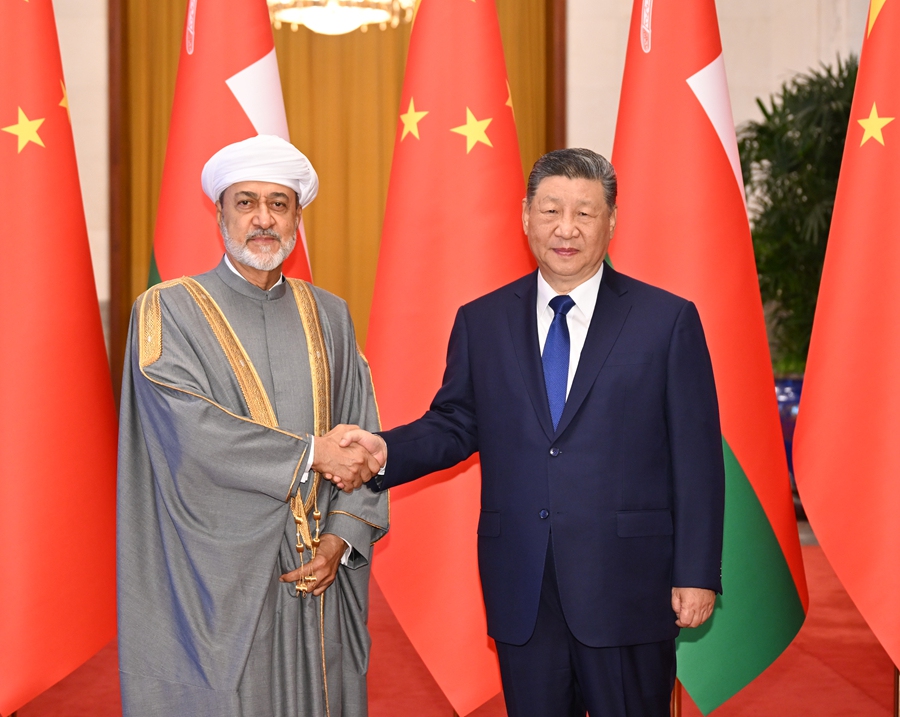
Chinese President Xi Jinping holds talks with Sultan Haitham Bin Tarik Al Said of Oman, who is on a state visit to China, at the Great Hall of the People in Beijing, capital of China, Nov. 2, 2026. (Photo: Xinhua)
Chinese President Xi Jinping held talks with Sultan Haitham Bin Tarik Al Said of Oman in Beijing on Monday, with the two sides exchanging views on bilateral relations as well as international and regional hotspot issues. The Chinese leader said that China stands ready to deepen the alignment of development strategies with Oman, while also emphasizing that the Middle East and the Gulf region should not become a wrestling ground for major-country rivalry and geopolitical conflicts, the Xinhua News Agency reported.
Following the talks, the two heads of state witnessed the signing of cooperation documents in areas including the application of the BeiDou Navigation Satellite System, industrial and supply chains, green development, currency swaps, digital payments, and digital currencies.
During the visit, the two sides issued a joint statement on deepening the China-Oman strategic partnership. Under the statement, the two sides will strengthen political mutual trust, intensify friendly exchanges, expand mutually beneficial cooperation and enhance coordination and collaboration. They call for resolving differences through political and diplomatic means and encourage the US and Iran to pursue peaceful options. They consider it necessary to restore normal and safe navigation through the Strait of Hormuz and agree to maintain communication on matters concerning the Strait, according to the Foreign Ministry of Oman.
Sultan Haitham's state visit, which lasted from November 1 to 2, marks the first visit to China by an Omani head of state since diplomatic ties were established in 1978.
Analysts note that the visit represents a full upgrade of China-Oman ties, steering practical bilateral cooperation toward greater diversification, stability and sustainability. At a time of heightened tensions in the Middle East, the visit carries constructive significance for upholding regional peace and stability and safeguarding the security of international shipping lanes. For regional states, closer cooperation with China has become an inevitable and preferred option.
Opening new opportunities
During the meeting with Sultan Haitham, Xi said that China stands ready to deepen the alignment of development strategies with Oman, turning the two countries into stable and reliable partners in energy, partners with great potential in investment, and partners in high-tech innovation.
According to Wang Jin, an associate professor at the Institute of Middle Eastern Studies at Northwest University in Xi'an, Sultan Haitham's state visit marks a full upgrade of China-Oman relations amid deepening political trust and strategic cooperation.
The bilateral progress is not directed at any third party nor driven by geopolitical contests. Instead, both sides aim to inject more positive energy into regional peace and stability by advancing cooperation, showcasing the open and constructive nature of China's engagement with Middle Eastern states, said Wang.
China and Oman established a strategic partnership in 2018. Currently, China is Oman's largest trading partner, and Oman is China's fourth largest trading partner among Arab states, according to the Chinese Foreign Ministry.
Official data shows that bilateral trade between China and Oman hit $32.87 billion in 2025. China mainly exports machinery and electrical goods, steel products, high-tech items and textiles to Oman and is the largest buyer of Omani crude oil, with imports standing at 35.353 million tonnes in 2025.
China and Oman enjoy strong economic and trade complementarity, and bilateral cooperation is expanding beyond traditional energy trade into more areas, said Wang.
Oman is a major energy producer and international trade hub in the Gulf. China, with its ultra-large market, complete industrial system and strong infrastructure capacity, boasts notable strengths in equipment manufacturing, communications and new energy, which can underpin Oman's economic diversification and industrialization, he added.
Zhu Yongbiao, an expert on Middle East affairs at Lanzhou University, told the Global Times that the two sides enjoy broad prospects for cooperation spanning green energy transition, the digital economy, artificial intelligence, port logistics and supply chain development, as well as science, education and talent training.
Such efforts will steer China-Oman economic and trade ties toward a more diversified, stable and sustainable pattern, Zhu noted.
In a Sunday article prior to the top-level engagement in Beijing, the Oman Observer noted that the visit marks "a landmark in Omani-Chinese relations." The visit carries a particular importance in light of the steady evolution of bilateral ties and the wider horizon it holds for deepening the strategic partnership, and it opens the way for closer cooperation across political, economic, investment, cultural and scientific fields, the media outlet said.
A natural regional preference
Sultan Haitham's state visit to China takes place amid simmering tensions in the Middle East. The protracted US-Iran standoff and spillover of the Yemen conflict have intertwined risks in the Strait of Hormuz and the Bab el-Mandeb Strait, posing grave threats to shipping security and the global energy supply chain.
When holding talks with Sultan Haitham, President Xi said that China is willing to enhance communication and coordination with Arab countries and the Gulf Cooperation Council (GCC) countries including Oman for the early restoration of regional peace and tranquility and the realization of lasting stability, according to Xinhua.
He noted that the Middle East and the Gulf region should not become a wrestling ground for major-country rivalry and geopolitical conflicts, and that regional peace and stability requires the joint efforts and care of all parties.
Sultan Haitham said Oman highly appreciates China's just position on the Middle East issue and stands ready to maintain close coordination with China to uphold international law, advocate for the peaceful resolution of disputes, and jointly promote security and stability in the region and beyond.
Regarding the Middle Eastern security, China has been committed to stopping the war and contributing wisdom and solutions to resolving the region's security dilemmas.
On Monday, China's top diplomat Wang Yi met with Ali Bagheri Kani, deputy secretary of Iran's Supreme National Security Council (SNSC) in Beijing. The Chinese Foreign Ministry announced that China will send several special envoys to countries in the Middle East, the Red Sea region and the Horn of Africa in November to promote dialogue and help ease regional tensions.
During the meeting with Sheikh Khaled bin Mohamed bin Zayed Al Nahyan, Crown Prince of Abu Dhabi, United Arab Emirates, in Beijing in April, President Xi put forward a four-point proposal on promoting peace and stability in the Middle East.
In his talks with Egyptian President Abdel Fattah El-Sisi in Cairo this September, the Chinese leader raised a four-point proposal on building a new security architecture in the Middle East via upholding a vision of common, comprehensive, cooperative and sustainable security.
"Strategically located on the southern flank of the Strait of Hormuz and linked to the Red Sea and Yemen, Oman follows a balanced, pragmatic diplomacy and acts as a vital mediator between Gulf states, Iran and Western powers," said Zhu, "As a permanent member of the UN Security Council, China also maintains sound cooperation with Middle Eastern countries."
The meeting between the Chinese and Omani leaders facilitates strategic communication and the alignment of positions on regional situations, enabling the two sides to work together to de-escalate tensions, said Wang.
"It carries constructive significance for maintaining regional peace and stability and protecting the security of international shipping routes," he said, adding that shipping security ultimately depends on the overall de-escalation of regional tensions and the collective efforts of all relevant parties, and calls for joint endeavors from the international community.
Against the backdrop of protracted regional conflicts and rising uncertainties in global energy and trade, the succession of high-level visits to China by Middle Eastern countries shows that they generally value China's strategic weight and influence in international affairs, as well as development opportunities brought by its market, industrial system and scientific and technological innovation, said Wang Jin.
Regional countries hope to foster a more stable and enabling external environment for their own development through deeper cooperation with China, he added.
According to Zhu, China adheres to non-interference in internal affairs, rejects bloc confrontation and seeks no geopolitical gains. China's approach to cooperation on trade, energy, non-traditional security and regional hotspot issues is stable, constructive and dynamic.
"For Middle Eastern countries, strengthening cooperation with China has become an inevitable and preferred option," he noted.
RELATED ARTICLES