Philippine groups' calls to de-escalate tensions with China may fall on deaf ears as politicians use bilateral ties for self serving gains: expert
By Published: Nov 03, 2026 12:13 PM

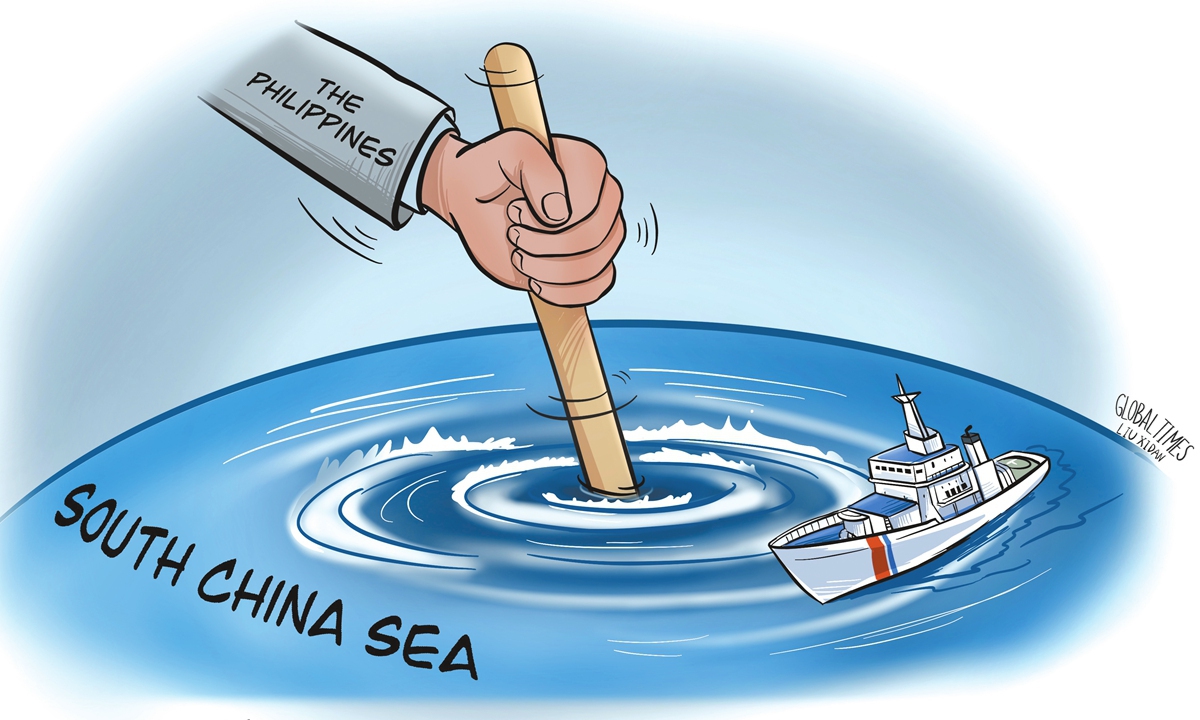
Illustration: Liu Xidan/GT
A joint statement issued by more than 20 Philippine business, industry and civil society groups calling for a de-escalation of tensions between the Philippines and China underscores mounting concerns in the country at a critical juncture in the worsening of bilateral relations. Still, such appeal may fail on deaf ears as some politicians, military figures and coast guard officials are exploiting South China Sea disputes for political gains, said a Chinese expert.
"We respectfully appeal to Philippine and Chinese authorities to lower the temperature, restore disciplined diplomatic engagement and build a stable, respectful and productive bilateral relationship," the groups said in a joint statement, according to the Philippine Star.
Business, labor, OFW, educators, economists, farmers, and youth groups issued a joint statement, saying that the path forward for the Philippines in its relationship with China should be one of sobriety, strategic clarity, economic pragmatism, and constructive engagement and the wider international community amid heightened exchanges between the two countries, according to Philippines' Logistics News.
"Amid global uncertainties, we urge measured diplomacy that advances Philippine interests. All parties should avoid inflammatory rhetoric, public recriminations, and social media exchanges that could further strain bilateral relations. Diplomacy is best pursued through established channels, coordinated institutions, informed dialogue, mutual respect, and a clear understanding of national interests," stated the statement.
It also cited data from the Philippines Statistics Authority in first semester of 2026 where China and its Hong Kong Special Administrative Region constitute the Philippines' largest trading partner, accounting for nearly 30 percent of total international trade in recent years, while the Philippines represents less than 1 percent (0.3 to 0.5) of China's total global trade.
The statement reflects growing concerns within the Philippines over the steadily deteriorating China Philippines relations. And bilateral ties have reached a dismal stage, verging on a freezing point, Chen Xiangmiao, director of the World Navy Research Center at the National Institute for South China Sea Studies, told the Global Times on Tuesday.
A confluence of recent incidents underscores this situation, including the Philippines' provocations in the South China Sea and proposals by certain Philippine lawmakers for the expulsion of the Chinese Ambassador. Chen referred to Jay Tarriela, a spokesperson for the Philippine Coast Guard, who made irresponsible remarks about China's stance on the Middle East. His comments came in response to a post published by the Chinese Embassy in the Philippines, which called on all parties to the Middle East conflict to respect one another's sovereignty and territorial integrity.
Certain actors, Tarriela in particular, exploit the ambiguity surrounding their official identities on social media to engage in "megaphone diplomacy." Such moves have steadily eroded bilateral ties and grown increasingly extreme, with China Philippines relations held hostage by a small group of military and coast guard affiliated politicians, said the expert.
In the joint statement, the Philippine business and civic groups also said that "to manage government pronouncements, the group has called for strengthened a centralized, coherent, and consistent foreign policy. Diplomatic positions should be articulated by designated authorities through coordinated institutions and established channels."
"Whatever our political differences or maritime disputes, constructive diplomacy and stable economic relations are essential to protecting livelihoods, maintaining investor confidence, controlling costs, accelerating clean-energy adoption, and sustaining development," the statement said.
The statement reflects the deep divisions in the Philippines amid soaring living costs, precarious employment and below-target growth. While some groups seek better ties with China, some forces within the Marcos government, military and coast guard pursue hardline policies that put political and security agendas first, deepening domestic divisions, according to experts.
There is mounting criticism inside the Philippines directed at those who stoke anti China rhetoric and weaponize South China Sea issues for partisan political gains. In an October 30 article for the Manila Times, Rigoberto D. Tiglao, former Cabinet secretary and ambassador, said that Defense Secretary Gilberto Teodoro Jr.'s hostile posture toward China stems from multiple factors. Beyond exploiting Sinophobia to advance his delusional 2028 presidential ambitions and being totally "brainwashed" by the US, "he is shockingly ignorant of our neighbor's extremely advanced economy, to the extent that it has overtaken the US and Europe in several technology fields," Tiglao wrote.
Chen said that appeals for de escalation may not sway those who pretending not to hear. Military, coast guard and like minded forces have hijacked Manila's political and diplomatic agenda by elevating security political concerns to overriding priority for their own gains while downplaying associated economic costs.
They harbor the illusion that backing and investment from the West and other external actors can serve as an alternative to counterbalance China's economic clout, a misconception, Chen warned, noting that the Philippines will end up swallowing the ultimate losses stemming from confrontation.
RELATED ARTICLES