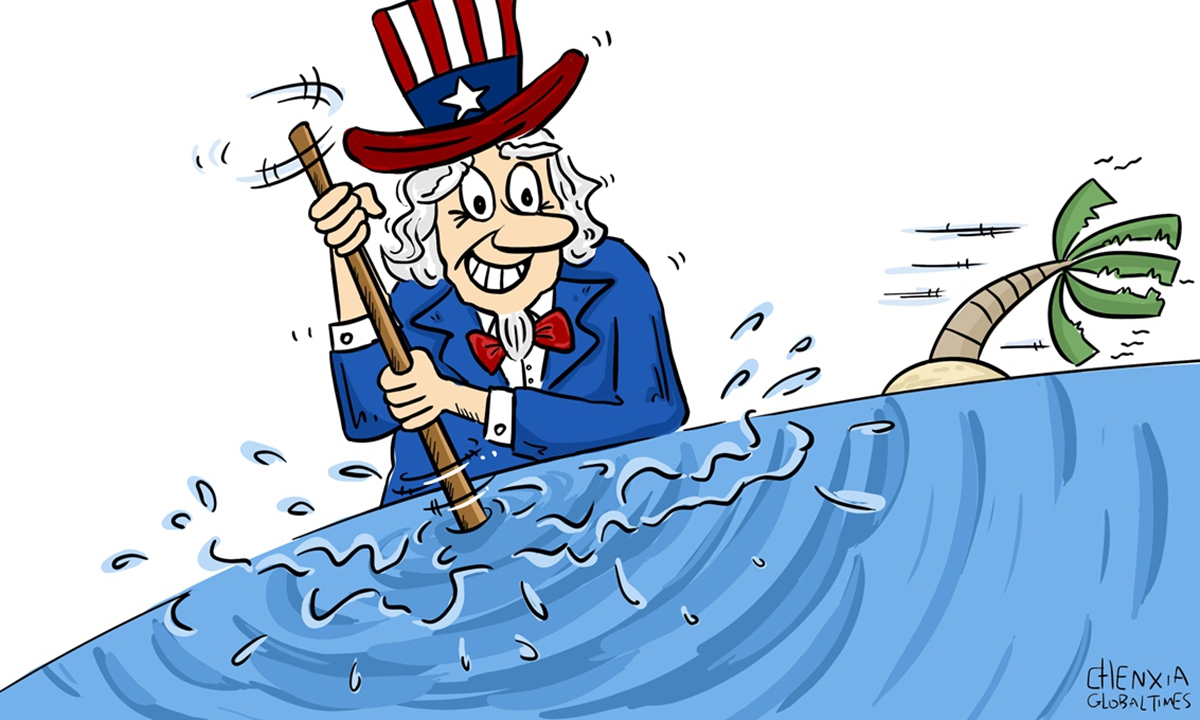
Illustration: Chen Xia/GT
The Hudson Institute, a US think tank, recently released a report titled "Righting the ship: Building a relevant US navy fleet for twenty-first-century deterrence and combat." The report mentions "China" more than 60 times, portraying Beijing's maritime power as a "threat" and viewing it as the core competitive variable challenging US maritime hegemony. Taking a cross-Taiwan-Straits conflict as a preset scenario, it puts forward the so-called "hellscape" concept.
Rather than a strategic analysis, this report reads more like a self-diagnosis of US anxiety over maritime supremacy: It accurately identifies the symptoms, yet prescribes the wrong remedy.
The report acknowledges that US naval dominance, which has lasted for more than 80 years, is waning. Yet it begs a critical question: Is this erosion caused by China "challenging" US hegemony, or by home-grown woes such as the hollowed-out domestic shipbuilding industry, an aging fleet, and endless wars overseas? The report did not offer any valid answers to this question.
The US shipbuilding industry is plagued by deep-seated problems, and the traditional approach of building large warships is no longer sustainable. Consequently, some in Washington have cited China's "System Destruction Warfare" as an external driver for reforming the US Navy. They advocate the large-scale deployment of unmanned maritime combat systems to build a counterforce capable of securing an advantage in maritime confrontations, while repeatedly wargaming ways to "deter and contain adversaries."
What makes this line of thinking most dangerous lies not in its concrete military wargaming, but in its conceptual framework: It designates China as a hypothetical adversary, treats the Taiwan Straits as a potential battlefield, and simplistically interprets all maritime force-building as great-power rivalry.
Such confrontational wargaming is more than a mere technical military assessment. Rooted in America's full set of security and political logic, it lays bare Washington's doctrine of absolute security. This mindset has remained consistent throughout US history. From its early days as a rising regional power to its pursuit of global hegemony, the US cannot tolerate the emergence of any nation capable of matching its power.
Coupled with the outsized influence of the military-industrial complex on US policymaking and fiscal resource allocation after World War II, US defense policy has developed an ingrained logic, that is to imagine and hype up external threats in order to secure sustained government budget allocations for the military.
This hegemonic mindset also highlights a defining characteristic of the US defense economy. Competition among the various branches of the US military over the annual defense budget is fierce, and the Navy, too, hopes to secure more funding for its branch by hyping "Chinese threat" claims.
This zero-sum mindset overlooks the fact that China is the world's largest trading nation, and the security of maritime shipping lanes is equally vital to China. The development of Chinese navy is not intended to challenge anyone, but rather to safeguard its legitimate maritime rights and interests and the security of its sea lanes. The development of China's Coast Guard forces corresponds to China's 32,000-kilometer coastline and extensive maritime economic interests; this is not expansion, but rather a necessary alignment.
This also exposes the US Navy's misguided positioning in the Asia-Pacific. Rather than committing to serving as a contributor to regional security, it is eager to stoke tensions, playing the role of a disruptor in the region. The Asia-Pacific should be moving toward peace, prosperity, and stability, but the US deliberately stirs up confrontation and hypes the prospect of war to force regional countries into security dependence on the US and maintain unequal regional relations - a course of action that does not align with the aspirations of most countries in the Asia-Pacific.
While verbally acknowledging that the US "can no longer recreate its past unchallenged dominance over the oceans," the report refuses to abandon its mindset of maritime hegemony. Its goal is not to adapt to a multipolar world, but to adopt a new set of tools to keep acting as the "world's policeman." From the "global deployment of aircraft carriers" to the "island-chain blockades using unmanned systems," only the tools have changed. What remains unchanged is the hegemonic obsession that Washington gets to call all the shots.
This report by the Hudson Institute is a "plan to prop up fading hegemony." While it acknowledges the decline of US maritime power, it attributes the cause to "China's rise" rather than reflecting on America's own strategic overextension and industrial hollowing-out. It proposes technical solutions such as the "hellscape" strategy, yet sidesteps the most fundamental question: What right does the US have to deploy military forces on other countries' doorsteps?
Rather than spending time devising "hellscape," US think tanks would do better to devote their energy to figuring out how to coexist peacefully with other major countries. After all, in the 21st-century world, hegemony is not the answer - coexistence is.
RELATED ARTICLES