COMMENTS / INSIDER'S EYE
GT Voice: Wall Street's bet on China is about more than finance

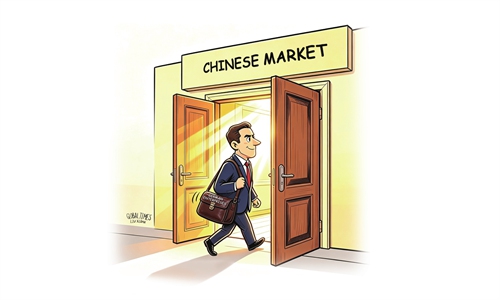
Illustration: Chen Xia/GT
Bloomberg recently published an article headlined "Wall Street Banks Are Finally Seeing Their China Bets Pay Off." As more Chinese companies take their businesses global, the likes of JPMorgan and Goldman Sachs are riding a wave of dealmaking. Some business lines are now posting double-digit revenue growth.
But Wall Street's bets on China go beyond a pickup in dealmaking. They reflect a broader transformation in the Chinese economy.
"In the next five years, a new wave of true multinational corporations will emerge from China," Alan Ho, JPMorgan's co-senior country officer for China, told Bloomberg. Their growth is opening up a fresh wave of business opportunities for foreign companies.
China has kept investment bankers unusually busy this year. Bloomberg reported that some Morgan Stanley bankers pulled multiple all-nighters through the peak summer months. One even gave up a week-long vacation. These late nights at foreign investment banks in China offer a glimpse of the growing opportunities that the country's changing business landscape is creating for foreign firms.
The story does not end with bankers. Foreign companies are finding new reasons to deepen their presence in China. Their role is no longer confined to financing Chinese companies or supporting their overseas expansion. Many are directly involved in China's economic transformation and global outreach, making them participants in this new wave of globalization.
The trade figures offer a clearer picture. In the first half of 2026, trade by foreign-invested enterprises in China grew 17.1 percent year-on-year. These firms accounted for nearly 40 percent of China's exports to South Korea, close to 30 percent of exports to the EU and more than 30 percent of exports to emerging markets such as Mexico and Vietnam. Trade by foreign-invested firms in the electronic information sector grew 57.4 percent.
China's new wave of globalization is opening up new ways for foreign companies to engage with its economy. They are not only supporting Chinese businesses as they expand overseas, but also taking a more direct part in China's economic development. In this sense, foreign companies are clear beneficiaries of China's latest economic developments.
This helps explain why foreign companies are betting on China. As technological progress drives China's economic transformation, foreign companies are betting not only on its domestic consumer market, but also on opportunities in its industrial supply chains, technological advances and the global expansion of Chinese businesses. Some foreign firms are even moving from "in China, for China" to "in China, for the world," gaining access to a wider range of opportunities.
As more Chinese companies go global, a new dynamic is emerging between China's economy and foreign businesses. The late-night lights at Morgan Stanley's offices are one small sign of this trend.
Yet much of this is missing from the Western debate. As Chinese companies and products reach more overseas markets, some commentators see a threat, warning of a so-called "China shock 2.0." Such a zero-sum view looks increasingly detached from commercial realities.
As more Chinese firms go global, some see a shock; others see new business. A number of foreign firms, however, are finding a fresh wave of opportunity in the international expansion of Chinese capital and companies. Bloomberg quoted Johannes Petry, a research director at Goethe University Frankfurt, who is working on a book about Wall Street in China, as saying: "The opportunity is increasingly tied to Chinese capital and companies going out into the world."
Seizing these opportunities may be harder than it sounds. Competition in China is intense. But the growing number of foreign companies betting on China, and not just Wall Street banks, points to a broader trend. This is not simply a vote of confidence in China's economy; it is backed by real business growth. The late nights in some of those offices may be just the beginning.
RELATED ARTICLES