Japan bears full responsibility for strained ties, FM says a year after Takaichi’s erroneous remarks on Taiwan question
By and Xing Xiaojing Published: Nov 06, 2026 11:16 PM

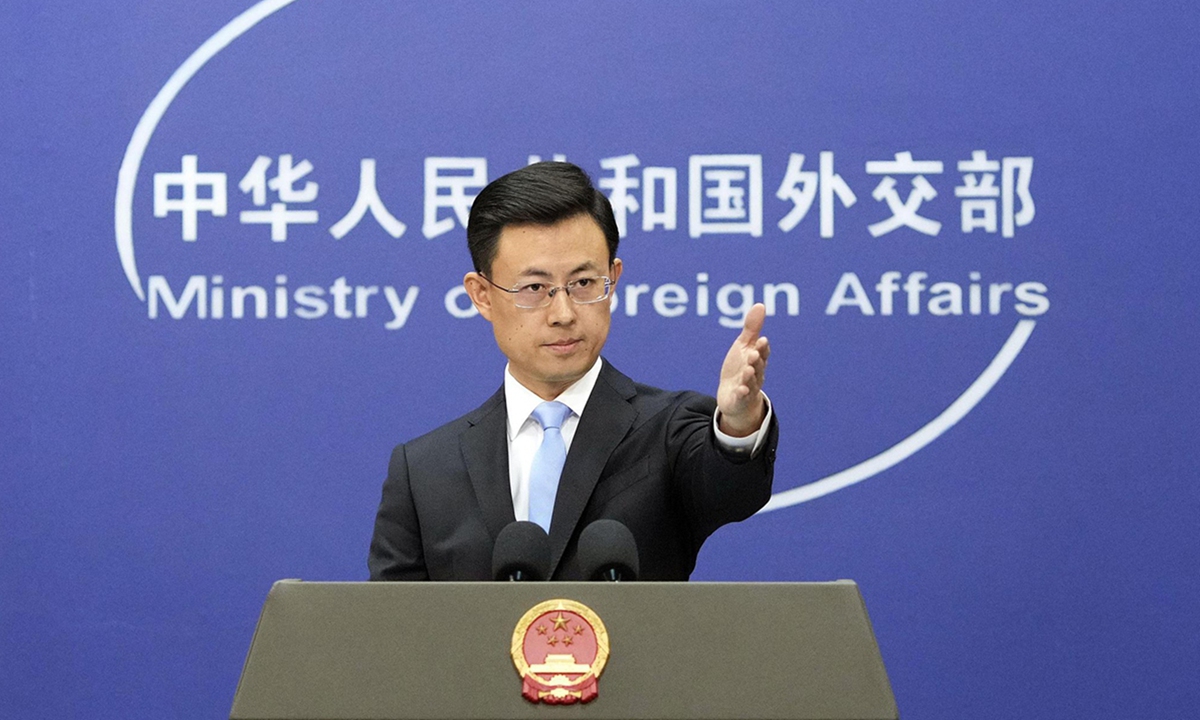
Chinese Foreign Ministry spokesperson Guo Jiakun
Nearly a year on from Japanese Prime Minister Sanae Takaichi's erroneous remarks on the Taiwan question, which have strained China-Japan ties, China is once again urging Japan to correct its erroneous words and deeds. Meanwhile, Japan has recently accelerated moves to revise its non-nuclear policy and expand its military capabilities, attracting opposition and criticism at home and abroad.
During a press briefing on Friday, Chinese Foreign Ministry spokesperson Guo Jiakun said that China-Japan relations currently face serious difficulties, and the responsibility lies entirely with the Japanese side, as the difficulties stem from the erroneous remarks on China's Taiwan made by the Japanese leader a year ago.
Takaichi's erroneous remarks openly sent an incorrect signal about attempting to intervene militarily in the Taiwan question, challenged China's national sovereignty, and undermined the political foundation of China-Japan relations, Guo said.
"Unfortunately, a year has passed, and the Japanese authorities are still going in circles, evading and dodging the issue," Guo said, adding that they "have yet to show any sincerity or take any action to reflect on and correct their mistakes."
"For the Japanese side, the most pressing task is to promptly correct its erroneous words and deeds on the Taiwan question; what is important is to adopt a correct attitude on historical issues; and what is fundamental is to truly develop an objective and rational perception of China," the spokesperson said.
The day before, Japan sent out another dangerous and provocative signal to the outside world. In a Thursday report, Kyodo News cited a source who said the Japanese government is considering including exceptions to the country's Three Non-Nuclear Principles in its revised National Security Strategy, which is scheduled to be finalized by the end of this year.
One option under consideration is to state in the document that Japan would allow nuclear weapons to be brought into the country in an emergency, Kyodo News reported.
Japan's Three Non-Nuclear Principles stipulate that the country will not possess, produce, or permit the introduction of nuclear weapons.
On Tuesday, Japanese Defense Minister Shinjiro Koizumi again called for discussions on reviewing the country's Three Non-Nuclear Principles and expressed support for considering the introduction of nuclear-powered submarines, Kyodo News reported.
Wang Guangtao, an associate professor at Fudan University's Center for Japanese Studies, told the Global Times on Friday that the pro-nuclear or latent nuclear-weapon advocacy in Japan has moved beyond mere academic debate and entered the policy-making pipeline.
Such alarming steps mark an acceleration of remilitarization, Wang said, and they also appear to be aimed at overturning the nuclear balance in East Asia, a move that would jolt the regional security architecture and undermine Japan's long‑held pacifist consensus.
The expert said this series of provocations from the Japanese government shows a lack of sincerity on Tokyo's part toward improving relations with China. He was also pessimistic about the potential for China-Japan interactions on the sidelines of the upcoming APEC summit, which will be held in Shenzhen later this month.
Against the current backdrop, the two sides will find it difficult to build smooth bilateral communication channels, Wang said. "Multilateral forums ought to offer an important chance for Japan to mend its ties with China. Yet Japan appears to be letting this opportunity slip away; one could even say it is voluntarily giving it up."
The worrying moves from the Japanese government have also met with pushback from the Japanese public. Nearly 10,000 Japanese citizens gathered in front of the National Diet Building in Tokyo on November 30 to protest moves by Takaichi's government to revise the country's nuclear policy and expand its military capabilities, the Xinhua News Agency reported.
"There is indeed a trend in Japan toward strengthening military capabilities. These moves have gone too far," a protester surnamed Yoshikawa told Xinhua. He said a military buildup that clearly exceeds the needs of self-defense, or even provokes other countries, is "highly abnormal.
At a press conference on Friday, Senior Colonel Chen Xi, spokesperson for China's Ministry of National Defense, said Japan's right‑wing forces have shed the disguise of focusing purely on defense and reactivated the military‑industrial complex, jeopardizing the safety and well‑being of the Japanese public as well as global peace and stability.
The international community must remain highly vigilant, firmly check Japan's attempts to crank up its "war machine" and retread the dangerous path of expansion, and jointly uphold the post‑war international order, Chen said.
RELATED ARTICLES