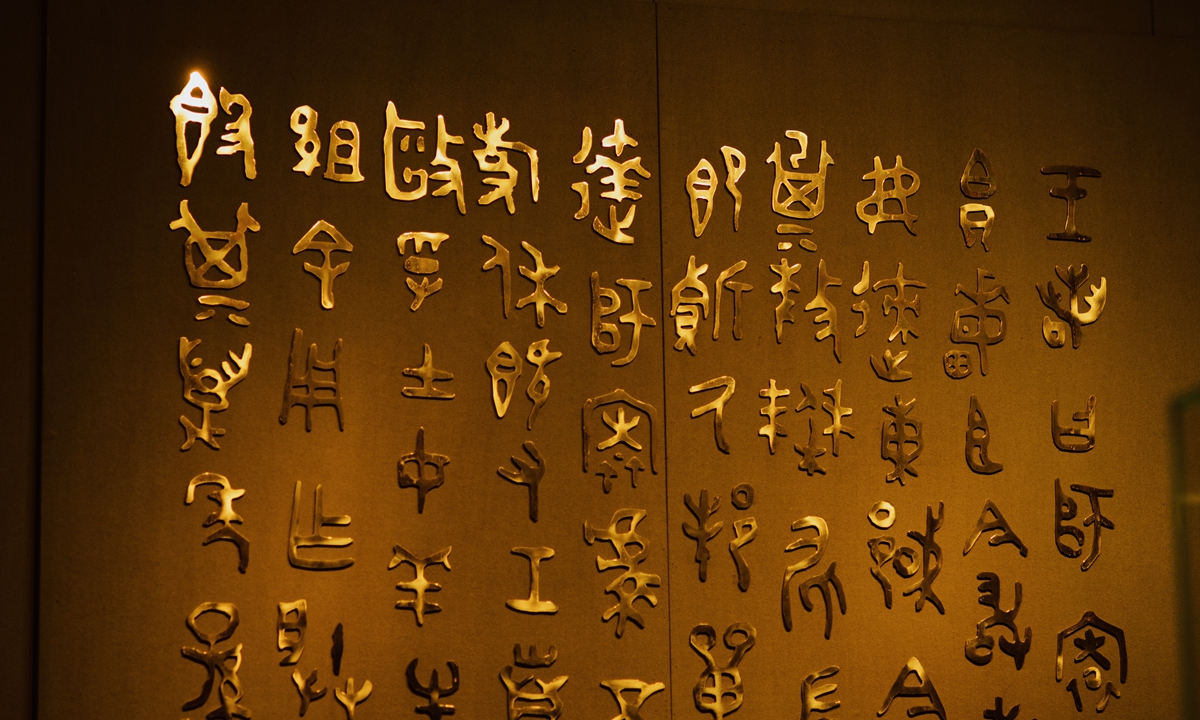
Ancient Chinese oracle bone script Photo: VCG
A national alliance and a School of Specalized Studies for lesser-known and endangered academic disciplines were launched on Friday, aiming to address talent shortages and fragmented resources through resource sharing, collaborative research and joint training, according to a statement sent to the Global Times on Sunday.
Initiated by the University of Chinese Academy of Social Sciences (UCASS), the open platform has brought together 82 universities, research institutions, archives and museums nationwide, including Tsinghua University and the First Historical Archives of China covering most of the country's major institutions in these fields.
The School of Specialized Studies at UCASS has a faculty led by eight members of the Chinese Academy of Social Sciences and 30 nationally recognized experts. Its departments cover oracle bone script and bamboo and silk manuscripts, ancient scripts of northern and southwestern ethnic groups, and classical civilizations of China and the West. Research areas also include Old Turkic, Tangut script, Manchu script, and ancient Tibetan. The school also has a digital intelligence laboratory, according to the statement.
Huang Dekuan, director of Tsinghua University's Research and Conservation Center for Unearthed Texts, said these disciplines are considered "lesser-known" because they attract limited attention and have few practitioners, while their high academic barriers make it difficult for newcomers to enter, according to state broadcaster CCTV News.
"They often face a shortage of successors, and some may even struggle to survive," Huang said, citing ancient writing systems such as oracle bone script and research into frontier history as examples. These fields are closely tied to the preservation of China's cultural roots and its long-term development, he noted.
Beyond the generational gap in talent, scattered resources and a lack of coordination among research institutions have also hindered their development, per CCTV.
UCASS President Xu Jincheng said the alliance would consolidate research resources and address shortages in personnel and academic capacity. Plans include establishing more than 10 institute-level research centers and funding 10 research teams. It will also introduce a mentorship system pairing students with a primary supervisor and a co-supervisor from another academic field, according to the statement.
The alliance's core significance lies in sharing cultural resources, textual databases and research platforms, while jointly developing talent training programs, Liu Zheng, a member of the Chinese Society of Cultural Relics, told the Global Times on Sunday.
Research in these fields requires long-term commitment, Liu said. Students of Tangut, for example, must first master the language, learn to interpret historical documents and understand historical context. Compiling a dictionary can take a researcher a decade.
"The output is not a viral hit, but a text that future generations can continue to read," Liu said.
Small enrollment numbers, limited career prospects and lengthy research cycles make it difficult for individual enthusiasm alone to sustain these disciplines. Left entirely to market forces, they risk being marginalized during university restructuring. Institutional support can pool resources and give researchers more room to pursue long-term projects without being constrained by short-term assessments, Liu noted.
Addressing employment concerns, Xu said these disciplines had distinct training pathways and career options.
The initiative has also sparked discussion on Chinese social media. Some users welcomed the alliance, saying it could help ensure that once-obscure disciplines would no longer be left on the margins. Others hoped it would create more opportunities for public lectures and discussions, making specialized academic subjects more accessible.
Zheng Dui, secretary-general of the China Tibetology Research Center, said these disciplines are rooted in the rich civilizations of China's diverse ethnic groups and provide essential academic support for understanding the history of China as a unified multiethnic state, according to China News Service.
Their high academic barriers, lengthy training periods and difficulties in passing knowledge between generations make coordinated support particularly important, Zheng said. The alliance will help consolidate academic resources, promote collaborative research and sustain cultural heritage, while contributing to the development of an independent system of Chinese knowledge and a deeper understanding of the history of the Chinese nation as a community.
RELATED ARTICLES