Indian companies actively attend 9th CIIE, eyeing deals in the vast market
China is an important market, we attend every major expo here: exhibitor
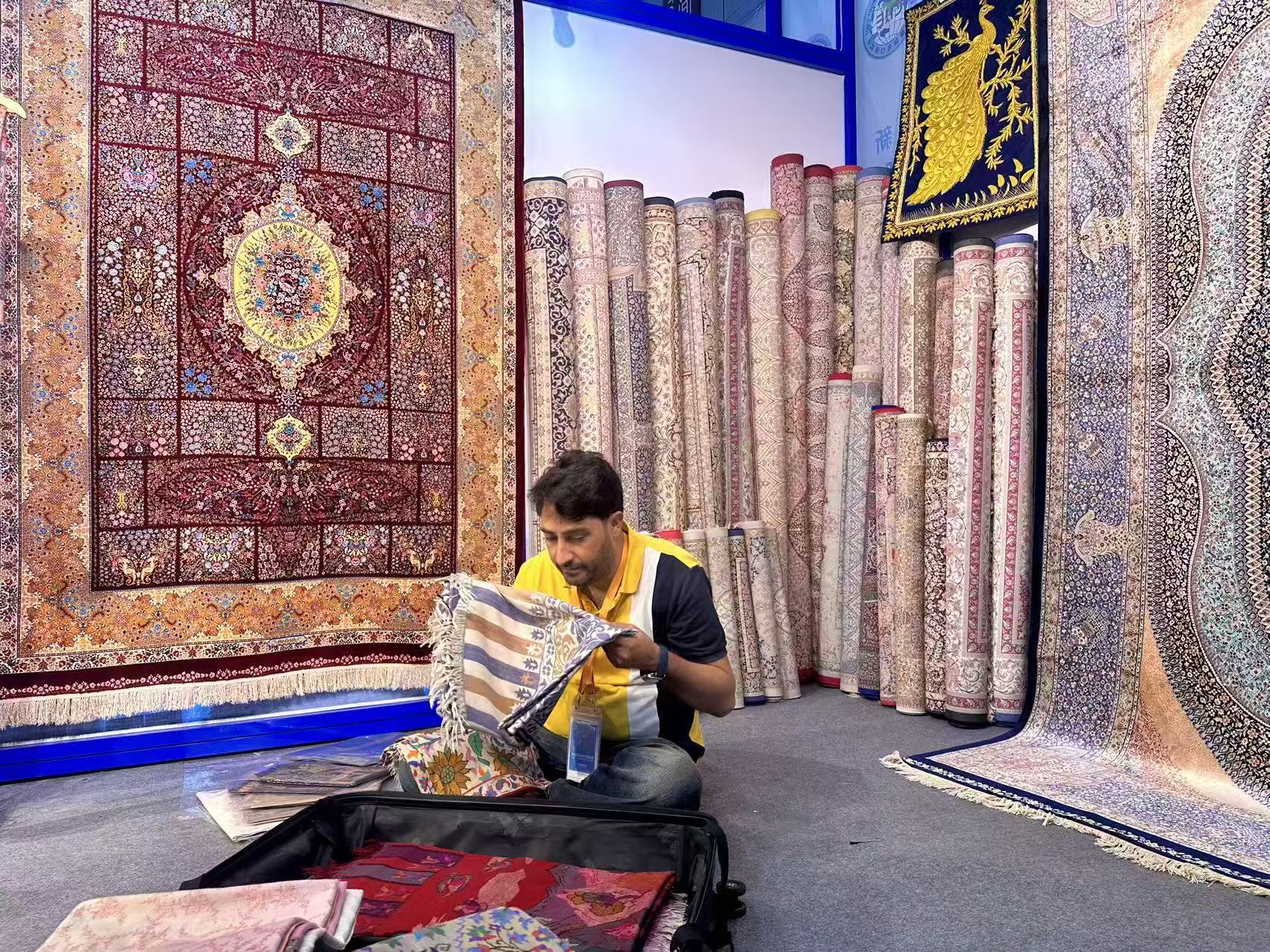
An Indian exhibitor arranges display items at the 9th China International Import Expo in Shanghai on November 7, 2026. Photo: Ma Jingjing/Global Times
On Saturday morning, the consumer goods section of the ongoing 9th China International Import Expo (CIIE) in Shanghai was already bustling with activity.
About a dozen Indian enterprises lined the halls, their booths adorned with vibrant displays of Kashmir cashmere scarves, hand-carved wooden furniture, intricate handicrafts, and aromatic Indian incense.
Every now and then, visitors stopped by to inquire about prices, run their fingers across the soft fabrics, or take photos of the exquisite pieces. Amid the lively chatter and occasional bursts of laughter, some Indian exhibitors warmly greeted potential clients in Chinese, showing eagerness to expand their presence in the vast Chinese market amid the improving economic and trade relationship between China and India.
Active participation
Among them was Shabir Ahmad Ahangar, whose booth was draped in an elegant array of cashmere scarves in rich jewel tones. As he carefully straightened a stack of shawls and hung a particularly fine piece on the rack for better display, he noticed visitors coming and immediately flashed a broad smile.
Switching effortlessly between Chinese and English, he told the Global Times that he has come to the CIIE many times. His booth has expanded from about 5 square meters when he first attended the CIIE several years ago to 20 square meters this year.
Last year, the company's sales at the expo were pretty good, and the expectation is high this year, he said, adding that the expo is crucial for expanding his customer base, which now spans not only China but also markets like Vietnam and Mongolia.
Just a few steps away, at the Sudha India International booth, Suyash Mehta was helping refine a hand-made chair with his father, owner of the Indian company. "This is my first time here, but my father has attended many times," Mehta said.
"We attend different expos, not just in Shanghai, but in different cities as well, like in Beijing, Kunming [in Southwest China's Yunnan Province,] and [North China's] Tianjin. We attended every exhibition this year," he said, noting that China, which takes about 30 percent market share for the company, is one of the important markets.
Compared with Mehta, Shahzad Ahmad, CEO of Prince Trading Co, was more familiar with the Chinese market as he first came to China in 2014. With his branch and warehouse based in Tianjin, he has deeply integrated into the Chinese business ecosystem.
"Everything is on mobile," he joked, referring to how he manages his operations seamlessly with the help of various smart applications in China.
"We modify our products according to Chinese culture and Chinese living style," he said. "Our Chinese customers also help us make our products more beautiful. They give us ideas."
When the conversation turned to China-India relations, Ahmad's tone grew more reflective yet hopeful. "Business is a good way to make good relations," he said.
Improving bilateral ties
Chinese experts say the warming business sentiment at the Shanghai expo reflects the deep complementarity between the two economies.
Qian Feng, director of the Research Department at Tsinghua University's National Strategy Institute, told the Global Times on Sunday that the active participation of Indian companies in the CIIE reflects their high expectations for the Chinese market. China possesses a vast consumer market, which holds significant appeal for Indian businesses, Qian said.
Indian exhibitors' hopes come amid improving economic and trade relations between China and India. According to data released by China's General Administration of Customs, imports and exports between China and India soared 25.4 percent year-on-year to reach $144.45 billion in the first nine months of 2026.
While bilateral trade has reached a new record high, institutional exchanges between the two countries have gradually resumed, and the list of areas of cooperation has continued to grow.
In September, China Southern Airlines flight CZ359 departed from Guangzhou Baiyun International Airport bound for Indira Gandhi International Airport in New Delhi, marking the relaunch of the airline's India services after a six-year suspension.
Qian said that China is the world's second-largest economy and one of India's most important trading partners. Improving economic and trade relations with China and expanding bilateral trade and investment cooperation serve India's own economic interests.
"India is currently at a critical stage of manufacturing development and industrial restructuring. In this process, India still has strong demand for Chinese supply chains, especially in areas such as electronic components and pharmaceutical raw materials, where the development of Indian manufacturing cannot be separated from products and supply-chain support provided by Chinese companies," Qian said.
Reflecting the complementarity of Chinese and Indian industries, the Indian government reportedly approved Indian firm Dixon's joint venture with Chinese smartphone maker Vivo Mobile in July, clearing the way for the companies to set up a smartphone manufacturing company in India.
"This is a small step. Much more is needed to fully normalize India-China cooperation in business and the economy in ways that benefit both countries," Sudheendra Kulkarni, an Indian scholar and the founder of India's Forum for a New South Asia, told the Global Times in a recent interview. "India has a large market for consumer and capital goods. China has proven industrial strengths in these areas."
Many Indian companies are waiting to form joint ventures with Chinese counterparts across the green energy ecosystem - electric vehicles and batteries, charging infrastructure, recycling and energy storage systems, renewable energy and grid infrastructure, smart meters, transmission systems, and green hydrogen equipment, Kulkarni said.
RELATED ARTICLES