Japan weighs retaining 'greatest strategic challenge' designation for China; experts warn of military expansion under 'China threat' pretext
By Published: Nov 09, 2026 12:24 PM

China Japan Photo: GT
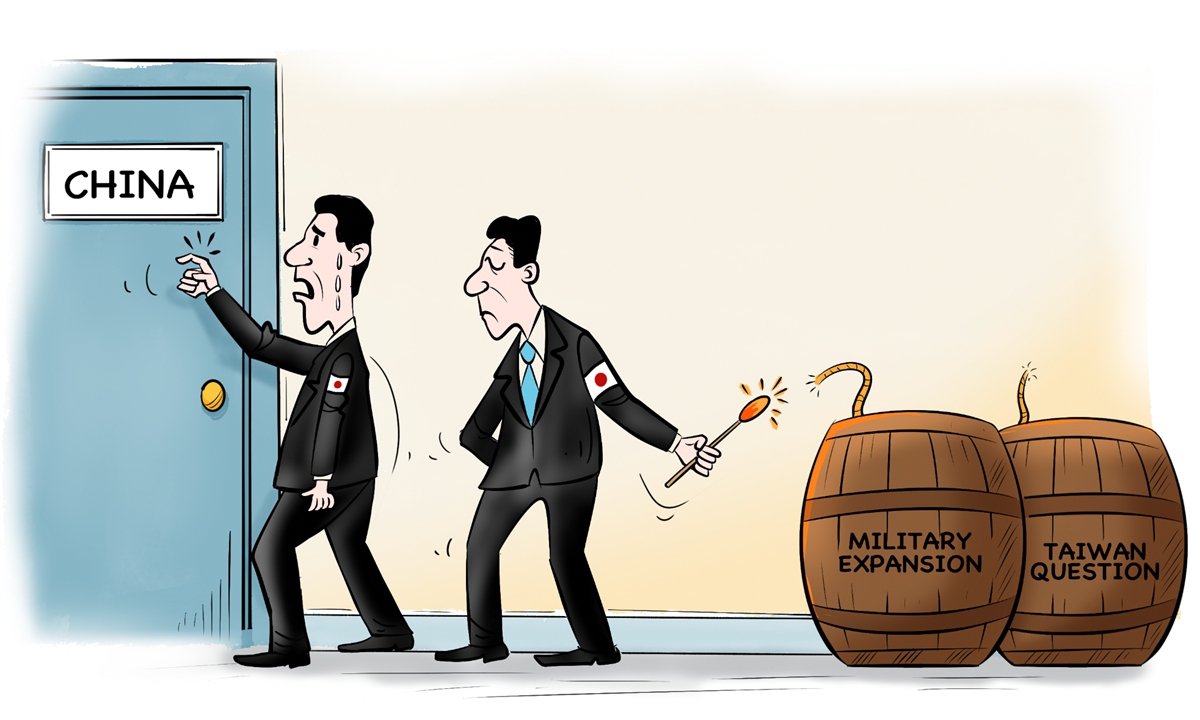
Japan is reportedly considering retaining its designation of China as its "greatest strategic challenge" in a planned revision of its National Security Strategy, though stopping short of labeling China a "threat" despite calls from some conservative political forces for tougher language. The move has brought renewed attention to the continued hyping of the so-called "China threat" by Japanese political forces, a narrative Beijing has criticized as a pretext for military expansion.
According to a report by the Yomiuri Shimbun on Monday, the Japan Innovation Party has proposed explicitly designating China as a "serious threat," while some conservative political forces within Japan's ruling camp have also called for a tougher assessment of China.
However, citing multiple government sources, the Yomiuri Shimbun reported that the prevailing view within the Japanese government is that "challenge" is already a sufficiently strong expression and that adopting even tougher language would bring no discernible diplomatic benefits.
The contrast between calls for stronger rhetoric and the government's reluctance to adopt it has brought renewed attention to the debate within Japan over its China policy, particularly the relationship between diplomatic engagement and security measures.
China has previously strongly criticized Japan's characterization of China as its "greatest strategic challenge," warning against Tokyo's accelerating remilitarization.
"The so-called 'greatest strategic challenge' is nothing but a pretext for Japan to engage in military expansion in the name of defense," Chinese Foreign Ministry spokesperson Guo Jiakun said at a regular press conference on November 5, warning that Japan's "reckless remilitarization and repeated breach of its 'exclusively defense-oriented' policy seriously threaten regional peace and stability, and challenge the postwar international order."
Japan's National Security Strategy, the highest-level document among its three key security documents, outlines the government's assessment of the international security environment and the strategic measures it intends to pursue.
When Japan first adopted the strategy in 2013, it described China as a matter of "concern." The characterization was elevated to a "challenge" in the 2022 revision, reflecting language used in US strategic documents at the time. The current strategy describes China's external posture and military activities as "an unprecedented and the greatest strategic challenge."
Lü Chao, a Chinese expert on Northeast Asian affairs at the Liaoning Academy of Social Sciences, told the Global Times that certain political forces in Japan are deliberately hyping up the so-called "China threat" to create a favorable political environment for expanding military production, developing offensive weapons and weakening the constraints of the country's postwar security framework.
"Taken together, these developments suggest that Japan is moving rapidly toward a new form of militarism," Lü said, adding that such a trajectory poses risks to the international order established after World War II.
The Yomiuri Shimbun also reported that the Japanese government intends to maintain its basic approach of "deterrence and dialogue" toward China, seeking to deter Beijing while continuing efforts to improve diplomatic relations.
Questioning the sincerity of Japan's reported "deterrence and dialogue" approach, Lü said Tokyo has shown few signs of meaningful engagement with Beijing while some Japanese political forces continue to fuel anti-China sentiment, noting that the contrast between Japan's rhetoric of dialogue and its security policies reveals a contradictory approach toward China.
Lü pointed out that despite different voices in Japan, the overall political environment has been shifting toward the right, while Japan's security policies increasingly emphasize military expansion and the development of offensive capabilities.
Song Zhongping, a Chinese military affairs expert, told the Global Times on Monday that Japan's continued hyping of the so-called "China threat" serves not only to justify military expansion but also to pave the way for revising its pacifist constitution.
"Japan's ultimate objective is constitutional revision. Once the constitutional constraints are removed, further military expansion and the strengthening of offensive capabilities would become much easier to justify," Song said.
He said that Japan's military buildup and constitutional revision efforts are interconnected steps toward loosening the constraints of the postwar international order, warning that such developments could raise serious concerns among countries that suffered from Japanese militarism during World War II.
RELATED ARTICLES