Civilization, mutual learning Illustration: VCG
Where does a city's civilization reside?
In maps and historical sites, and in the taste of everyday home cooking; in museum display cases, and in the tone of a language. Macao shows that the meeting of civilizations happens both in the depths of history and, continuously, in the ordinary life people share.
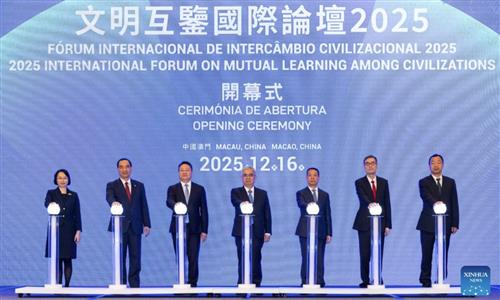
From Monday to Tuesday, the International Forum on Mutual Learning among Civilizations 2026, hosted by the government of the Macao Special Administrative Region (SAR), was held in Macao. Nearly 300 government officials, international organization representatives, and experts and scholars from more than 20 countries and regions gathered for nearly 40 keynote speeches and academic exchanges. The forum included three sub-forums and academic salons, focusing on "Cross-disciplinary Cultural Dialogue," "The Glory of Civilizations in the AI Era," and "Cultural Connections between China and the Portuguese-speaking Countries."
In a world of intertwined turbulence and change, an international forum themed on "Mutual Learning among Civilizations, Inheritance and Development" stands out. It poses a timely question: As conflict and division persist, and as AI profoundly reshapes our society, how can humanity understand one another across differences and safeguard human dignity amid development?
Macao offers a concrete window to observe this question. For more than 400 years, people of different regions, faiths, and traditions have met and intersected here. From World Heritage sites to living intangible cultural heritage, from Western-style historic churches to traditional Lingnan mansions, diverse cultures have left traces of engagement and shared development. The country's positioning of Macao as an "important window for exchanges and mutual learning between Chinese and Western civilizations" affirms this historical and lived experience.
The essence of civilization lies in how we live together
When people speak of civilization, they often think of cities, inventions, technology, and knowledge. These are important achievements, yet a deeper measure of civilization lies in how people grow, how society treats others, and how people confront differences while sustaining a shared life.
In his keynote address at the forum, Feng Shi, a member of the Chinese Academy of Social Sciences, spoke of "civilization under heaven" from the perspectives of ancient scripts and traditional thought, linking civilization to moral cultivation, individual growth into adulthood, and social education. This line of thinking returns civilization to the human scale: Technology can enhance capabilities, but it cannot decide for people where those capabilities should be directed; institutions can organize social life, yet they also require justice, responsibility, and trust as their foundation.
Respect for others, honesty and trustworthiness, the cherishing of life, and the assumption of responsibility are common issues across all societies. Each civilization has its own ways of expressing and understanding these values. The significance of civilizational exchange lies in enabling one another's experiences to be told, heard, and examined.
This requires both self-reflection within one civilization and mutual learning among civilizations. Self-reflection means looking back on one's own history and discerning experiences and lessons; mutual learning means learning from other civilizations and, through exchange, coming to know oneself anew. Subjectivity allows a civilization to enter dialogue with its own historical and intellectual resources, while openness enables it to listen, learn, and reflect. The two support each other; only then can exchange truly become mutual learning.
Chinese poetry is beautiful, moving, and astonishing, said Hugh Bowden, a professor of ancient history in King's College London's Department of Classics. He added that his favorite poet is Tang Dynasty (618-907) poet Li Bai. He believes that cultural exchange is the best path to resolving conflict and promoting development. The more knowledge of Eastern and Western cultures is shared and circulated, the better the world will become.
The Macao experience: letting multiculturalism enter everyday life
Macao's multiculturalism is not confined to its architecture or historical records. It is also preserved in its food, language, and theater.
At the forum, Vice President of the Cultural Affairs Bureau of the Macao SAR Government Mu Xinxin illustrated how cultural fusion has become part of local life by examining Macao people's culinary traditions and Patuá Theater. Local cuisine embodies long-term exchanges across regions, family life, and the use of local ingredients. While each dish carries its own cultural origins, together they have developed a distinctive local flavor within Macanese homes and daily routines.
Patuá, a creole language system, also preserves Macao's cultural memory. Based on Portuguese and incorporating elements from Malay, Cantonese and other languages, it was once the mother tongue of the Macanese community. The usage of a single word or the rhythm of an expression can record linguistic contact and community life. Patuá Theater brings this language onto the stage, allowing audiences to hear a particular cultural experience while bringing community memory into the public sphere.
The inclusion of Macanese culinary techniques and Patuá Theater in China's National List of Representative Intangible Cultural Heritage has provided institutional support for their protection and transmission. While safeguarding skills, documenting texts, and organizing presentations are all important, what matters more is ensuring that the culture continues to be used, shared, and understood. Traditions can only endure and grow when they remain connected to contemporary life.
Macao's experience also reminds us that coexistence takes time. Cultural communities need long-term interaction to build trust and shared living to form connections. Only when differences are respected and groups are able to participate in public life can diversity move from mere coexistence to joint creation.
Dialogue among civilizations requires an equal platform
While everyday interactions make the coexistence of civilizations tangible, dialogue at the international level requires stable and equal conditions.
Zheng Yongnian, dean of the School of Public Policy at the Chinese University of Hong Kong, Shenzhen, noted at the forum that the international community does not lack opportunities for cultural exchange; what is truly scarce are dialogue platforms that are equal, in-depth, and capable of generating lasting impact. The effectiveness of such exchanges cannot be judged solely by whether events are held; it also depends on whether differing viewpoints can be expressed and whether each side's perspectives receive a response.
Takashi Hamashita, director of the Research Department at the Toyo Bunko in Japan and a senior research fellow at the Institute for Advanced Studies in Humanities at Sun Yat-sen University, believes that the essence of cross-cultural exchange has never been one-sided export or import, but rather "mutual understanding." If certain voices consistently dominate the agenda, forcing other civilizations to merely explain themselves and respond to criticism, it becomes difficult to establish an equal relationship through dialogue. True mutual learning requires that all parties participate in discussions based on their own historical experiences and are willing to listen earnestly to others. It does not require everyone to reach the same conclusion, but it helps people understand differences, reduce misjudgments, and leave room for cooperation.
Since Macao's return to the motherland, the successful implementation of "One Country, Two Systems" has driven economic development, social stability, and improvements in people's livelihoods, while also safeguarding the city's cultural diversity. With an open attitude, Macao is serving as a window for the exchange and mutual learning between Chinese and Western civilizations, as well as a "precise liaison" between China and Portuguese-speaking countries.
At the forum, Qiang Shigong, president of the Minzu University of China, explored the institutional bridges for civilizational exchange through Macao's history and the "One Country, Two Systems" policy, while Li Cheng, director of the Center on Contemporary China and the World at the University of Hong Kong, used the Pearl River as a metaphor to illustrate the Greater Bay Area's open structure, where tributaries converge and connect with the world.
By hosting this forum, Macao is providing a platform for dialogue that fosters broader exchanges and mutual learning among civilizations while preserving its own unique characteristics. This allows experiences from different regions to be brought into shared discussions and helps transform dialogue from one-time encounters into sustained cooperation.
Retaining human‑centered values in the AI era
The forum also turned its attention to AI. Technology is influencing employment, education, privacy, public decision-making, and security, while also prompting people to rethink capabilities, responsibilities, and the place of humanity.
AI can enhance efficiency and expand access to knowledge, but it cannot decide on behalf of humans which questions are worth exploring, nor can it shoulder moral responsibilities for society. Education must therefore cultivate the ability to analyze information, evaluate evidence, understand ethical consequences, and assume public responsibility, rather than stopping at merely teaching how to use tools.
Different countries and societies have varying experiences regarding technological innovation, individual rights, public interests, and regulatory responsibilities. AI governance requires cross-societal dialogue to identify common principles on specific issues, ensuring that safety, responsibility, transparency, accountability, and human autonomy are fully discussed. Technological development does not automatically lead to civilizational progress; its direction is ultimately determined by how humanity sets goals, allocates responsibilities, and ensures that technology serves the broader common good.
Turning shared values into shared practices
"Civilization under heaven" is not a project to be accomplished by any single civilization alone, nor does it imply that different civilizations will ultimately converge into a single form. It requires each civilization to draw upon its own history, engage in dialogue with its accumulated experience and wisdom, and seek shared responsibilities amid differences.
Macao's institutional practices, cooperation with other cities, and everyday culture provide examples of this possibility at various levels: Institutions create stable spaces for interaction; cooperation with other cities expands opportunities for shared development; and dining tables, language, and the theater bring mutual understanding into daily life. The forum brings together diverse voices, while Macao's historical experience provides a concrete foundation for mutual learning among civilizations.
Shared values must ultimately be tested by shared practices: Can peace be maintained? Can the fruits of development benefit more people? Can different cultures have equal space for expression? Can new technologies respect human dignity and autonomy? Can differences be resolved through communication and institutional mechanisms? These questions require ongoing dialogue and collective answers from all parties.
Mutual learning among civilizations begins with encounters and must progress toward understanding and cooperation. It starts with ideas but must be implemented in institutions, education, technological governance, and the daily choices of ordinary people.
Macao's dinner tables bring people together to savour diverse flavors. Patuá Theater keeps the voice of a unique community alive. The theatre enables different audiences to hear one another's lived experiences. These lived practices remind us that differences can be respected, and serve as resources for collective creation.
May the dialogue among civilizations evolve from a series of forums into enduring institutions and practices. May the mutual learning among civilizations progress from mere introductions to equal understanding and joint cooperation. And may the development of AI always uphold human dignity and autonomy.
As different civilizations deepen their understanding and expand their cooperation, their respective moral wisdom and intellectual resources will also have the opportunity to become a treasure cherished by all of humanity.
May this world, where change and turmoil intertwine, see fewer and fewer wars and conflicts, and more and more peace and tranquility. May an era of civilization under heaven arrive soon.
RELATED ARTICLES