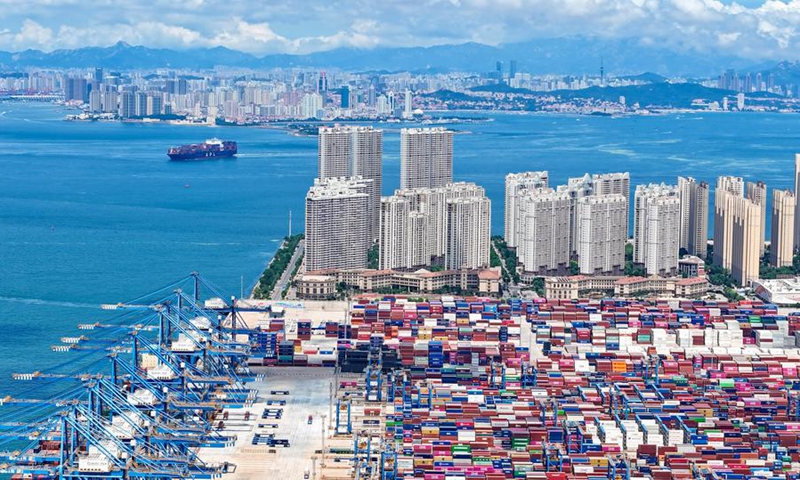
This aerial drone photo shows a container ship approaching Qingdao Port in Qingdao, East China's Shandong Province. Photo: Xinhua
Editor's Note:
China's economy is steadily advancing along the path of high-quality development, even as domestic and international circumstances become increasingly complex. Some Western media outlets, whether due to misunderstanding or bias, have repeatedly questioned or even distorted China's economic development. Accordingly, the Global Times is launching the "Q&A on China's Economy" column to present facts and clarify perceptions.
Does China's massive export surplus cause global trade imbalances? Many Western media outlets have pushed the flawed narrative that "China is responsible for global trade imbalances." The logic may seem straightforward: China exports too much, which inevitably squeezes other economies and throws global trade out of balance. At its core, this argument is a variant of the "China Shock 2.0" thesis.
The "global trade imbalances" referenced in such commentary describe an observable phenomenon. In reality, imbalances are no catastrophe; they are normal features of global economic development.
In the 19th century, the British Empire, the world's first "factory of the world," ran trade surpluses by flooding global markets with manufactured goods while sourcing raw materials cheaply from Asia, Africa and Latin America.
After World War II, the US accounted for nearly 50 percent of global GDP and over half of global industrial output, maintaining a long-running trade surplus while Europe and Japan posted deficits.
After the US dollar's decoupling from gold in 1971, the US shifted to persistent deficits. Since then, the surplus economies successively included Japan, Germany, petroleum exporting countries, the so-called "Asian Tigers" (South Korea, the island of Taiwan, Singapore and Hong Kong Special Administrative Region), and then China.
This recurring pattern of imbalances has been shaped largely by the very party behind the "China responsibility" narrative: the US.
The root of America's trade imbalance lies in structural flaws within its domestic economy and the Triffin dilemma inherent to the dollar's status as the global reserve currency. The US federal deficit reached roughly $1.8 trillion in fiscal year 2024, and household savings rates have long lagged those of other major economies.
The gap between savings and investment must be filled by net inflows from abroad, and trade deficit is merely the external accounting reflection of that gap. Even if the source of the deficit shifts from China to Vietnam or Mexico, America's savings shortfall remains unchanged.
And, after the collapse of the Bretton Woods system and the severing of the link with gold, the US dollar, as the world's primary reserve and settlement currency, had to be supplied to the rest of the globe in large volumes. The major way to export dollars has been for the US to maintain large, persistent trade deficits.
From the perspective of global value chains, a surplus does not mean "profiting at others' expense," nor does a deficit equal "losing out."
The logic is simple. When a smartphone undergoes final assembly in China, its full export value is counted toward China's surplus, yet the bulk of the value chain - chips, patents and brand premiums - accrues to firms in the US, Europe, Japan and South Korea.
A considerable share of China's goods exports comes from multinational manufacturers operating in China, with profits channeled back to parent companies via transfer pricing. American consumers gain access to cheaper manufactured goods, and US factories rely on imported intermediate inputs and equipment to sustain their competitiveness.
China's export competitiveness stems from its comparative advantages. It has no need, nor any intention, to seek competitive gains through currency depreciation.
Since the exchange rate regime reform in 2005, the yuan has floated in both directions and remained relatively strong among the world's major currencies, while China's foreign trade has maintained steady growth.
Multiple rounds of yuan appreciation have not derailed China's trade expansion, nor has yuan depreciation delivered a marked lift to China's export market share.
As China upgrades export mix, shifting away from labor-intensive goods toward capital- and technology-intensive products, its trade has become far less sensitive to exchange rate swings. Currency movements have not affected the overall stable trajectory of China's foreign trade.
The deep-seated causes of global economic imbalances lie in national economic structures and savings-investment dynamics. Resolving the imbalances ultimately requires domestic reforms and coordinated adjustments across countries.
Attempting to fix imbalances by raising tariffs substitutes trade policy for macroeconomic adjustment and uses restrictions on foreign supply to paper over domestic structural weaknesses.
In the 1930s, the US passed the Smoot-Hawley Tariff Act, causing a surge in protectionism. Amid collapsing demand, financial crisis and spreading trade barriers, global trade volume shrank by roughly two-thirds between 1929 and 1934. Individual countries may have seen their trade accounts converge as imports and exports contracted, yet this so-called balance was achieved on the back of shrinking demand, stalled production and recession. It was a costly "downward adjustment."
The viable path for all nations is to pursue higher-level dynamic balance in the global economy through greater openness and shared development.
Countries need to improve their external balances by expanding markets, deepening specialization and lifting productivity, so that growth and rebalancing reinforce one another.
China continues to pursue opening-up, ease market access and actively boost imports. It offers duty-free treatment covering 100 percent of tariff lines for the least-developed countries with diplomatic ties to China. These steps serve both the internal imperative of advancing high-quality development and the goal of sharing opportunities in its super-size consumer market with the world.
Global economic rebalancing should aim to optimize structures amid development, expand demand through cooperation, and carry out adjustments in the context of growth, so that all countries can unlock more development opportunities through their own efforts and mutually beneficial cooperation.
RELATED ARTICLES