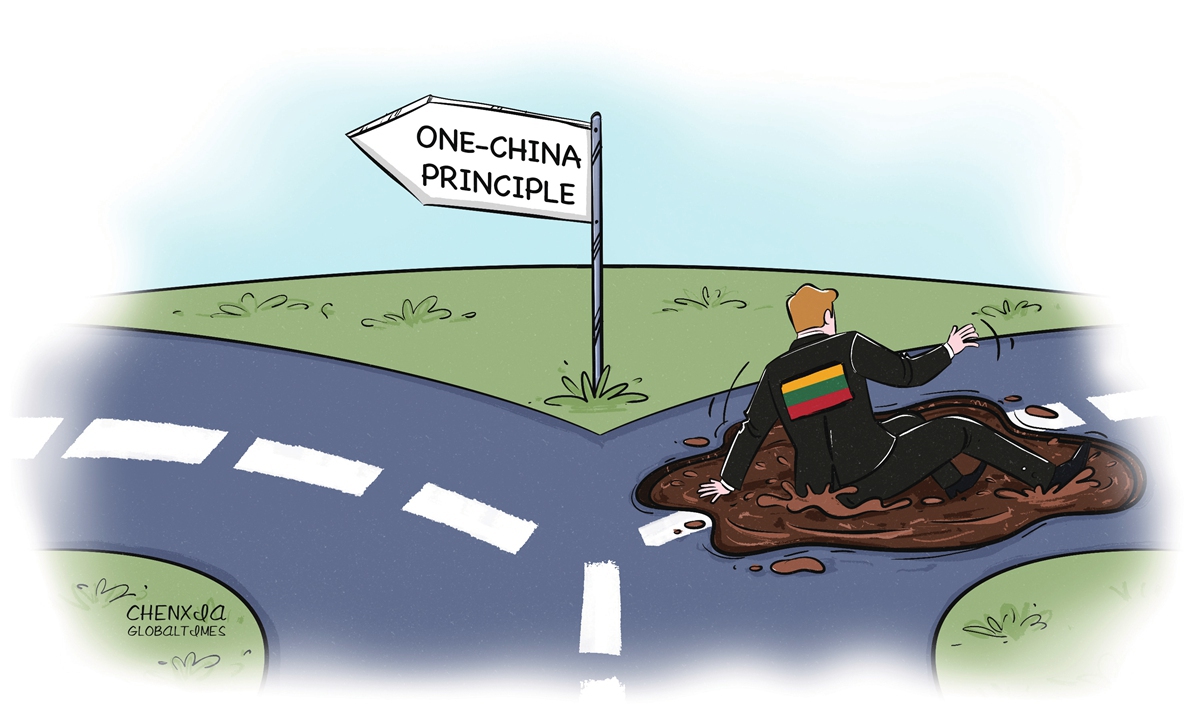
Lithuania Illustration: Chen Xia/GT
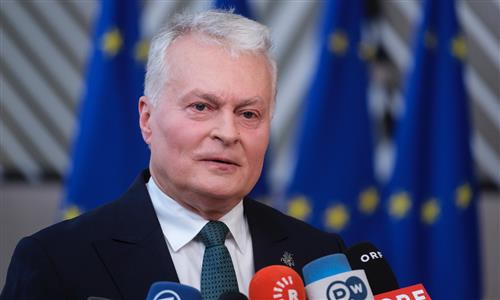
Recently, media reports said Lithuania's foreign affairs department is pushing to change the name of the "Taiwan Representative Office." Since the beginning of this year, Lithuania has been floating signals about "restoring diplomatic relations with China." Lithuanian President Gitanas Nauseda has acknowledged that setting up the "Taiwan Representative Office" was a mistake, and the new government has set a goal of normalizing diplomatic relations with China. But beyond that, we have so far not seen more concrete steps from Lithuania to improve the situation.
Five years ago, Lithuania's previous government crossed China's red line on the Taiwan question. Disregarding China's solemn protests, it openly allowed the Taiwan authorities to establish a so-called representative office under the name "Taiwan," deliberately creating the false impression of "one China, one Taiwan." This move seriously undermined the political foundation of China-Lithuania relations and made Lithuania an outlier among EU member states in their relations with China. Yet Vilnius gravely underestimated China's capacity for strategic countermeasures. Before bilateral relations deteriorated in 2021, practical economic and trade cooperation had kept bilateral trade on an upward trend for an extended period, reaching a historic high in 2020. Following the deterioration of relations, however, economic and trade cooperation suffered a comprehensive downturn. The harsh realities of the past five years have demonstrated that abandoning the one-China principle and openly supporting the Taiwan authorities haven't benefited Lithuania. Instead, they have damaged its economy and left it diplomatically disadvantaged.
Clearly, Lithuania's current government is unwilling to continue shouldering the burden of this disastrous legacy. Yet it remains hesitant and indecisive when it comes to addressing the fundamental issue of correcting its mistakes. For example, while signaling its hope to "put bilateral relations back on track," it has simultaneously claimed that it is "too early" to discuss renaming the so-called "Taiwan Representative Office." To some extent, the current government's hope to mend ties with China has been driven by Lithuania's difficult domestic economic situation and public opinion. A Lithuanian survey conducted this year shows that nearly 60 percent of Lithuanians have recognized the illusory nature and enormous costs of attempting to "use Taiwan to contain China," and want their government to repair relations with China and abandon opportunistic political maneuvering.
However, Vilnius still clings to illusions about the empty promises made by certain Western actors and the flattering labels of "democracy" they have bestowed upon it. That is why Lithuania continues to hold on to this political hot potato, despite the discomfort it causes. This also suggests that Lithuania may not yet be prepared for the normalization of relations with China.
The one-China principle is a widely recognized norm governing international relations and a broad consensus of the international community. It also constitutes the political foundation of China-Lithuania and China-EU relations. Anti-China forces in the West have sought to turn Lithuania into a strategic pawn in their geopolitical maneuvering, encouraging it to play the "Taiwan card" to provoke China. Such underhanded tactics, which tie the interests of smaller countries to great-power rivalry for the benefits of others, will ultimately leave those smaller countries bearing the consequences and suffering a backlash. Lithuania's prolonged and costly detour has made this reality even clearer to the international community.
It must be noted that renaming the Taiwan-related representative office is an inevitable trend, and such a change would be only the first step, not the final destination, in Lithuania's efforts to correct its mistakes. Even if Lithuania changes the erroneous name of the so-called "Taiwan Representative Office," this would not mean that its relations with China could immediately "return to the past." Nor should Vilnius attempt to use the proposed name change as a bargaining chip in negotiations with China. The Taiwan question is China's internal affair and the core of China's core interests. There is no room for compromise or concession. What Lithuania needs to do is bring its foreign policy fully into alignment with the one-China principle. Only then can bilateral relations potentially resume practical cooperation, and only then can Lithuania truly move beyond its past strategic dilemma.
The one-China principle is a binding constraint, not an optional choice. Any separatist attempt to play the "Taiwan card" or engage in word games over names will inevitably run up against the solid wall of the one-China principle. The higher one jumps, the harder the impact. All parties should have a clear understanding of this reality: Any attempt to play the "Taiwan card" for opportunistic political gains or engage in political gambling is doomed to fail.
China is open to communication, but Lithuania must also demonstrate the right attitude toward dialogue. We hope Lithuania will correct its mistakes as soon as possible, honor the political commitments it made in the communiqué on the establishment of diplomatic relations between the two countries, and return to the right path of adhering to the one-China principle. It should translate its stated willingness to improve bilateral relations into concrete actions, thereby creating the conditions for the normalization of China-Lithuania relations. In particular, certain Lithuanian politicians should refrain from political opportunism on this fundamental matter of principle. Otherwise, no matter how many signals they send expressing a "desire to restore relations," such statements will amount to nothing more than empty gestures.
RELATED ARTICLES