Jensen Huang just stepped down – and US media can’t wait to imagine ‘China always loses’
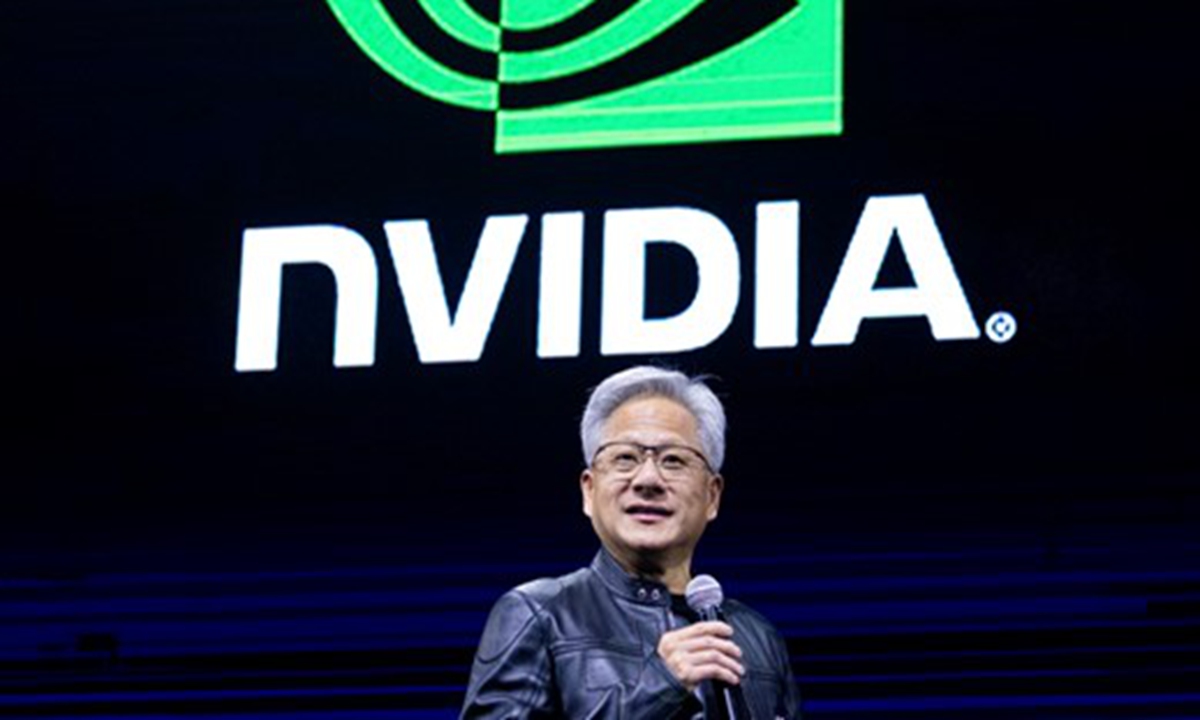
NVIDIA CEO Jensen Huang Photo: VCG
Shortly after Jensen Huang stepped down from Nvidia, Bloomberg immediately published an article declaring China the "biggest loser." The article's logic is extremely bizarre: The technological edge held by Chinese AI companies relies on smuggling American chips and distilling American technology, and the departure of Huang, who served as a "loophole" in US chip restrictions against China and a staunch advocate for Silicon Valley's open-source model, would be "extinguishing already faint hopes for cooperation on that front" and leaving China "stranded on the other side."
It seems Bloomberg had this article prepared well in advance, just waiting for Huang to step down so they could attach this label on China. Over the years, US media has frequently labeled China the "biggest loser" in various scenarios, from the US mortgage crisis and the US-Iran conflict, to the depreciation of the Japanese yen. Whenever something happens, there's always someone claiming that "China has lost again," a recurring trope that has led Chinese netizens to coin a term to mock this phenomenon: "China always loses."
In reality, this narrative is consistently proven wrong time and again. It reduces the intricate web of international relations to a simple, zero-sum game of winners and losers, reflexively interpreting every event as a "loss for China." This approach serves to uphold a psychological sense of "American exceptionalism" while allowing the US to evade the reality of the profound crises it faces at home. Such repeatedly failed "predictions" have not only eroded the country's own analytical capacity but have also, over the years, misdirected US foreign policy, ultimately exacting a higher strategic cost for the US.
This Bloomberg article, which claims that "China is the biggest loser," is a product of the anxiety felt by certain people in the US. Unable to face or accept the reality of China's independent industrial development, they have resorted to a form of self-delusion to deceive themselves, as if by simply concocting a "loser," the US could somehow be spared from its own losses.
As observers of this entire situation, we would like to offer a well-intentioned reminder: Huang has repeatedly advocated for open source and openness precisely because, in the tech industry, openness means life, while closure spells death. If openness really depended on Huang alone and his departure closes off channels for technological cooperation, the US may face bigger problems ahead.
RELATED ARTICLES