Chinese industrial advances fuel Jiaolong’s deep-sea upgrades
Lower costs and homegrown equipment help submersible sustain more missions
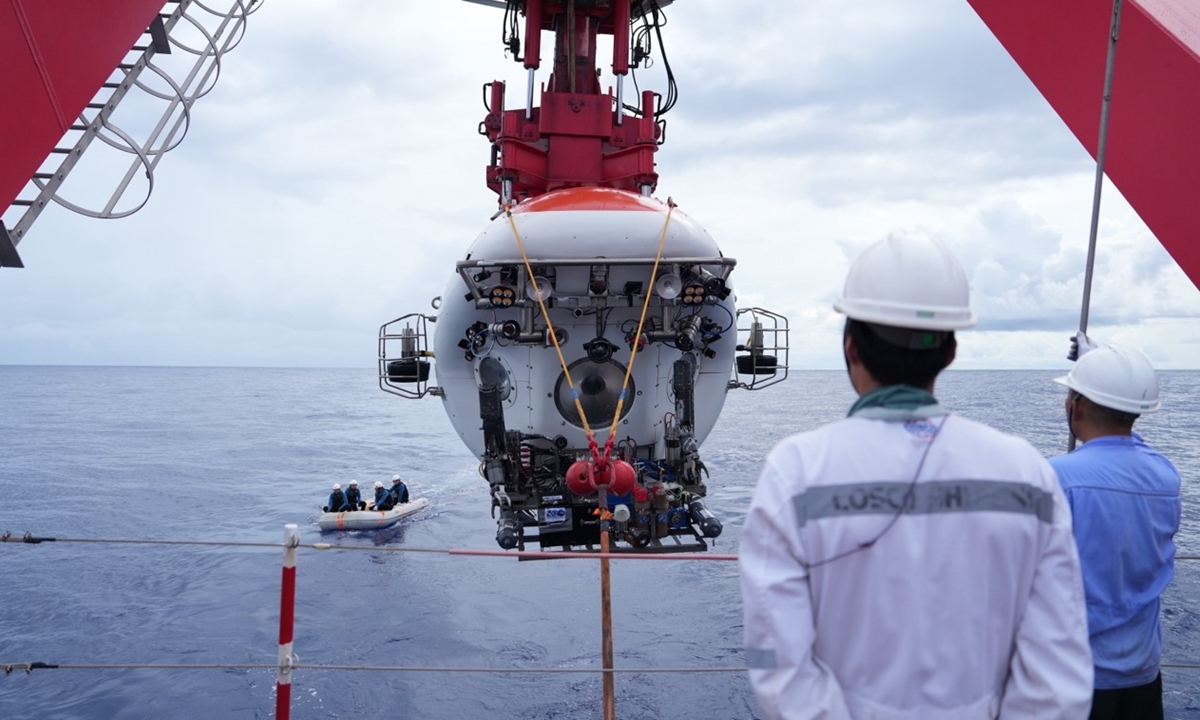
China's manned submersible Jiaolong is recovered aboard its mother ship, Deep Sea No. 1, after completing its 476th dive on November 3, 2026. Photo: Feng Fan/Global Times
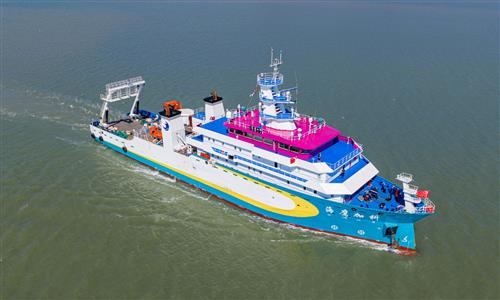
For the pilots and researchers aboard Deep Sea No. 1, a busy stretch at sea can mean sending Jiaolong on dives lasting around 10 hours, day after day. Keeping the Chinese manned submersible working at that pace has become easier as new batteries last longer, domestic thrusters run more quietly and equipment needs less maintenance.The research vessel is now in the South Pacific on China Deep Ocean Affairs Administration's Cruise DY100 scientific expedition, during which Jiaolong has explored sites in the Philippine Basin, the Ontong Java Plateau and the Caroline Basin. With 478 dives completed, the submersible is approaching another milestone: its 500th descent.
Behind that rising tally is a series of upgrades that offers a close look at how advances across Chinese industry are reaching the deep sea. Interviews aboard Deep Sea No. 1 show how longer equipment life and lower operating costs are allowing Jiaolong to undertake more missions and encouraging more research institutions to use it.
China's first independently designed and integrated deep-sea manned submersible has recently been fitted with high-energy-density, oil-immersed lithium battery packs, higher-resolution cameras and domestically developed direct-drive, low-noise DC thrusters. For those working with Jiaolong, the benefits are apparent both underwater and in the cost of getting there.
A battery change with wider benefits
"When Jiaolong used silver-zinc batteries, a battery pack might last only a year and could be used just 30 times after activation," Jiaolong pilot Qi Haibin told the Global Times. "After switching to the new lithium battery packs, the service life increased from one year to five years, and the number of uses rose from 30 to 750."
That change has altered the economics of a research dive. According to a researcher aboard Deep Sea No. 1, the old silver-zinc battery packs cost an average of about 6 million yuan each, with prices fluctuating alongside global silver prices. Spread across their limited number of uses, that meant a battery cost of roughly 200,000 yuan ($29,982.08) for a single dive, before other expenses were considered.
The expense discouraged some research institutions from using Jiaolong for deep-sea exploration. The switch to lithium batteries has sharply reduced the battery cost per dive, helping bring the total cost of a dive down to around half its previous level and drawing more institutions into Jiaolong's scientific expeditions, the researcher said.
The gains reflect a connection between a highly specialized research vehicle and a much larger industrial sector. Jiaolong's batteries have demanding requirements, but the advances supporting their development have taken place alongside the rapid growth of China's commercial battery industry.
"The overall development of China's battery industry has undoubtedly provided important support for Jiaolong's lithium-ion battery upgrade," a researcher aboard Deep Sea No. 1 told the Global Times. They said the submersible requires greater safety and energy density than conventional lithium batteries, while the underlying technology has advanced in step with that of other manufacturers in the market.
The scale of that industrial development is reflected in an International Energy Agency commentary published on September 7, titled "The rise of lithium-ion batteries." China accounts for 85 percent of global lithium-ion battery production, and its two largest battery producers together contribute more than half of global output, the commentary said.
Aboard Jiaolong, the significance of those wider advances is practical: a longer-lasting power source means a lower battery bill spread across many more missions. Combined with higher energy density, it helps sustain the repeated dives required by a busy scientific expedition.
Homegrown technology at work
While the battery upgrade has benefited from progress across a large commercial industry, other changes aboard Jiaolong have come from developing domestic alternatives to equipment affected by overseas export restrictions.
A researcher aboard Deep Sea No. 1 told the Global Times that Chinese-made components have replaced imported equipment in the buoyancy adjustment system and hydraulic power unit. Domestically produced buoyancy materials have also replaced imported ones. The replacements have matched or exceeded the performance of the original equipment, they said.
The propulsion system shows what that improvement means during a dive. According to Qi, the new domestic thrusters produce substantially less underwater noise, allowing acoustic equipment to pick up signals more clearly and creating a more comfortable working environment for the pilots.
The difference continues after the submersible returns to its mother ship. "Previously, we had to maintain and service the thrusters on every expedition," Qi said. "Since replacing them with domestically produced thrusters, they have been virtually maintenance-free."
With less servicing required and equipment able to serve more missions, the upgrades are making Jiaolong better suited to sustained scientific work. That capability is developing as China pursues a broader effort to expand its marine economy while strengthening protection of the ocean environment.
At a press conference on November 3, 2026, Ma Weichen, an official at the National Development and Reform Commission (NDRC), said China would continue to focus on new technologies, new industries and new areas for development to advance the high-quality development of its marine economy.
The priorities include tackling major marine technological challenges, developing more advanced equipment and supporting emerging industries, Ma said. China will also take an integrated approach to protection, development and utilization across nearshore waters, the open ocean, polar regions and the deep sea. Its gross ocean product is expected to exceed 13 trillion yuan by 2030, he said.
The policy emphasis on protection is accompanied by continued efforts to survey marine ecosystems. An October 22 report jointly released by the NDRC and the Ministry of Natural Resources cited coral reef ecological surveys of Tiexian Jiao, Niu'e Jiao and Huangyan Dao among China's achievements in marine conservation since the start of the 14th Five-Year Plan period.
The report said China had designated 151,000 square kilometers of marine areas within ecological conservation redlines and established 352 marine and coastal protected areas. It also highlighted the establishment of the Huangyan Dao National-Level Nature Reserve and the issuance of management measures for it.
Other achievements included working to expand the existing World Heritage site for migratory bird habitats along China's Yellow Sea-Bohai Gulf coast and completing the country's first national marine disaster risk survey. Overall, marine environmental quality had improved markedly and ecological protection had made continued progress, the report said.
For the team aboard Deep Sea No. 1, the change in Jiaolong's working life is recorded dive by dive. Pilot Zhang Yi noted that the submersible began its 1,000-meter-class sea trials in 2009 and completed its 300th dive in August 2024. In little more than two years since then, the tally has risen to 478.
As Jiaolong moves toward its 500th dive, the benefits of its upgrades reach beyond the submersible. For research institutions once deterred by the cost, they mean more chances to take their questions to the seabed.
RELATED ARTICLES