China's AI study tours gain traction during autumn school breaks, but should prioritize sustained learning over operating high-tech products: expert
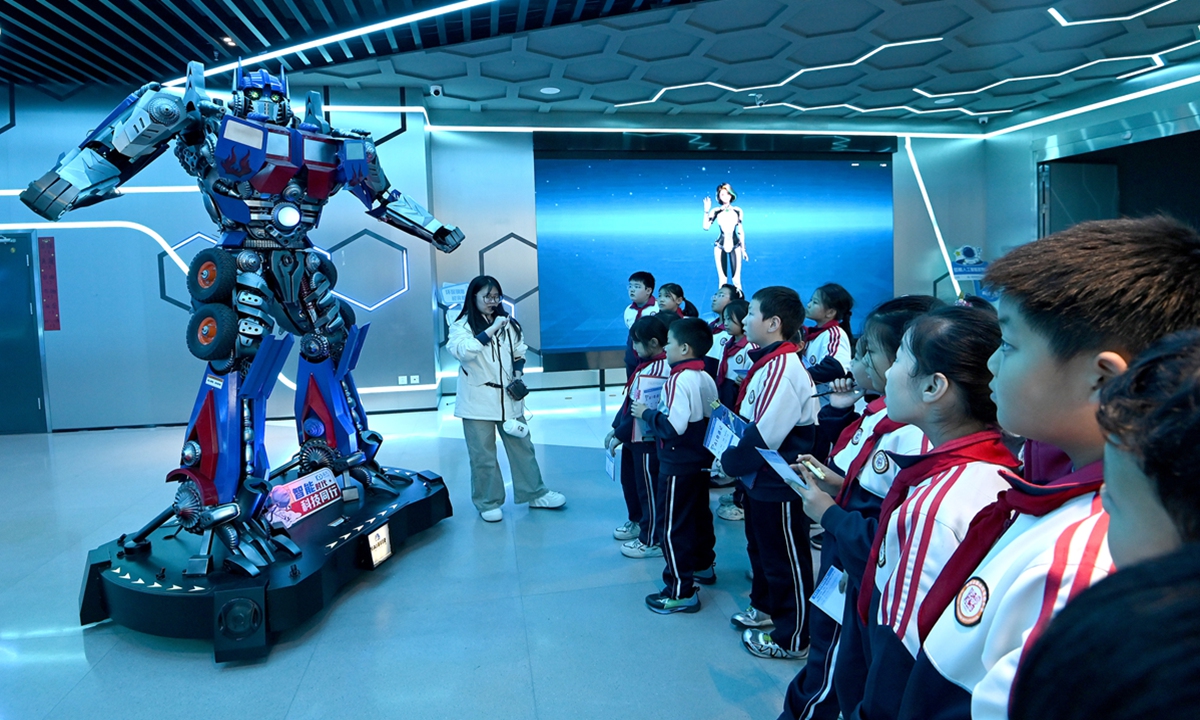
Primary school students visit an artificial intelligence education center in Handan, North China's Hebei Province, to explore AI technologies on November 12, 2026. Photo: VCG
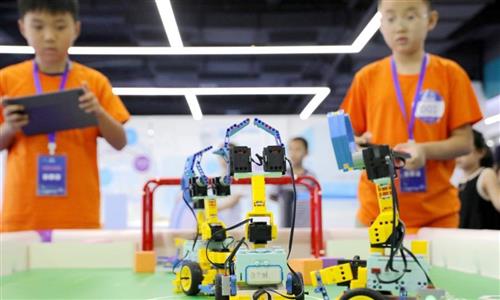
As autumn school breaks arrive in several parts of China during mid-November,study tours featuring artificial intelligence (AI), robotics and other emerging technologies have become increasingly popular, sparking discussions on whether such programs should go beyond letting children operate high-tech products.
Across China, a growing range of activities is bringing emerging technologies closer to younger generations, turning industrial bases, museums and science centers into classrooms beyond school walls.
At an embodied intelligence industrial base in Jinan, East China's Shandong Province, students can put on VR headsets and use motion-capture devices to control robotic arms to pick up objects, while watching humanoid robots write calligraphy and make coffee. The base estimated that it would receive more than 5,000 young visitors during the autumn break and the following weekend, making a period record since it began offering study programs.
In Qingdao, also in Shandong, a science carnival organized by the city's academy of young scientists attracted more than 2,000 students with 12 interactive challenges and six full inquiry-based courses, according to the local education bureau.
For some parents, such experiences offer children an opportunity to look beyond conventional classroom learning and get an early glimpse of future technological developments.
Qiu Shuhua, a mother of a middle school student in East China's Jiangsu Province, told the Global Times on Sunday that while their generation's study tours were often about sightseeing and learning history, today's children have opportunities to explore AI, large language models and AI agents at technology events.
Although children may not fully understand these technologies yet, close encounters with the latest developments can gradually broaden their horizons and help them imagine the future, Qiu said. "One generation's study tours were about looking back at history; the next generation's are about facing the future," she added.
Li Qingdu, an AI and robotics researcher and educator, told the Global Times that AI study programs should help students understand the underlying logic of artificial intelligence and develop problem-solving skills through practice, rather than simply allowing them to operate technological products.
Li suggested that programs for young learners should cover core aspects of AI, including perception, reasoning, learning, decision-making and interaction, while helping students recognize the technology's capabilities and limitations. AI study tours have developed rapidly only over the past three years, and their educational frameworks are still immature, cautioning against excessive reliance on such programs, Li noted.
As AI becomes increasingly integrated into everyday life, some parents are also considering how to introduce the technology to children in an age-appropriate and guided way. Science-oriented activities that combine hands-on learning with professional explanations can offer another approach.
Su Zizhou, a mother of an elementary school child from Shenzhen, South China's Guangdong Province, told the Global Times that they took their child to Shanghai Science and Technology Museum during the autumn break for an AI-themed study program. The activities included a science and technology class, hands-on crafts and guided tours covering topics ranging from rainforest ecosystems to astronomy.
Beyond AI-focused programs, other institutions have also used the school break to encourage broader scientific exploration. The Jiangsu Science and Technology Museum, for example, organized science experiment shows, maker activities, science crafts and interactive programs from November 6 to 10.
RELATED ARTICLES