Chinese scientists identify ‘fairy circles’ in northern China’s drylands for the first time and propose how they form
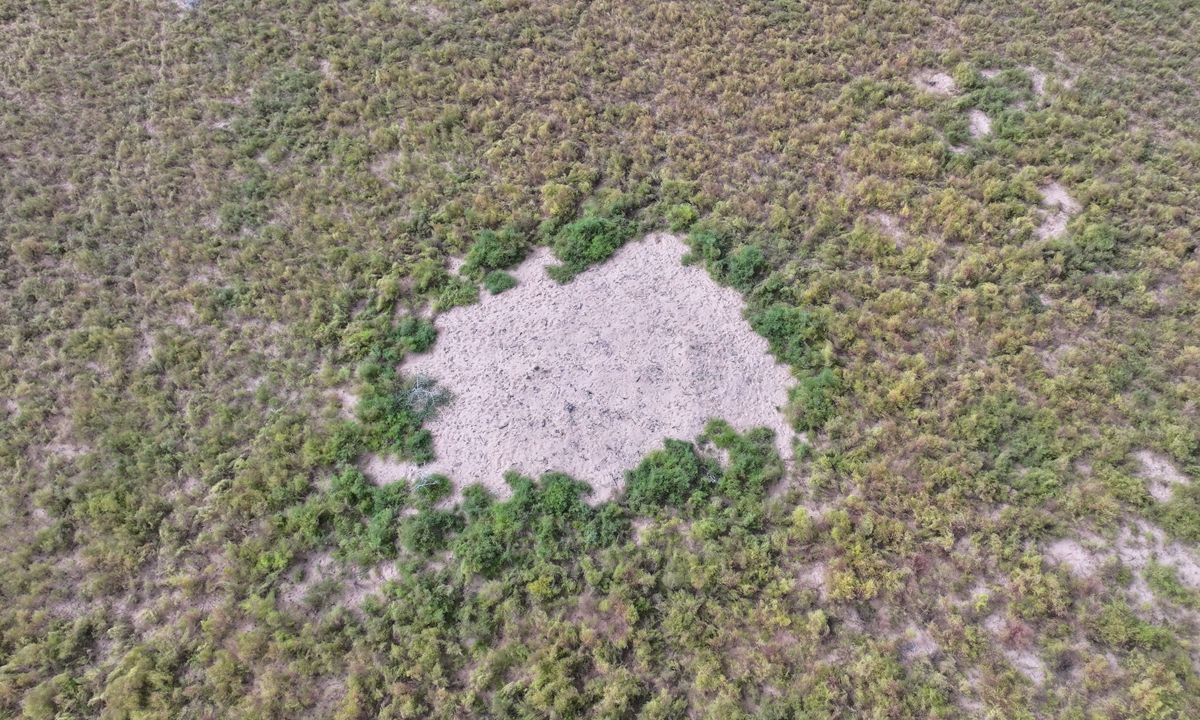
Fairy circles photographed by the research team near Alxa Left Banner, North China's Inner Mongolia Autonomous Region Photo: Courtesy of Yu Kailiang
Chinese scientists have recently identified fairy circles, unusual ring-shaped patterns with sparse vegetation or bare in centers, for the first time in northern China's arid regions and used phase transition theory from statistical physics to explain how the circles may have formed in these drylands, the Global Times learned from the research group on Sunday.
The joint research conducted by the research team led by Yu Guirui, an academician of the Institute of Geographic Sciences and Natural Resources Research, Chinese Academy of Sciences (CAS), in collaboration with researchers from the Lanzhou University and Gansu Agricultural University, was published on the international academic journal Proceedings of the National Academy of Sciences (PNAS) on November 11 local time.
Found in the arid regions of Namibia and Australia, fairy circles are unusual ring-shaped patterns in which vegetation flourishes around the edges but is sparse or absent in the center. In China, previous fairy circle research had focused largely on coastal salt marshes, with no confirmed existence in arid and semi-arid regions.
The research team studied precipitation gradients along the edges of sandy areas and deserts in northern China, used drones to capture high-resolution images and conducted field surveys. They discovered these patterns, formed by hollow rings of shrubs, at the boundaries between shrublands and grasslands.
According to Sun Jingyao, first author of the research paper and postdoctoral researcher at the Institute of Geographic Sciences and Natural Resources Research, the discovery marks the first confirmed record of fairy circles in China's arid regions, alongside with the mechanisms behind their formation being identified as well.
Challenging conventional explanations that attribute fairy circles to termite activity or biomass-water feedbacks, the study applies phase transition theory to ecology, suggesting that the patterns emerge naturally when ecosystems reach a critical state, Sun said.
Sun explained that phase transition theory, a branch of physics, examines abrupt changes in matter as it shifts from one state or phase to another, and the critical behavior associated with these changes.
The researchers used mathematical modeling to demonstrate that fairy circles represent a spatially partitioned "metastable state" in which shrubs and grasses coexist amid intense competition for resources.
Sun explained that as precipitation increases and competition from grasses intensifies, the centers of shrub patches become bare due to water scarcity, forming hollow spaces. These hollow rings, in turn, help collect water and sustain the survival of the shrubs.
Phase transition theory enables researchers to explain fairy circles and look for early warning signs of ecological collapse along desert margins.
Yu Kailiang, corresponding author of the research paper and a research fellow at the institute, told the Global Times on Sunday that fairy circles and vegetation patch expansion were previously treated as isolated natural phenomena and studied separately.
However, this study links these phenomena through physical principles, demonstrating that seemingly different abrupt ecological shifts are all manifestations of the same underlying organizational mechanism. It also offers a testable framework for identifying spatial warning signs of potential ecosystem collapse, Yu said.
RELATED ARTICLES