Weaving shared knowledge: China-Africa exchanges build capability beyond goodwill
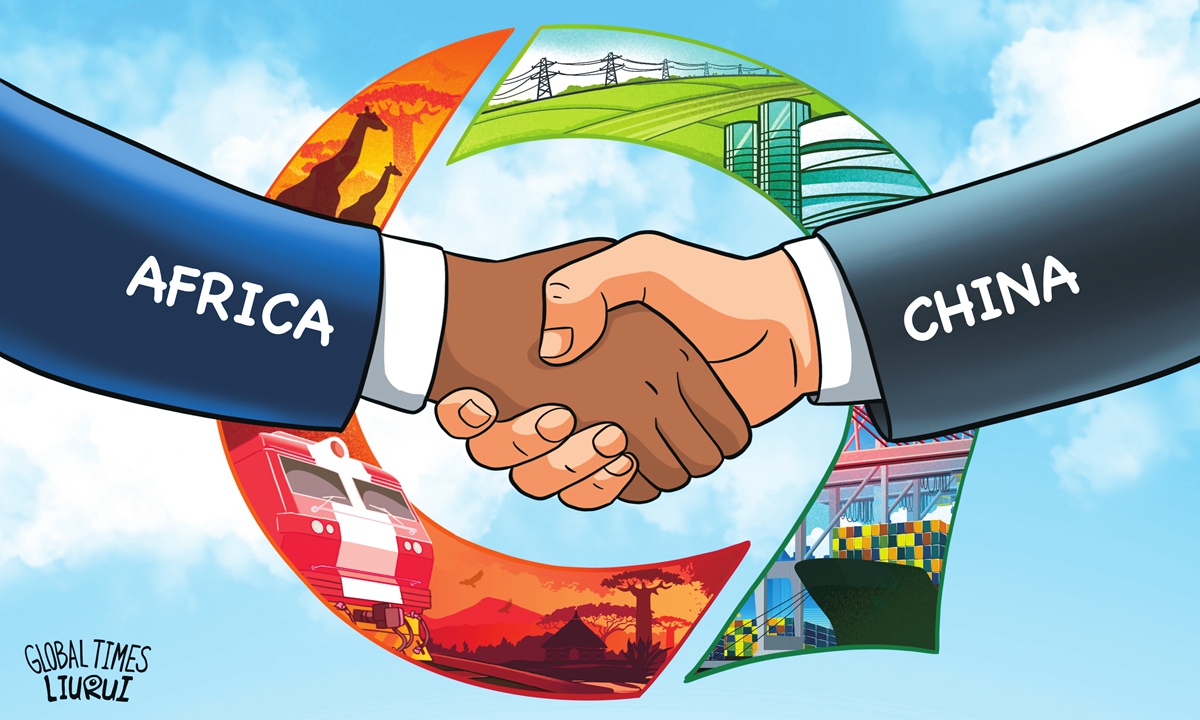
Closer cooperation. Illustration: Liu Rui/GT
In 2026, marking 70 years of China-Africa relations, the two sides launched a Year of People-to-People Exchanges, spanning education, vocational training, science and technology, AI, tourism, and green development, with nearly 600 events scheduled. The focus is less about sentiment and more about capacity: to build capability, not just goodwill. The year also coincides with the fifth anniversary of the Global Development Initiative. Five years in, the question is no longer whether China's record is impressive, but whether it can be translated into knowledge that others can actually use.The symbolism runs deep. In 2026, a series of China-Africa conferences have drawn to a close. These conferences and events are like threads linking China and Africa together.
Recently, I attended the 8th Annual Conference on Sustainable Development in Addis Ababa, co-hosted by the United Nations Economic Commission for Africa and Renmin University of China. At the close of the conference, the host cited an Ethiopian proverb: "When spider webs unite, they can tie up a lion." Each spider may not see the full pattern when it begins weaving, yet the web is made up of countless individual threads.
China-Africa cooperation is not finished by one single conference. It takes shape step by step through all the activities in this Year of People-to-People Exchanges.
The African Modernization Report 2026, released at the conference, poses four questions regarding both Chinese and African practices in China-Africa cooperation - how to coordinate multiple objectives, how to preserve continuity while allowing adjustment, how to draw the line between government and market, and how to assess results in a digital age. It answers none of them because no country has ready-made solutions.
The report takes Angola as its subject of study. Angola has an estimated 35 million hectares of arable land, but only about one sixth is farmed. Around half of its people still do not have electricity. Invited by the governing party to help draft an industrial plan, the Chinese researchers did not begin by writing. They went - several times - and walked the farming provinces. The test will not be whether Angola's plan ends up resembling a Chinese five-year plan, but whether, five years from now, Angolan officials can independently revise it without the Chinese team.
An African economist stressed at the conference that Africa does not lack plans. The trouble is that they are not always carried out as intended. Learning from another country, she stressed, does not mean copying its institutions or reproducing its model - it means identifying methods that can be adapted. Then, she reached for a Chinese saying, "cross the river by feeling for the stones," not as a slogan, but as a working description of how planning becomes real. This is the true value of an idea: It is not just applauded in meetings, but actually put into practice.
If an idea only matters when it is used, we need to figure out how to make it work after the applause ends. We need practical, long-term working arrangements built step by step. Five priorities stand out:
First, think tank dialogue should keep these ideas alive after the hall empties, ensuring that what was said at the conferences is followed up rather than filed away. Second, joint research should extend country studies to more nations, designed and written collaboratively with African scholars. Third, policy and industry advisory services should support industrialization, agriculture, the digital economy and the African Continental Free Trade Area. Fourth, talent development should open the door wider to young African scholars and students through more scholarships and exchanges, because capacity that is not renewed in people does not last. Fifth, capacity building for public officials should be strengthened by sharing experience in planning and public administration, adjusted to each country's own priorities.
In all this, China and Africa come to the table as fellow students of development, each bringing its own library. Africa carries its own deep wisdom - Ubuntu, "I am because we are" - and has much to teach the world. If the people of China and Africa move in the same direction, they can create something remarkable on the road to modernization.
Building an independent knowledge system means responding to global development questions, deepening the dialogue between Chinese development experience and African modernization practice, and contributing wisdom and strength to the Global South's common march toward modernization and to a community with a shared future for humanity.
What is being woven between China and Africa is something different: knowledge, friendship and hope - not to hold anything down, but to lift our shared future up. May the threads joined between the two sides grow strong enough to carry the dreams of both peoples.
The author is a faculty member with the School of Applied Economics, Renmin University of China. opinion@globaltimes.com.cn
RELATED ARTICLES