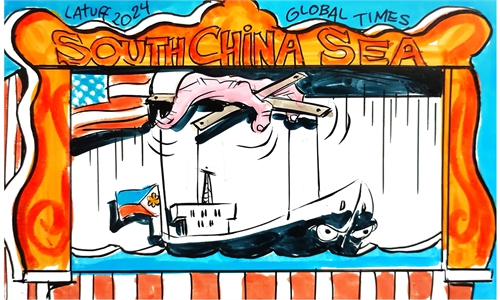
South China Sea Photo: VCG
The 29th China-ASEAN Summit, held recently in Manila, the Philippines, fully recognized the positive progress made in consultations on the Code of Conduct (COC) in the South China Sea. The parties have now reached a preliminary agreement on approximately 80 percent of the draft COC. This demonstrates that, after years of efforts, COC consultations have entered the final and critical stage. Such progress has been hard-won and deserves to be cherished.The formulation of the COC is an initiative by regional countries to safeguard stability in the South China Sea. Since the signing of the Declaration on the Conduct of Parties (DOC) in the South China Sea in 2002, China and ASEAN countries have worked to advance the formulation of the COC as an upgraded version of the DOC, providing stronger rules-based safeguards for peace and stability in the region. From the adoption of the COC framework in 2017 to the completion of the single draft negotiating text of the COC in 2018, followed by the first, second and third readings, consultations on the COC have steadily moved forward. In 2026, the parties held two rounds of senior officials' meetings and nine rounds of negotiations, marking an unprecedented pace of negotiations and yielding important breakthroughs. As co-chairs, China and Malaysia have played a positive role in this process, earning full recognition from all parties.
The COC is intended to provide institutional safeguards for managing differences. The South China Sea issue is complex and sensitive, and should be peacefully resolved through negotiations and consultations among the directly concerned countries. The COC does not address territorial sovereignty or maritime delimitation issues, nor does it affect the positions and claims of any party. Rather, it provides a common set of rules for managing maritime relations and differences, preventing maritime friction and handling unexpected incidents, thereby creating favorable conditions for resolving disputes.
The COC is also expected to open up broad prospects for maritime cooperation. Over the years, under the framework of the DOC, China and ASEAN countries have fostered numerous cooperation outcomes in areas such as marine scientific research, environmental protection, disaster prevention and mitigation, and maritime patrol and law enforcement. As an enhanced version of the DOC, the COC will help advance South China Sea cooperation into broader and deeper areas, including the blue economy, maritime connectivity and the sustainable development of marine resources. This will fully unleash the potential of the South China Sea as a sea of cooperation and deliver tangible benefits to people across the region.
The COC is also a concrete manifestation of multilateralism at the regional level. It will be consistent with international law, including the United Nations Convention on the Law of the Sea, and better safeguard the legitimate rights and interests of all parties in the South China Sea. It must be made clear, however, that respecting the legitimate rights of third parties does not give countries outside the region a pretext to interfere in South China Sea disputes, expand their military presence or heighten regional tensions. Such countries should fully respect the efforts of regional countries to advance the COC consultations and play a constructive role in maintaining peace and stability in the South China Sea.
At the same time, we should maintain realistic expectations for the COC. Difficult issues remain in the negotiations, individual maritime incidents may still give rise to disputes, and disruptive voices from outside the region have yet to die down. The consultations ahead will not be plain sailing. They will require all parties to demonstrate wisdom and patience, uphold consensus-based decision-making, and respect one another's legitimate concerns. Reaching an agreement on the COC at an early date is certainly important. But peace and stability in the South China Sea do not depend on a single document alone. They also rest on the political consensus, mutual trust and tangible cooperation built through the sustained consultation process.
China's resolve to safeguard peace and stability in the South China Sea remains unwavering, and its commitment to advancing consultations on the COC remains steadfast. As long as China and ASEAN countries remain confident and committed to their efforts, and firmly uphold the right principles and direction for properly handling the South China Sea issue, peace and stability in the region will be safeguarded more effectively, the positive momentum for maritime dialogue and cooperation will be sustained, and rule-based governance in the South China Sea will yield even greater results.
The author is an observer on international affairs. opinion@globaltimes.com.cn
RELATED ARTICLES