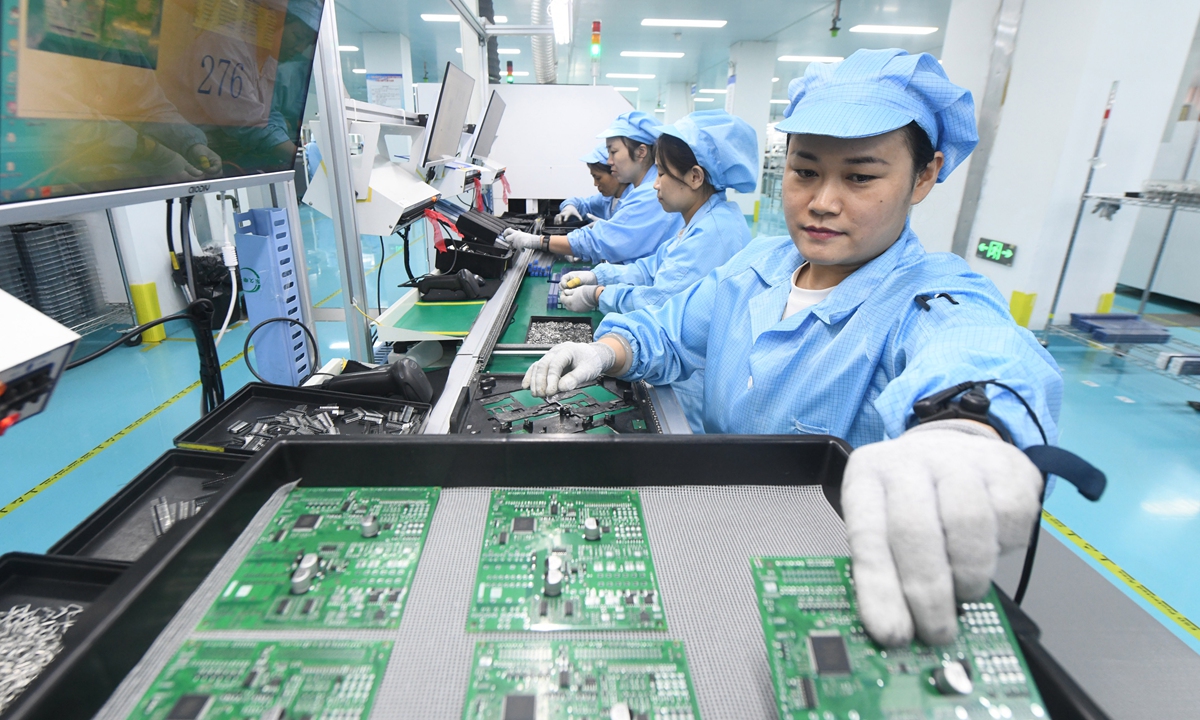
Workers produce electronic components for exports at a factory in Xinle, North China's Hebei Province, on June 16, 2026. In the first five months of 2026, China's total imports and exports of artificial intelligence-related products, including electronic components, computer parts, and optical fibers and cables, surged by 52.4 percent year-on-year, official data showed. Photo: VCG
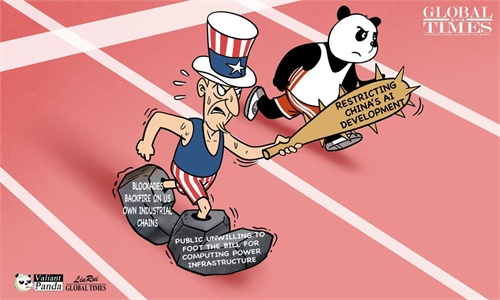
The public consultation over the revision of the Catalogue of Technologies Prohibited and Restricted from Export concluded recently. A month earlier, China's Ministry of Commerce (MOFCOM) and Ministry of Science and Technology issued a notice soliciting public comments and implemented interim management measures requiring pre-export registration for relevant technologies. The proposed revisions would add 40 key technologies in artificial intelligence (AI), biomedicine and photovoltaics, including 14 proposed to be prohibited and 26 to be restricted from export.Shortly after the announcement, some overseas media outlets rushed to sensationalize the move, misrepresenting China's lawful export controls as an attempt to build "barriers" to technology exports. Such narratives either deliberately misread China's policies or reflect strategic anxieties over China's technological development.
Export controls on technology are a sovereign right and an internationally accepted practice. Every sovereign state has the right to regulate technology exports in accordance with the law on grounds of national security and public interest. While some countries exercise this right reasonably, politicians in others have frequently sought to abuse and overextend it. China has consistently adhered to the principles of legality, transparency and non-discrimination. Since the Catalogue was first introduced in 2001, relevant authorities have revised it several times, adding and removing items and adjusting the scope of restrictions and permissions. The latest revision is likewise a routine regulatory exercise conducted in accordance with laws and regulations, and is not directed at any particular country, region or entity.
Just as important as what is subject to regulation is what remains open for export. Yet overseas commentary has deliberately magnified the word "controls" while turning a blind eye to the boundaries of what China's policy actually leaves open. MOFCOM has clearly delineated the scope of regulation. The AI technologies covered by the proposed controls have been precisely defined, and the vast majority of AI technologies can still be exported freely after the measures take effect.
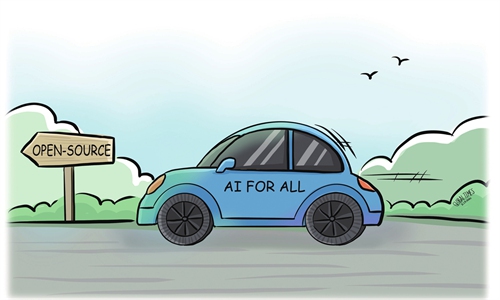
China has long encouraged open-source development and openness, and the proposed measures also strike a balance between industrial development and the global public interest. To foster an open-source AI ecosystem, streamlined technology export procedures, including automatic licensing, apply to AI open-sourcing, overseas computing infrastructure development and operation by Chinese companies, chip tape-outs and manufacturing abroad, cross-border joint R&D, and participation in international standards-setting. These measures effectively enable "immediate approval upon filing." Technologies that have entered the public domain through open sourcing or publication in academic papers are not subject to export control.
China has also proposed supporting Global South countries in strengthening their AI capabilities, bridging the digital divide and advancing sustainable development. This will leave ample room for international scientific and technological cooperation while maintaining essential security safeguards.
Facts show that security controls and open cooperation are by no means mutually exclusive. It is the uncontrolled and unregulated proliferation of cutting-edge technologies that creates risks. A case in point is AI-driven technology for generating and mutating malicious code, which is proposed for inclusion on the prohibited export list. Imposing necessary controls on such high-risk technologies is precisely about establishing security safeguards and preventing technological abuse, ensuring that AI develops in a safe, controllable and beneficial direction.
China's export controls in high-tech fields such as AI constitute an institutional framework that coordinates development with security and balances openness with regulation. They reflect China's responsibility to safeguard national security and prevent the misuse of technology, while maintaining clear channels for international scientific and technological exchanges and cooperation. Those rushing to pin the label of "barriers" on China cannot conceal their own anxieties over technological protectionism, nor can they change China's firm commitment to working with the global community to ensure that science and technology serve the greater good.
The author is a research fellow at the Institutes of Science and Development, Chinese Academy of Sciences. opinion@globaltimes.com.cn
RELATED ARTICLES