Japan’s failed bid for formal US meeting ‘reflects diplomatic anxiety’
Tokyo leverages Quad to shore up US commitments: expert
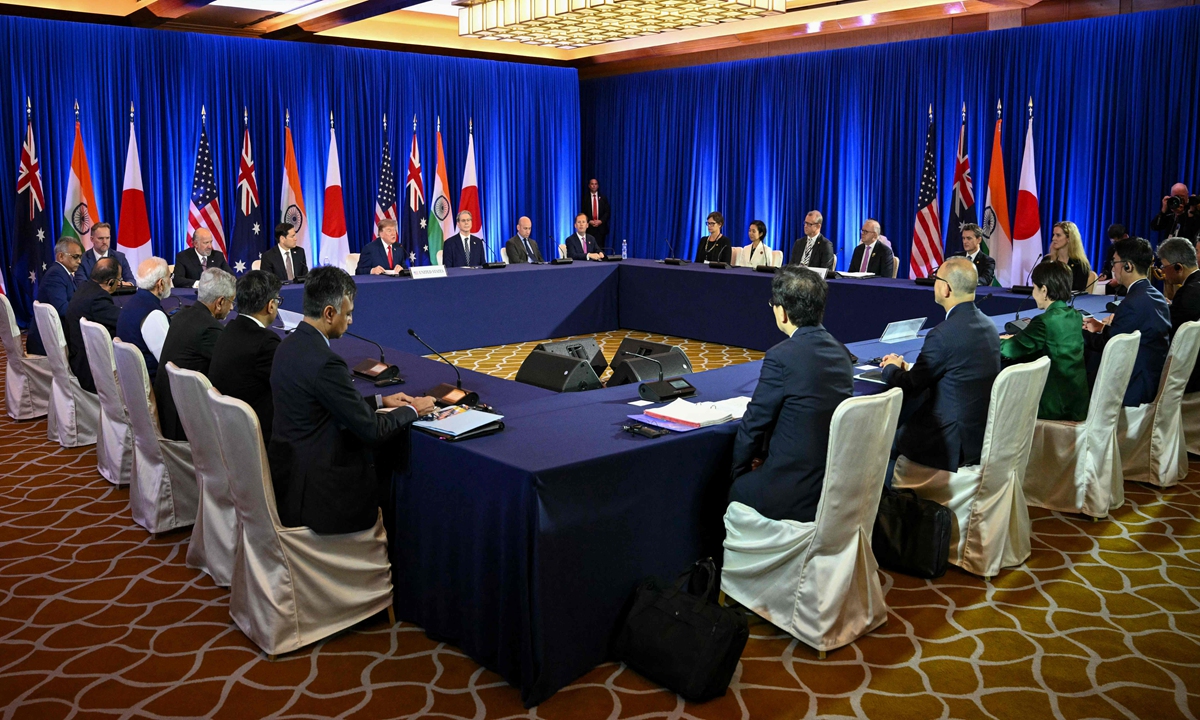
US President Donald Trump, Australia's Prime Minister Anthony Albanese, India's Prime Minister Narendra Modi and Japan's Prime Minister Sanae Takaichi take part in a meeting of the Quad group - the US, Japan, Australia and India - on the sidelines of the 49th Association of Southeast Asian Nations (ASEAN) Summit in Manila on November 17, 2026. Photo: VCG
Japanese Prime Minister Sanae Takaichi had initially sought to arrange a formal bilateral meeting with US President Donald Trump during the recent ASEAN meetings in Manila, Philippines, Japanese media reported on Wednesday. However, according to the Mainichi Shimbun, the two sides were unable to coordinate their schedules, and the two leaders instead held a brief exchange during a dinner held during the meetings.Chinese experts noted that the fact that Japan had been eager to secure a formal bilateral meeting but ultimately had to settle for a brief exchange squeezed into a dinner schedule is telling, and reflects Tokyo's acute diplomatic anxiety. Heavily reliant on its security alliance with the US while remaining wary of shifts in Washington's policies, Japan hopes to use multilateral platforms to reinforce and secure US commitments, they said.
The brief exchange took place on the sidelines of a series of ASEAN-related summits in Manila. On the same day, leaders of the Quadrilateral Security Dialogue (Quad), comprising the US, Japan, Australia and India, held a summit and issued a joint statement voicing so-called "grave concerns about economic coercion, including through arbitrary export restrictions."
The statement did not name any country, however, major Japanese media outlets, including the Yomiuri Shimbun, Mainichi Shimbun and NHK, interpreted the language as targeting China, with attention focused on export restrictions and supply-chain issues. However, the statement itself made no explicit reference to China or rare earths.
Lü Chao, a professor at the Liaoning Academy of Social Sciences, told the Global Times that the Quad statement largely follows policy positions the four countries had consistently articulated in recent years, with little new or groundbreaking content. Although the document avoided naming any specific country, Japanese media seized on its ambiguous wording to amplify geopolitical narratives, exposing the diplomatic anxiety of Japan's current administration, Lü said.
The contradiction lies in Japan's attempt to strengthen its security alignment with the US while preserving its extensive economic ties with China. Japan's industrial and supply-chain ties with China remain deeply intertwined, and Japanese business circles have little appetite for economic decoupling. This leaves Tokyo seeking to maintain engagement and preserve economic cooperation with China while aligning itself with Washington on security and geopolitical issues, effectively pursuing a two-track approach, Lü said.
Beyond the language on economic coercion, the joint press release outlined initiatives to expand cooperation in maritime surveillance, cybersecurity and regional connectivity. These include plans for Quad maritime patrol aircraft to participate in a maritime exercise in 2027 and the launch of the first Quad Business Leaders' Forum in early 2027. The four countries also pledged to deepen cooperation on cable connectivity and resilience, including undersea cable projects in the Indian Ocean.
The Quad's own limitations, however, raise questions on how far it can serve as a unified strategic platform. Chinese observers noted that the grouping remains a loose arrangement rather than a genuine alliance, with members prioritizing their respective national interests and many cooperation initiatives failing to translate into tangible results. Even if the latest summit delivers progress on some projects, the Quad is unlikely to develop into a unified mechanism, they said, as geopolitical competition conflicts with the economic cooperation needed to drive growth.
This divergence in interests limits the appeal of the Quad's efforts to frame trade and economic issues in geopolitical terms. Lü said the term "economic coercion" is an attempt to politicize normal trade and economic management measures. Most Asia-Pacific countries favor avoiding bloc confrontation and being forced to choose sides, making it difficult for exclusive groupings such as the Quad to gain broad regional support, he added.
For Japan, however, embracing such a confrontational narrative while seeking to retain the economic benefits of ties with China presents a dilemma. Its attempt to echo Washington's position on geopolitical and security issues while maintaining economic engagement with China would only further narrow Tokyo's diplomatic room for maneuver and undermine regional peace and stability, Lü said.
The "brief exchange" reflects this underlying dilemma: Japan is seeking stronger security commitments from Washington while facing the constraints of its own economic interdependence with China. This dilemma is likely to persist, the expert added.
RELATED ARTICLES