The Asia-Pacific is a realm for shared devt, a stage for co-op side by side: Global Times editorial
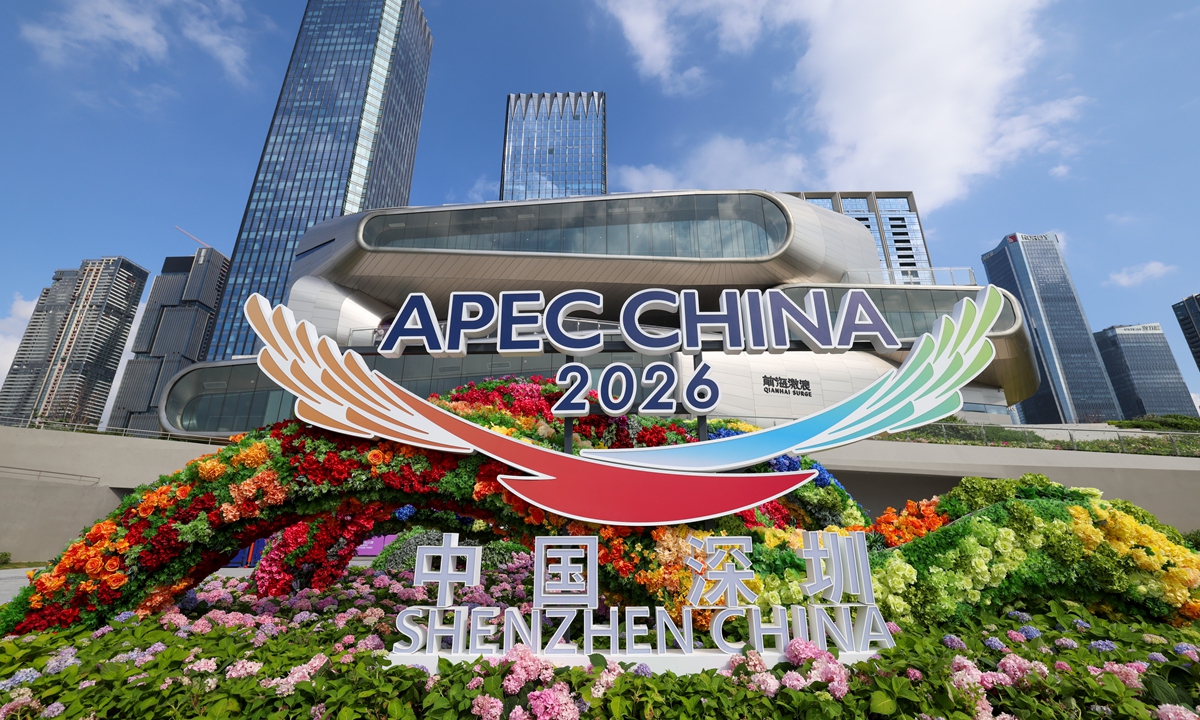
The APEC "China Year" logo decoration is seen at Qianhai Stone Park in Shenzhen. China will hold the 33rd APEC Economic Leaders' Meeting in Shenzhen from November 18 to 19, 2026. Photo: Xinhua
Chinese President Xi Jinping on Wednesday delivered a keynote speech titled "Forging Ahead with Resolve, Toward a Bright Future for the Asia-Pacific" at the APEC CEO Summit 2026 in Shenzhen, South China's Guangdong Province. In the speech, the Chinese leader provided an in-depth explanation of the right path for the Asia-Pacific region to navigate the profound global changes unseen in a century, and clearly outlined the vast opportunities for cooperation that China's 15th Five-Year Plan will bring to the Asia-Pacific and the world. The address drew an enthusiastic response; attendees noted that it charted a course toward shared prosperity in the Asia-Pacific and further bolstered the confidence of the region's business community in achieving mutually beneficial cooperation.
The Asia-Pacific is the most dynamic region in the global economy and a primary engine of growth, as well as a hub for innovation and openness. At present, the international landscape is fraught with turbulence and complexity; global economic growth lacks sufficient momentum, while unilateralism and protectionism are on the rise.
Meanwhile, global trade has demonstrated resilience despite these headwinds, and breakthroughs in emerging technologies - such as artificial intelligence and green, low-carbon solutions - are accelerating, profoundly reshaping the global division of labor and the landscape of world development. What has happened to the world, and what path should the Asia-Pacific take? Should we choose openness or closure, cooperation or fragmentation, change or stagnation? The eyes of the world are turned toward the Asia-Pacific, and the region's expectations are focused on China.
China has put forward four proposals for building an Asia-Pacific community and fostering shared prosperity in the region: uphold peace and stability, build bridges of opening up and cooperation, boost innovation to drive growth, and expand our ways for mutual benefits and win-win outcomes.
These four proposals represent the "right choice" for the Asia-Pacific as it navigates a period of profound changes unseen in a century. They are grounded in the practical needs of the region's current stage of development while aligning with the long-term trajectory of global economic transformation, effectively charting a clear, reliable course for all parties in the Asia-Pacific to follow amid turbulent times.
Within this substantial agenda, the opening-up dividends unleashed by China's 15th Five-Year Plan present a significant opportunity that has captured the attention of the Asia-Pacific region and the world at large. China is the world's second-largest consumer market and home to the world's largest middle-income group. Ranging from the semi-conductor, the new-energy vehicle sector and biomedicine to the broad expansion of emerging fields such as smart home technology, the silver economy and winter sports tourism, the comprehensive expansion of China's high-tech and high-value-added sectors creates brand-new opportunities for high-quality goods and services from economies across the Asia-Pacific.
Through measures such as the steady reduction of tariffs, the expansion of market access, and ongoing, in-depth exploration of "institutional opening-up" - encompassing rules, regulations, management, and standards - China is fostering a more stable and predictable environment for global enterprises to invest and thrive. Regardless of how the international landscape may shift, China's commitment to mutually beneficial cooperation with the world remains steadfast.
The Shenzhen initiative of the APEC CEO Summit 2026, released during the summit, marks the first time in the 30-year history of the APEC CEO Summit that an outcome document has been issued in the form of an initiative. From deepening an open regional economy to driving inclusive growth through technological innovation, and from streamlining the arteries of regional integration to working together toward shared prosperity - these four priority areas outline the collective aspirations of the Asia-Pacific business community for regional cooperation, while offering a fresh approach to collaboration amidst a complex and ever-changing international economic landscape.
The world is focused on Shenzhen, where a series of significant meetings are unfolding, and long-gestating cooperative concepts are being transformed into actionable, implementable plans. Inside and outside the venue, political and business leaders from the Asia-Pacific region and beyond are gathering to discuss pressing issues - such as connectivity, artificial intelligence, sustainable development, the construction of the Free Trade Area of the Asia-Pacific, and the digital economy - sharing their perspectives and proposing concrete, practical solutions. Many corporate representatives arrived with carefully prepared lists of potential collaborations, utilizing even their coffee breaks for multiple rounds of engagement to swiftly identify new partnership opportunities. Standing at a new starting point for Asia-Pacific cooperation, the coastal city of Shenzhen is fully leveraging its role as a pivotal platform for fostering consensus and pooling collective strength.
APEC emerged alongside the wave of economic globalization, propelling the Asia-Pacific region to the forefront of the times. Every step forward in Asia-Pacific cooperation has been driven by a firm commitment from all parties to work together side by side. The consensus reached today in Shenzhen marks a fresh departure point for the Asia-Pacific region to navigate through storms and challenges together. As the proposals put forward and the commitments made during this meeting are translated into concrete action, the vision and blueprint for an Asia-Pacific community will gradually become a reality of common prosperity, infusing a vital sense of certainty into an otherwise turbulent and unsettled world.
RELATED ARTICLES