Xiamen could show 'gold standard' in ocean governance as BBNJ secretariat host: Singaporean scientist
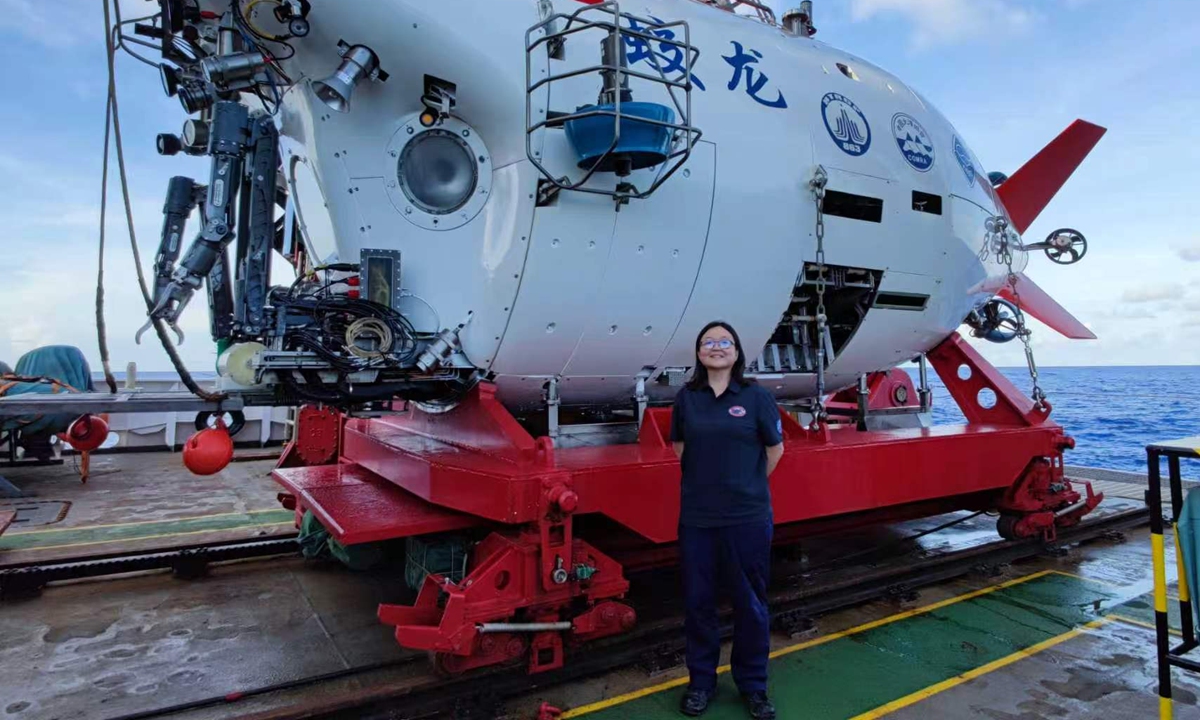
Marine scientist Chuar Cheah Hoay of the National University of Singapore stands beside China's Jiaolong submersible. Photo: Courtesy of Chuar
Editor's Note:When marine scientist Chuar Cheah Hoay (Chuar) of the National University of Singapore descended into the deep sea aboard China's Jiaolong submersible, she was doing more than exploring the ocean floor - she was experiencing firsthand the power of international scientific collaboration. In an exclusive interview with Global Times (GT) reporter Zhang Ao, Chuar recalls the amazement of coming face to face with deep-sea sponges and corals, explains why China's open-access research expeditions offer invaluable opportunities for scientists from countries without their own deep-sea facilities and shares her vision for Xiamen as a potential "gold standard" in ocean governance if it wins the bid to host the Biodiversity Beyond National Jurisdiction (BBNJ) Secretariat.
GT: In August 2024, you dove to the seafloor of the Western Pacific aboard the Jiaolong submersible, where you observed deep-sea sponge communities and coral reefs in person. You once noted that this experience was far more striking than reading books or watching documentaries. Could you share more about your impressions of the dive? As a marine scientist, how has taking part in this Chinese-organized oceanographic expedition shaped your research?
Chuar: "Jiaolong" was a name I had heard and read about many times, since it was China's first deep-sea manned submersible. Seeing deep-sea animals through the submersible viewport is a completely different experience from watching them on a screen; everything feels much more real. I was also impressed by the pilot. He was very skilled at operating the submersible, and he also has great knowledge of the fauna in the region.
This was my first human-occupied-vehicle-based deep-sea expedition, so I learnt a lot, not only about the fauna, but the overall operation, including how different pieces of sampling equipment were deployed and coordinated during the cruise. Thanks to the cruise organisers, I was able to bring some of the collected materials back to Singapore for further study. The materials partly contributed to a publication co-authored with Dr Zhang Dongsheng from the Second Institute of Oceanography, so it was a very fruitful trip.
I hope there will be more opportunities for international expeditions and research collaborations like this with Chinese colleagues. The deep sea is vast and still largely unexplored, and working together allows us to share expertise and knowledge, as well as forge friendships and encourage collaborations.
GT: In recent years, China has kept opening ocean research cruises, granting foreign scientists access to deep-submergence platforms such as the Jiaolong, and launching global big-science initiatives including the Digital DEPTH project. As a scientist who has taken part firsthand, how do you assess this open, shared model?
Chuar: I think it's a very generous initiative, and a really valuable form of capacity building. For most marine researchers, getting the chance to sample the deep sea with a manned submersible is rare. These vehicles are expensive to run, and spaces are limited. Therefore, opening them up to foreign scientists makes a real difference, especially for those from countries without their own deep-sea facilities.
As for what makes it stand out, I would say it's the scale and openness of the access. I really appreciated the effort to invite scientists from different countries and give everyone hands-on involvement, from taking part in the dives to bringing the samples home for further study.
GT: Singapore and China enjoy in-depth cooperation on marine affairs. The two sides have carried out extensive collaboration across marine conservation, ocean exploration and high-seas fisheries. In your view, what role has China played in this partnership?
Chuar: I can only speak from my own experience. When I joined the Digital DEPTH expedition, the Chinese team was very generous and supportive, both in sharing their research experience and in allowing me to bring samples back to Singapore for further study. I think collaborations like this show how countries of different sizes can work well together when there's mutual respect and a shared interest in understanding and protecting the ocean.
GT: In global ocean governance, what unique strengths or resources does China possess that other nations would find hard to replicate?
Chuar: From the science point of view, what stands out to me is the scale of China's research capacity and long-term commitment, as exemplified by the large number of research vessels and deep-sea vehicles, and a large, growing community of marine scientists.
GT: China has rolled out a suite of concrete initiatives in recent years to advance global ocean governance: bidding to host the BBNJ Secretariat, advocating for marine protected areas in Antarctica and strengthening cooperation with island nations amid rising global temperatures, among other efforts. How do you view these initiatives? What do they mean for the landscape of global ocean governance?
Chuar: I view these initiatives positively. While no country can solve the global ocean issues alone, I don't think there's ever "too much" involvement when it comes to protecting the ocean.
It's encouraging to see a major country like China taking an active role. When a big player commits to these efforts, it can motivate other countries to join in.
GT: Xiamen, China, is now bidding to host the BBNJ Secretariat. Do you think Xiamen is a suitable host? If the Secretariat is eventually based in Xiamen, how would that help deepen global ocean governance and marine cooperation?
Chuar: Xiamen is a beautiful coastal city, and I am happy to learn that the city is bidding to host the secretariat. If the secretariat does come to Xiamen, I hope it will lead by example and show a "gold standard" in ocean governance. That would naturally build trust and strengthen international cooperation on protecting biodiversity in the high seas.
GT: Looking ahead, in which areas do you believe China can make greater contributions to global ocean governance?
Chuar: As a marine biologist, I can only really speak from the science side, but I think that's where China can contribute a lot. Good ocean governance depends on good science, and there's still so much we don't know about the deep sea. China already has experienced scientists, excellent research vessels and submersibles, so it's well placed to engage international scientists, especially from countries without deep-sea research capacity.
RELATED ARTICLES