China-Russia-US summit is unprecedented and makes history: Global Times editorial
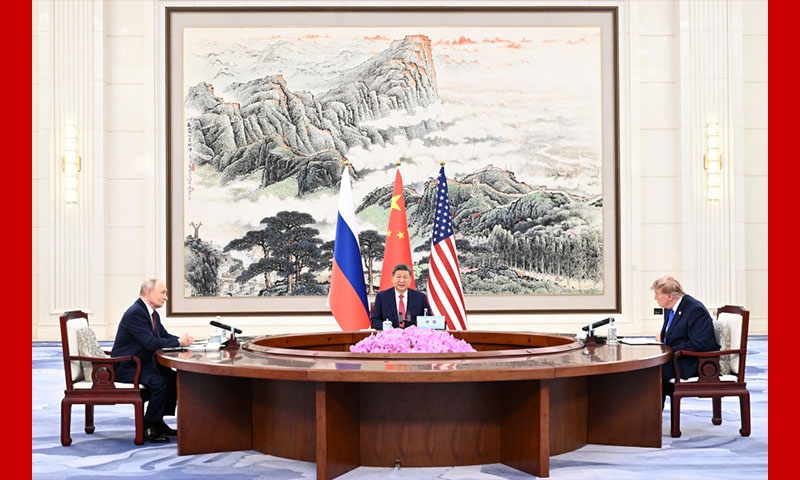
Photo: Xinhua
China, Russia and the US have different national conditions, but this doesn't mean confrontation is inevitable. By communicating in advance, considering issues from one another's perspectives and acting with caution on major sensitive matters involving each other's interests, particularly by refraining from crossing each other's red lines, major powers can indeed avoid the "Thucydides Trap."
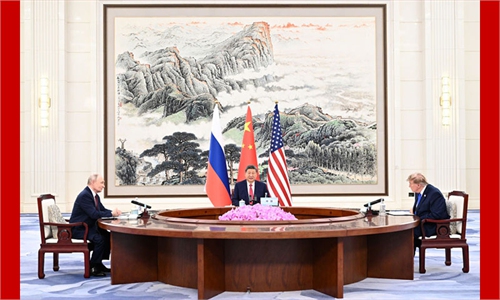
Chinese President Xi Jinping on Thursday afternoon held a China-Russia-US summit with Russian President Vladimir Putin and US President Donald Trump in Shenzhen, South China's Guangdong Province. President Xi made four points on how major countries could find the right way to get along and jointly underpin world peace: Major countries should uphold mutual respect, uphold peaceful coexistence, uphold win-win cooperation, and uphold dialogue and consultation. The four "upholds" outline a clear path and set of rules for building a new model of major-country relations, and provide important guidance for China, Russia, and the US to strengthen strategic communication and practical cooperation and jointly safeguard world peace.
The core agenda of this summit centers on two key dimensions: safeguarding world peace and promoting strategic stability in major-country relations. These issues not only determine the future trajectory of major-country relations but are also inextricably linked to the vital development interests of nations across the globe. Looking back at the evolution of the international order, humanity has taken many wrong turns in the management of major-country relations.
Since modern times, the rise of many emerging powers has been accompanied by intense geopolitical conflicts; the harrowing lessons of the two world wars, for instance, were rooted in zero-sum games played by major powers. Peace among major countries brings stability to the world, while their contention would only lead to chaos. Forging a new, right path for major countries to get along serves the interests of the three nations and aligns with the expectations of the international community.
Can major countries move beyond the narrative of competition and achieve constructive interactions? This is a question that China, Russia and the US must answer. Historically, as the principal victors of the anti-fascist alliance in World War II, the three countries fought side by side to defeat militarism and fascism, laying the foundations for the postwar international order underpinned by the United Nations Charter.
Firmly upholding the postwar international order, safeguarding the purposes and principles of the UN Charter, and defending the hard-won achievements of victory in World War II are both a historical responsibility shared by the three countries as victors and a common commitment to all peace-loving nations around the world. As major countries of the world and permanent members of the UN Security Council, China, Russia and the US should, and can, set an example by working together to address global challenges, jointly safeguarding world peace and stability.
In today's world, the overarching trends of economic globalization and global multipolarity are irreversible, but they are also facing enormous challenges. Against the backdrop of frequent fluctuations in international energy prices and an uneven transition from traditional energy to new-energy sources, the international community is deeply concerned about energy security, the security of shipping routes, and the security of industrial and supply chains.
Enhanced communication and coordination among China, Russia, and the US will help prevent major countries from falling into vicious competition over resources, technology, and corridors, help maintain the stability and smooth functioning of energy industrial and supply chains, and help safeguard the stability of the global energy market.
China, Russia and the US have different national conditions, but this doesn't mean confrontation is inevitable. By communicating in advance, considering issues from one another's perspectives and acting with caution on major sensitive matters involving each other's interests, particularly by refraining from crossing each other's red lines, major powers can indeed avoid the "Thucydides Trap."
The Taiwan question lies at the very core of China's core interests and constitutes the first red line that must not be crossed by any country seeking to develop relations with China. For a long time, the reason "Taiwan independence" separatist forces have repeatedly dared to test the limits of danger is precisely that they have clung to the illusion of exploiting tensions among major countries, attempting to profit from their rivalries. The leaders of China, Russia and the US share common views on safeguarding world peace and have reached a series of important consensuses on maintaining strategic stability and international security. This means that the space in which "Taiwan independence" forces have imagined they could survive by exploiting divisions among major countries is steadily narrowing.
Many analysts believe that without China's sustained efforts and its role as the host, this "historic gathering" would probably have been difficult to achieve. While we will not engage in hypothetical analysis, it is undeniable that China played an important role in facilitating the meeting. This is closely linked to China's position as a responsible major country and its diplomatic philosophy of promoting a new model of major-country relations. Both the Russian and US leaders expressed appreciation to China for hosting this historic meeting. The meeting represents not only an important milestone in the history of international relations, but also a landmark event in major-country diplomacy with Chinese characteristics.
The China-Russia-US Heads of State Declaration toward Peace released after the summit represents a joint solution of peace provided by the three countries based on both current and future situations. Its provisions on reforming the United Nations, reaffirming the importance of stable energy flows, and emphasizing that a nuclear war cannot be won and must never be fought largely echo the four points made by the Chinese side on how major countries should get along with each other. Certainly, a single meeting cannot resolve every problem. But as long as countries uphold mutual respect, peaceful coexistence, mutually beneficial cooperation, and dialogue and consultation, a way forward can always be found.
The China-Russia-US summit in Shenzhen can be seen as a starting point, opening up new possibilities for constructive interactions among major countries and for exploring the right way for them to get along. It also represents an important attempt by major countries to jointly explore constructing a new type of major-country relations in an era of multipolarity. The seeds sown by the meeting of the three heads of state will surely take root, sprout, bloom, and bear fruit.
RELATED ARTICLES