Looking forward to Asia-Pacific cooperation soaring high and far on a boundless journey: Global Times editorial

This photo taken on November 16, 2026 shows a view of Shenzhen, South China's Guangdong Province with APEC elements. China will hold the 33rd APEC Economic Leaders' Meeting in Shenzhen from November 18 to 19. Photo: VCG
The historic gathering of APEC members in Shenzhen will become a new starting point for their joint efforts to build an Asia-Pacific community. From here, the vision of Asia-Pacific cooperation will take flight, transforming the collective strength forged within the conference halls into sustained momentum for regional cooperation in the years ahead.
"China is an advocate, promoter and forerunner of Asia-Pacific economic cooperation. We would like to work with all parties to pool wisdom and synergy in building the four key pillars of an Asia-Pacific community." Chinese President Xi Jinping on Thursday chaired the 33rd APEC Economic Leaders' Meeting in Shenzhen, South China's Guangdong Province, and delivered important remarks titled "Building an Asia-Pacific Community and Writing a New Chapter of the Asia-Pacific Miracle."
Focusing on new opportunities and challenges facing the Asia-Pacific region and the world, the Chinese leader, for the first time in the history of APEC, systematically expounded China's proposition on what kind of Asia-Pacific community to build and how to build it, and reaffirmed China's steadfast commitment to supporting Asia-Pacific cooperation, while demonstrating a great sense of responsibility and a global vision in leading and promoting cooperation both within the Asia-Pacific and across the globe.
More than three decades ago, APEC was born as the times required, embarking on a grand journey toward building an Asia-Pacific community. Over the past 30-plus years, the Asia-Pacific region has undergone profound transformations, creating an "Asia-Pacific miracle" of rapid economic growth. Today, the region has become an anchor of stability for global development.
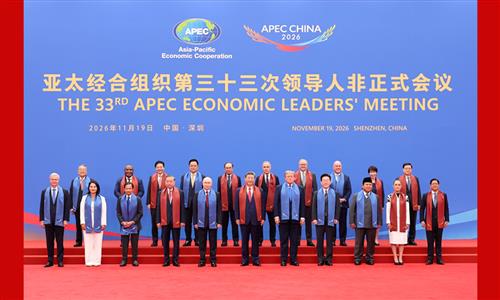
Whether the Asia-Pacific can continue to write this success story concerns not only the general well-being of the economies within the region but also the broader landscape of world peace and development. Faced with this pressing question of the times, the leaders and representatives of 21 economies convened in Shenzhen to chart the course for the future of Asia-Pacific cooperation. This marks the first time in recent years that a full "family photo" of APEC members has been realized, a clear testament to the shared aspiration of all parties for mutually beneficial cooperation.
The Chinese side proposed that, in the face of new opportunities and challenges, Asia-Pacific cooperation must adapt to the new realities, take new strides, and open up new prospects and strive to build an Asia-Pacific community characterized by solidarity and mutual assistance, openness and integration, enterprise and innovation, as well as inclusive development. As an advocate, promoter and forerunner of Asia-Pacific economic cooperation, China is willing to work with all parties to pool wisdom and synergy in strengthening the pillar of economy and trade, upgrading the pillar of connectivity, fostering the pillar of innovation and enhancing the pillar of development.
The economy and trade pillar serves as the bedrock and the essential foundation for Asia-Pacific cooperation. The connectivity pillar is a vital support, having effectively underpinned nearly half of the region's cooperative endeavors over the past 12 years. The innovation pillar serves as the primary engine for growth, driving the digital, intelligent, and green transformation of the Asia-Pacific region. The development pillar embodies a people-centered value orientation and offers the key to resolving complex challenges inherent in globalization and regional economic integration. These four pillars complement and reinforce one another, collectively supporting the edifice of an Asia-Pacific community.
The Asia-Pacific is where China has its roots and where its future lies. To support Asia-Pacific cooperation, China has introduced a series of concrete supporting measures: providing funding to support APEC practical cooperation, establishing a Center for Asia-Pacific Community Studies, and setting up cooperation institutions in areas such as digital technology, cross-border data flows, clean energy, and the development of small and medium-sized enterprises.
These initiatives impose no exclusionary barriers. Instead, they focus on building platforms, establishing mechanisms, and promoting shared benefits, ensuring that the outcomes of cooperation are visible, tangible, and accessible. China will continue to honor its commitments through concrete actions, working with all parties to ensure that cooperation projects take root and bear fruit. It will inject fresh momentum into the building of an Asia-Pacific community and provide tangible support for the "four pillars" through the provision of more practical public goods.
The meeting unanimously adopted the 2026 APEC Leaders' Declaration, which put forward the "Shenzhen Vision" for building an Asia-Pacific community, along with three outcome documents covering trade, connectivity, and innovation. As the most significant outcome of the APEC "China Year" and a new milestone in APEC cooperation, the "Shenzhen Vision" reaffirms APEC's role as the primary platform for regional economic cooperation. Guided by the principles of voluntary participation, non-binding arrangements, and consensus-building, it commits to transforming APEC into a more modern, efficient, and pragmatic incubator of ideas.
The tides of Shenzhen Bay bear witness to the powerful momentum of Asia-Pacific cooperation. APEC members are transforming their shared commitment to standing together through challenges into tangible connections spanning mountains and oceans. From the Port of Chancay opening new routes for Asia-Pacific supply chains and the Pinglu Canal strengthening land-sea links between southwestern China and Southeast Asia, to Juncao technology taking root in Pacific Island countries; from the Asia-Pacific Model E-Port Network significantly improving the efficiency of cross-border customs clearance and cross-border electricity transmission lines linking the region's clean energy resources, to APEC cooperation zones for small and medium-sized enterprises building bridges that connect countless small and micro businesses to shared markets, these concrete projects are weaving a strong connection. Through practical cooperation, the contours of an Asia-Pacific community are becoming ever clearer and more tangible.
Over the past 30-plus years, China and the Asia-Pacific have advanced together, reinforcing each other's development and achieving shared prosperity through openness. Today, as a new chapter begins, China's high-standard opening-up and high-quality development will bring fresh development opportunities to the Asia-Pacific. The historic gathering of APEC members in Shenzhen will become a new starting point for their joint efforts to build an Asia-Pacific community. From here, the vision of Asia-Pacific cooperation will take flight, transforming the collective strength forged within the conference halls into sustained momentum for regional cooperation in the years ahead. Amid a rapidly changing global landscape, this momentum will provide a firm foundation for an Asia-Pacific home that belongs to all its members and is defined by shared prosperity.
RELATED ARTICLES