IN-DEPTH / IN-DEPTH
GT on the spot: From AI remixes to tea livestreams, young people bring fresh energy to ethnic unity in Yunnan
New rhythms, shared roots


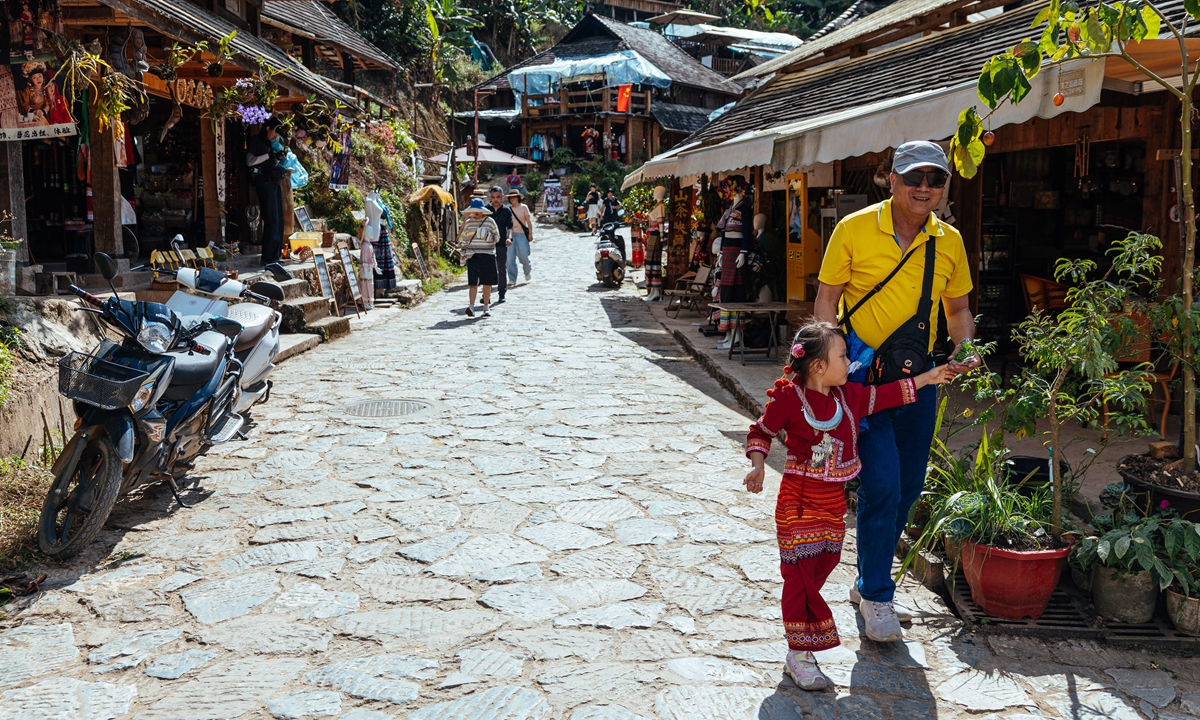
Visitors experience the relaxed pace of life in Nuogan village on Jingmai Mountain in Pu'er, Southwest China's Yunnan Province. Photo: Li Hao/Global Times
A Jingpo melody from Southwest China's Yunnan Province has found a new life on phone screens. Reworked with artificial intelligence and paired with striking dance videos, it has encouraged people far beyond its birthplace to follow the rhythm and discover the culture behind it.
On Jingmai Mountain in Pu'er, another screen connects viewers with a different tradition. Xianjin, an ethnic Dai woman born in the 2000s, uses livestreams to talk about her hometown's tea, ancient forests and village life.
During a recent reporting tour in Yunnan, Global Times reporter explored how younger generations are creating opportunities for exchange among ethnic groups, bringing fresh energy to efforts to forge a strong sense of community for the Chinese nation.
Lyrics of the soil
At Longchuan's Munao Zongge square in Dehong Dai and Jingpo Autonomous Prefecture, Yunnan, local dancers in ethnic dress and visitors form long lines, moving to the same beat. The procession brings people together in an activity they can join without being professional performers or belonging to a particular ethnic group.
The viral music has deep roots, but its present form is a recent creation. Jingpo artist Shi Legan composed the "Munao Zongge March" in 1991. Earlier this year, Beijing musician Zhen Zhen adapted that melody with new lyrics and AI-assisted arrangements and vocals.
Without A-list celebrities or professional promotional campaigns, the song "Munao Zongge" has garnered nearly 3 billion views on China's major short-video platform Douyin.
Munao Zongge, a major Jingpo celebration featuring collective dancing, was included in China's national intangible cultural heritage list in 2006. Its winding dance formations carry memories of the Jingpo people's migration, giving today's online enthusiasm a connection to a much longer history.
The name carries the idea of gathering to sing and dance. During major celebrations, participants from neighboring ethnic groups also share a meal served on banana leaves, extending the gathering from the dance ground to the dining table.
For Zhen, a video of mass dancing prompted an interest that became three weeks of work. Research changed his understanding of the music: early attempts to treat it as a love song gave way to lyrics informed by Jingpo history.
AI helped him arrange the music and produce virtual voices, but its research results sometimes conflicted. He went back to books and papers to check the information himself.
"Lyrics have to grow out of the soil," Zhen said.
In Longchuan, community dance leader Song Haihe introduced that participants include locals from different ethnic groups alongside visitors from across the country.
The cultural interest also brings visitors to local businesses.
Longchuan received 42,000 domestic tourist visits during this year's National Day holiday, while overnight stays in commercial accommodation rose 11.07 percent year-on-year, according to the county's culture and tourism authorities.
For someone first drawn to the music through a short video, these regular gatherings provide a place to learn its steps alongside local people. The encounter can continue after the video ends.
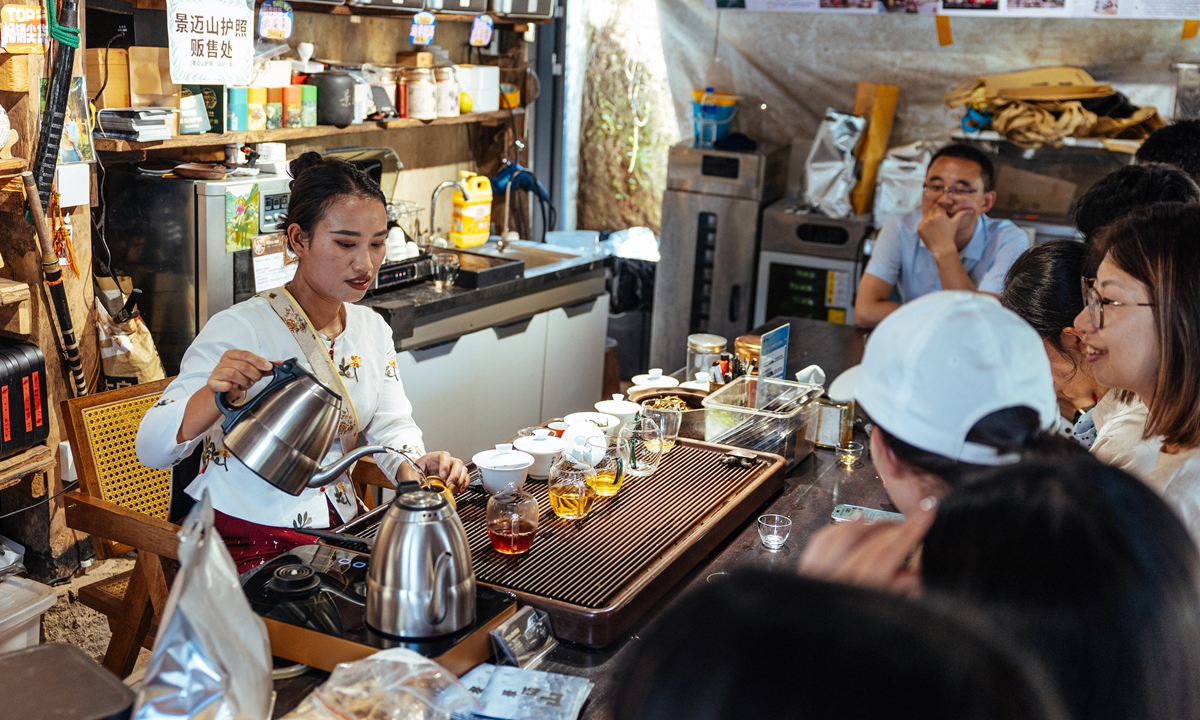
Xianjin welcomes visitors to her family's tea shop in Nuogan village. Photo: Li Hao/Global Times
Connections over tea
On Jingmai Mountain, Xianjin faces a related task: giving people who discover her hometown online a reason to understand it more closely.
An encounter at a tea exhibition in 2020 exposed a problem she would have to overcome. When she introduced tea from her hometown, a trader asked: "Where is Jingmai Mountain?" Having a distinctive product did not guarantee that buyers knew its origins. After returning home, she began livestreaming to introduce the tea and its place of origin.
Her days combine brewing tea, making tea-flavored ice cream and filming village life. She opened a tea house after seeing more visitors arrive following the mountain's World Heritage inscription in 2023.
Early in her business, she realized that selling the name "Jingmai tea" was insufficient. Her videos began showing what distinguished its place of origin: clouds over the mountain, hand-processing techniques and daily life in traditional houses.
The landscape behind those sales is itself a product of longstanding cooperation.
UNESCO describes Jingmai Mountain's tea-growing system as having developed over more than a thousand years through the practices of the Blang and Dai peoples. Tea grows beneath a forest canopy, within a landscape of villages, groves and protective forests.
Local authorities told the Global Times that the inscribed heritage area includes five old tea forests, nine traditional villages and three protective partition forests. Protecting the trees also means maintaining the communities and knowledge that have sustained them.
During the reporting tour, Xianjin pointed to renovated old houses and explained that residents of different ethnic groups had worked to preserve them. The forests and village buildings were a shared inheritance.
Jingmai village official Yan Sailuan described cooperation that extends from celebrations to farm work. People gather in one another's villages for festivals, contribute labor and organize long-table banquets; during tea picking and other agricultural work, neighbors help one another.
Skills circulate through the same relationships. In Wengji village, tea-processing heritage practitioner Sanwen teaches learners from different villages and ethnic groups. His workshop has also become a place where visitors can experience traditional tea making.
The opportunities extend beyond individual businesses.
Jingmai Mountain received 694,300 tourist visits in 2025, with culture and tourism revenue reaching 563 million yuan ($84.45 million).
Residents have converted traditional homes into tea shops, restaurants and guesthouses, retaining the buildings' distinctive appearance while finding new uses for them.
The younger generation is adding new partners to these networks. Xia Haoling, who previously worked in branding and new media in Shanghai, settled on Jingmai Mountain and established the Zhishan brand, developing scented sachets and incense inspired by local plants and Blang culture.
The growing business has changed everyday logistics, too. Previously, tea sold online had to be packed late into the night and taken down to the township for dispatch the next morning. Couriers now come up to the village regularly to collect parcels.
For Xianjin, the ancient forests remain the starting point of these new ventures.
"These roots belong to all of us, whichever ethnic group we come from," she said.
RELATED ARTICLES