China-Russia-US summit ‘landmark diplomatic event to go down in history’
Summit lays peace foundation; sustained global effort needed to deliver results: experts
By and Li Yu Published: Nov 21, 2026 12:28 AM

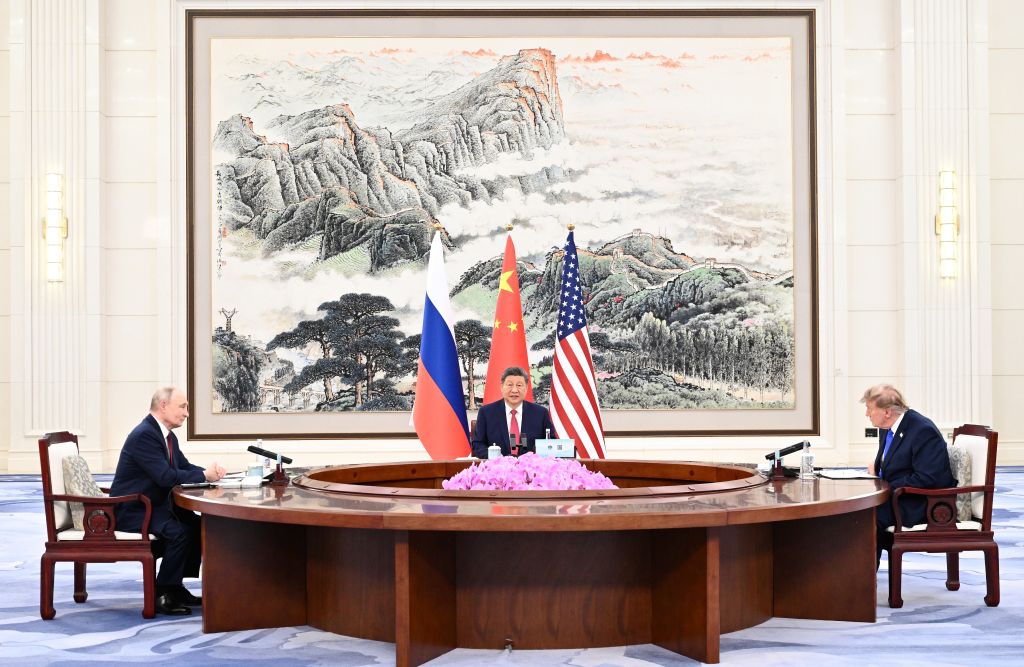
Chinese President Xi Jinping holds a China-Russia-U.S. summit with Russian President Vladimir Putin and U.S. President Donald Trump in Shenzhen, south China's Guangdong Province, Nov. 19, 2026. (Photo: Xinhua)
The historic first face-to-face meeting between the leaders of China, Russia and the US continued to draw attention on Friday, one day after the three countries released a peace declaration in Shenzhen.
International media across Europe, the US and the Middle East are discussing the impact of the meeting and closely watching the three major countries' next steps, especially on stabilizing their relations and sustaining the momentum, de-escalating regional and global conflicts and maintaining global strategic stability. Chinese analysts noted the landmark gathering has charted new course for major-country diplomacy, with its joint declaration integrating strategic vision and practical measures to tackle pressing global issues of common concern.
They noted that the meeting planted a seed for world peace. Meaningful dialogue and consultation among major countries create a realistic prospect that they can jointly underpin global peace. Still, for that seed to grow into a towering tree capable of sheltering global security, sustained and collective nurturing will be required from the three nations and the wider international community.
Peace summit
The meeting between Chinese President Xi Jinping, Russian President Vladimir Putin and US President Donald Trump reached important consensus. The China-Russia-US Heads of State Declaration toward Peace issued after the meeting is instrumental to addressing global challenges and maintaining world peace and stability, Chinese Foreign Minister Wang Yi, also a member of the Political Bureau of the Communist Party of China Central Committee, said on Thursday. "You could certainly call it a peace summit."
Wang also called the face-to-face meeting — the first of its kind between the three heads of state — a landmark diplomatic event that will go down in history, and is of great significance with a far-reaching impact. He added that the meeting showed "a strong sense of major country responsibility."
It created a paradigm for interaction between major countries in the new era, and represented a new step in building a new type of major-country relations. It was indeed a major pioneering move in the history of international relations, Wang said. "This is not only good for the three countries, but also benefits the whole world," Wang said.
Both the Russian and US presidents offered positive assessments of the talks.
Russian President Vladimir Putin believes that the trilateral meeting in Shenzhen will go down in diplomatic history. "First of all, when it comes to history and historical importance: no such meetings had taken place before, and now it has happened. This is undoubtedly a page in diplomatic history," Putin said, according to TASS.
"Heading back to Washington, D.C., from China. It was a Great and Highly Consequential Trip," Trump posted on his social media platform while en route home. In an interview with NBC News, Trump gave high praise to the trilateral meeting. "I think it was a 12. On a scale of zero to 10, I think it was a 12."
This trilateral meeting is groundbreaking across multiple dimensions: major-country interaction models, approaches to international relations, global governance practices, and frameworks for managing global crises, said Diao Daming, a professor from Renmin University of China.
"This dialogue has charted a clear path for fostering a new type of major-country relationship and demonstrated and validated that the prospect of such a relationship aligns with the universal expectations of the international community," Diao said.
The declaration stands as one of the key outcomes of this trilateral meeting of the leaders of China, Russia and the US. It embodies "a high degree of consensus in terms of top-level design and practical action." The document sets clear directions for major-country interactions as well as the evolution of the international landscape and international order, while offering concrete and effective responses to concerns arising from current major-country dynamics.
"It contains guiding frameworks for the long term and puts forward mutually acceptable solutions to issues of shared concern to the three nations and the world. That means the declaration functions both as a forward-looking long-term blueprint and a response to pressing hotspot issues of the moment," he added.
The declaration calls for UN reform to address global challenges, expanded production and supply of refined petroleum products to shore up energy stability, recognition of the principle of state consent and respect for immunities of state officials, and mentions dialogue on nuclear risk reduction and non-proliferation.
He Weiwen, a senior fellow at the Center for China and Globalization, told the Global Times that the first point has broad implications because it reaffirms the UN's mandate to maintain international peace and security. Amid continued concern over the possible use of nuclear weapons, the three countries reaffirmed that "a nuclear war cannot be won and must never be fought" and agreed to discuss ways to reduce nuclear risks and prevent proliferation.
China has long championed nuclear non-proliferation, and trilateral dialogue can help strengthen global nuclear security, said He.
Jin Canrong, another international relations professor at Renmin University of China, stressed that these commitments reinforce the post-WWII international order. "The simple fact that leaders of the three major countries sat down together and agreed on shared principles is itself a step toward greater strategic stability and world peace," he said.
Wide attention
Many outlets provided live updates on the meeting and highlighted "unprecedented" in their headlines.
The trilateral meeting between China, Russia and the US was significant. Preserving world peace, however, requires the participation of all countries, and all countries should have a voice in international affairs, said He.
The trilateral meeting represents a new way for major powers to consult as equals on global governance under the principles of the UN Charter. It marks "a historic innovation in major-power relations in the new era" and underscores the responsibility major powers bear for safeguarding world peace and advancing global governance, said He.
"Judging the meeting in zero-sum terms, by who won and who lost, misses its purpose," said the expert.
In response to a question on how the consensus reached at the meeting will be followed up, and how China views its own role on Thursday, Chinese Foreign Minister Wang Yi stated that China will work with Russia and the US to fully and efficiently implement the consensus of the trilateral meeting, maintain communication and coordination at the working level, and make unremitting efforts toward building a better world.
Diao said the Shenzhen meeting had planted a seed for world peace by showing how major countries can work together through dialogue to safeguard global security. For that seed to take root and grow, he added, the three countries and the broader international community would need to nurture it together.
"This process demands joint efforts from the whole world, including major countries, which play the most pivotal role," Diao said.
RELATED ARTICLES