The world is talking about Shenzhen – what are they talking about?: Global Times editorial
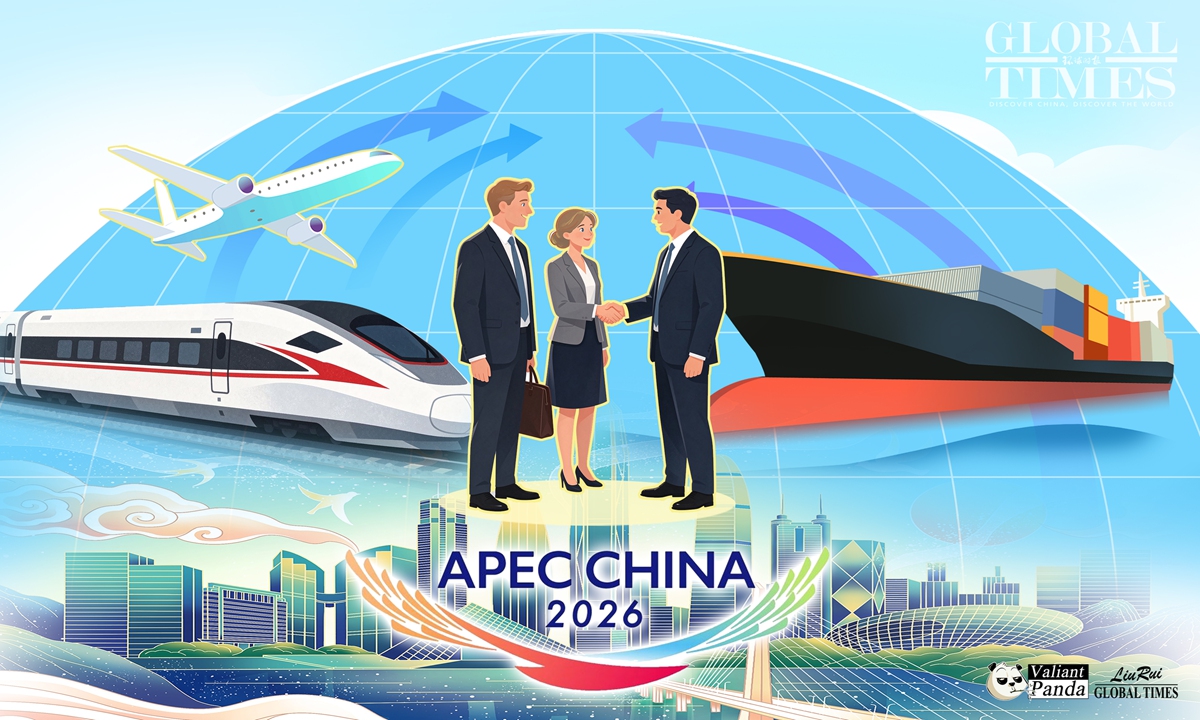
APEC China 2026. Illustration: Liu Rui/GT
Viewed from the world's perspective, Western developed countries are not only observing where China is headed but also reflecting on what they may have missed. Developing nations are examining what kinds of urban lifestyles and industrial development can become a reality, and whether the path to industrialization must necessarily follow the old path of "polluting first, then cleaning up." Shenzhen is not the sole answer to the future, yet it proves there is more than one path forward.Over the past week, Shenzhen has undoubtedly stood at the center of the world's spotlight. In media reports from around the globe - ranging from its densely packed skyscrapers to self-driving taxis on the streets - Shenzhen has been portrayed as a "futuristic city."
Canadian Prime Minister Mark Carney praised Shenzhen, saying, "The future is designed here, tested here and built here." US President Donald Trump noted that Shenzhen is "clean" and "immaculate," adding that, in contrast, the development and governance of some US cities are "embarrassing." Peruvian President Keiko Fujimori stated that "there is no doubt that we can learn from Shenzhen" in its approach to smart and digital urban governance.
On overseas social media platforms, "Shenzhen" continues to dominate the feed. One netizen wrote, "This might be the most futuristic city I've ever visited in my life," while another added, "I wish my country could have a Shenzhen too."
Why has a once remote fishing village attracted so much attention? When the world talks about Shenzhen, what exactly are they talking about? Perhaps the answer lies in one word: future.
Seen from within China, Shenzhen embodies the concrete form of Chinese modernization, offering a vivid interpretation of the idea that "the next 'China' is still China." When the Special Economic Zone was established in 1980, Shenzhen's population was less than 30,000. Now, it has developed into a modern international metropolis and "super hub" with a population of over 18 million.
Today, people here see self-driving cars cruising the streets, drone deliveries becoming part of daily life, robots operating in factories and shopping malls, and companies like Huawei, BYD, DJI, and Tencent making their mark on the global market. Behind these achievements lie China's sustained investment and stable planning - rooted in its own development and oriented toward the future - and, ultimately, a people-centered approach to development.
Viewed from the world's perspective, Western developed countries are not only observing where China is headed but also reflecting on what they may have missed.
A key reason why Trump's assessment of Shenzhen's roads and urban environment sparked debate in US public opinion is that it touched on the long-standing challenges of urban governance facing American society.
Road maintenance, public transportation, and environmental sanitation - these seemingly ordinary public services are, in fact, persistent challenges that many countries struggle to address.
Developing nations, meanwhile, are examining what kinds of urban lifestyles and industrial development can become a reality, and whether the path to industrialization must necessarily follow the old path of "polluting first, then cleaning up." Whether developed or developing, countries are beginning to consider whether they should pursue this kind of future.
Shenzhen is not the sole answer to the future, yet it proves that there is more than one path forward. Different countries have different historical traditions, cultural practices, resource endowments, and social systems; there can be no single "standard answer" for urban modernization. Nor is Shenzhen's path a template that can be simply replicated. Its significance lies in demonstrating that openness can spur innovation, industry can foster technology, technology can improve lives, and global cooperation can expand the scope for development.
Chilean President Jose Antonio Kast remarked, "Shenzhen's transformation reminds us that progress is not a miracle but a resolution." Australian Prime Minister Anthony Albanese, drawing on his experiences from visits in 1998 and 2026, remarked that if someone were to place photographs from then and now side by side, it was almost impossible to believe they were of the same place. This demonstrates that the future can be continuously shaped through reform, opening-up, and relentless exploration.
What the world needs is not a replica of Shenzhen, but more cities like Shenzhen that can shape their own futures. Today, Shenzhen has evolved from a place where the Chinese people learned about the world through the "window of the world" to a place where the world observes China and envisions the future.
In just over 40 years, Shenzhen has traversed a journey that took some major international metropolises abroad more than a century to complete, proving that modernization does not follow a single predetermined path. A late-developing economy can fully forge its own path - one that balances efficiency with people's livelihoods, and vitality with order. This demonstrates that the "future" is not merely a fixed blueprint. Every country and every civilization can draw upon its own historical traditions, social structures, and resource endowments to find a "future blueprint" that suits it best.
British urban planning scholar Peter Hall once wrote Cities of Tomorrow, which traces urban planning practices from the late 19th century to the late 20th century - a work in which London, New York, Paris, and Chicago frequently feature. Today, one "city of tomorrow" after another is emerging across China.
We welcome more countries, enterprises, research institutions, and innovators to come to Shenzhen. Rather than merely viewing a single "pre-existing model," we can strive to build more models and explore abundant future forms of AI, green development, urban governance, public services, and industrial cooperation.
Shenzhen's story is far from finished, and the exploration of Chinese modernization is still underway. The invitation Shenzhen extends to the world is this: China is willing to showcase its own future, and welcomes the world to bring its own dreams here to jointly create even more bright futures.
RELATED ARTICLES