Jensen Huang’s dramatic reinstatement: Will there be ‘Jensen Li’ or ‘Jensen Zhang’?
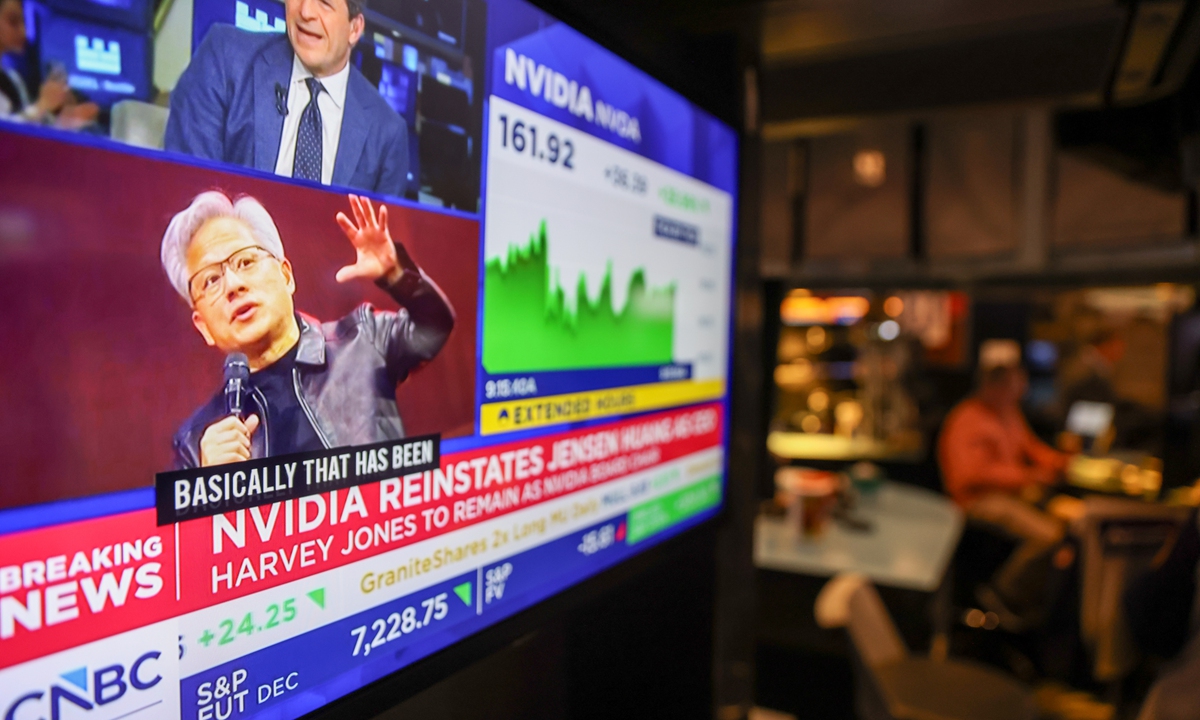
A television broadcasts Nvidia news on the floor of the New York Stock Exchange (NYSE) in the US on November 23, 2026. An overnight bounce in stocks erupted into a surge after Nvidia's reinstatement of Jensen Huang as chief executive officer recharged artificial-intelligence bets. Photo: VCG
On November 23, Nvidia announced that the company's board of directors had unanimously voted to reinstate Jensen Huang to his positions as President, CEO, and a member of the board, effective immediately. The announcement stated that the board received input from senior levels of the US government and, based on that input, determined that Huang's reinstatement poses no national security risk. Thus, this farce - first instigated by US media and rife with gossip, conspiracy theories, and Hollywood-style drama - has taken yet another dramatic turn.
The statement that "Jensen Huang's reinstatement poses no national security risk" is clearly a conclusion regarding the earlier allegations that he had been "infiltrated by Chinese spies." As two of the most active media players shaping the narrative around this episode, the Wall Street Journal ran a muted report after Huang's reinstatement, while the New York Times framed his comeback as entirely down to "Trump's backing." Both outlets must be displeased with how things turned out.
Ever since the Jensen Huang farce broke, the US public discourse has been rife with sensationalism. The behavior of certain politicians and media outlets has less to do with genuine "concern" for Jensen Huang's personal affairs or Nvidia's corporate governance than with wildcats that have caught the scent of blood and are eager to pounce. By exploiting the situation to cast aspersions on "Chinese infiltration," they have had a negative impact on American society's perception of China. It is foreseeable that the malicious attempts to sow discord in China-US relations will not automatically disappear simply because Huang has been reinstated. Their greed and prejudice remain lurking beneath the surface of American politics and public discourse, ready to resurface at any moment in the next "Jensen Li" or "Jensen Zhang" incident.
The next round of "witch hunts" may not appear in the form of "spies," but it could lurk in various hidden corners: investigation letters, delays in export licenses, congressional hearings, and baseless "exposés" in the media... They do not need to be ultimately confirmed; they only need to create enough uncertainty at critical junctures to make companies self-censor and self-restrict when making decisions. This uncertainty is, in itself, a double-edged sword that can harm both others and oneself.
The dramatic turn in Jensen Huang's fate is a matter for the US itself. However, when a messy farce can quickly be linked to the "China threat," the warning is already strong enough. It reminds us that the specter of profiting from anti-China narratives still wanders through American society. We must remain vigilant.
RELATED ARTICLES