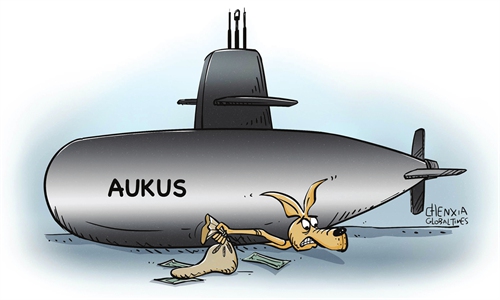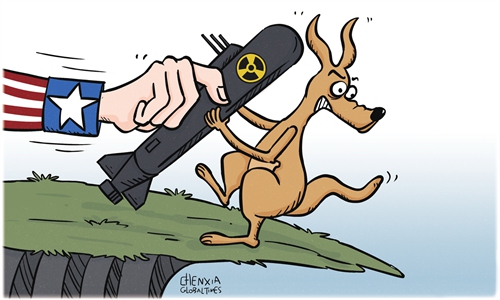
AUKUS Illustration: Chen Xia/Global Times
A recent report by the US Congressional Budget Office (CBO) warned that selling nuclear-powered submarines to Australia would put sustained pressure on the size of the US Navy's attack submarine fleet for years to come. Yet Australian Deputy Prime Minister and Defense Minister Richard Marles was quick to push back, insisting that US submarine production capacity is increasing and that AUKUS is "very much happening." While Americans are worried that they do not have enough submarines for themselves, Australians are assuring them that they can certainly build enough. Canberra's confidence in AUKUS no longer seems to depend on what shipyards can actually produce.
The CBO figures make for uncomfortable reading. The US currently builds only about 1.13 Virginia-class submarines a year, far short of the two needed to meet its own requirements, let alone the 2.33 needed to also supply Australia. Construction now takes 10 to 11 years, up from five or six. More tellingly, the US Navy's latest shipbuilding plan does not even account for submarine transfers to Australia. Canberra's much-touted generational defense project is nowhere to be found in Washington's own planning. This is no minor delay, but clear evidence that US interests come first and Australia's needs take a back seat.
The absurdity of this deal is that Australia must put up real money, while the US has left itself a way out of its delivery commitments. The buyer is paying to expand the seller's production capacity, while the seller retains the final say over whether the goods will be delivered. This is not equal military cooperation. It is Australia footing the bill to help the US resolve its defense industrial woes.
More seriously, the submarines may be a long time coming, but the military arrangements are already moving ahead. Under the plan, US and British nuclear-powered submarines will begin rotating through HMAS Stirling naval base in Western Australia from 2027. Australia is investing heavily in expanding the port, maintenance facilities and logistical support infrastructure, turning the base into a major hub for US undersea operations in the Southern Hemisphere. Australia's own nuclear-powered submarines are nowhere in sight, yet the US has already secured the convenience of using Australian territory for forward military deployments. Whose combat capabilities does AUKUS actually prioritize strengthening? The answer couldn't be clearer.
Canberra repeatedly stresses that the submarines will be under Australian command. But when their equipment, intelligence, maintenance, training, command and communications systems are all deeply integrated with those of the US, how much room will Australia really have to make independent decisions? Flying the Australian flag on a submarine does not automatically free Australia from US operational plans.
An especially important question is what threat Australia actually faces that would justify spending such vast sums on nuclear-powered attack submarines. China has never posed a credible threat of military invasion to the Australian mainland, while the two countries have extensive shared interests in economic cooperation. Nuclear-powered attack submarines are designed for long-range underwater operations and stealth missions. And AUKUS is not about ordinary coastal defense. It is about embedding Australia more deeply in the US military posture in the Western Pacific directed at China. A country that already enjoys considerable geographic strategic depth is voluntarily spending money to turn itself into a potential forward operating base in a conflict. This inversion of national security priorities is the greatest strategic absurdity of AUKUS.
After years of ups and downs, China-Australia relations have returned to a state of comprehensive stability, with trade and people-to-people exchanges regaining momentum. Yet the self-contradictory policy regarding AUKUS is forcing Australia to bear the costs of an arms race while undermining its own economic interests. The bases Australia is spending heavily to build, its long-term military spending commitments and its deepening military dependence on the US will only further constrain its strategic room for maneuver.
What AUKUS has exposed is no longer merely the risk of delayed deliveries. The arrangement is fundamentally unequal. The US wants Australian bases, funding and wartime support, while Australia gets little more than a blank check whose delivery date and conditions are determined entirely by Washington.
Rather than defending US shipbuilders, Marles should be explaining to Australian taxpayers whom this enormously expensive program is actually meant to protect. The US submarines have yet to be delivered, but Australia has already placed its military facilities, financial resources and strategic choices increasingly in Washington's hands. Such dependence is the starkest and most stinging irony of AUKUS, an agreement supposedly designed to "enhance sovereignty."
The author is director of the Asia-Pacific Studies Center at East China Normal University. opinion@globaltimes.com.cn
RELATED ARTICLES