Chinese, Pakistani astronauts achieve first-ever 'space handshake' in China’s Tiangong space station
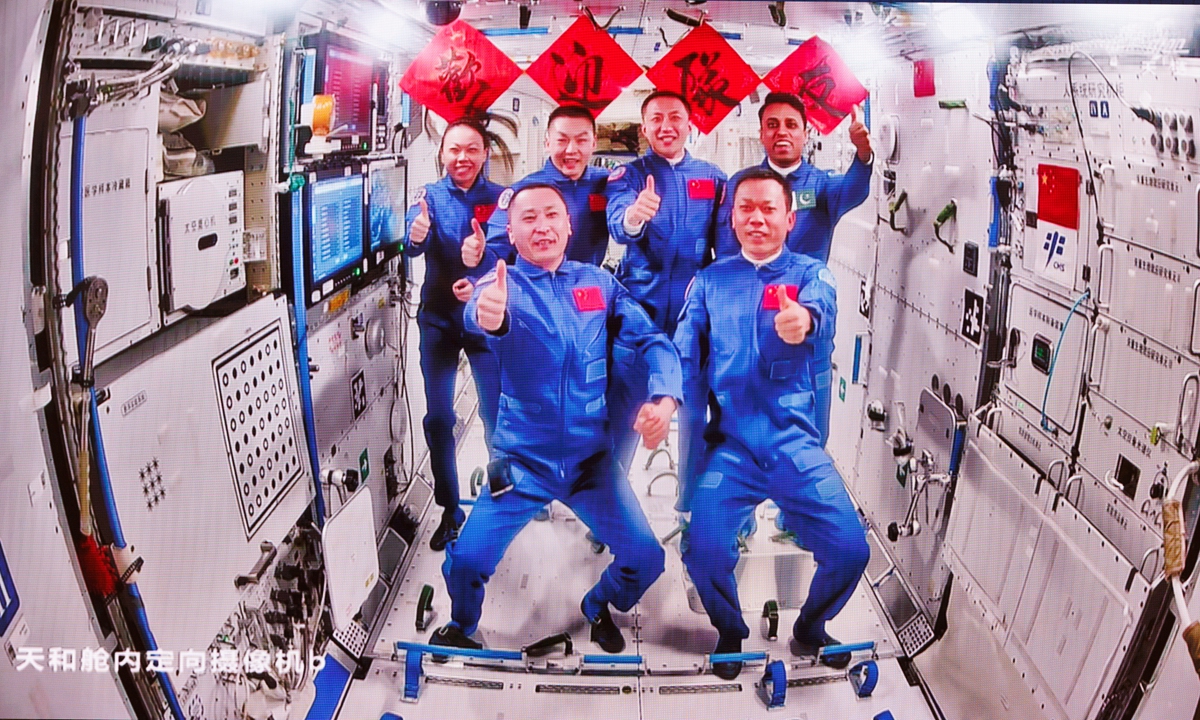
This image captured at Beijing Aerospace Control Center on November 25, 2026 shows a group picture of the crew of Shenzhou-23 and Shenzhou-24 spaceships. Photo: Xinhua
China's Tiangong space station welcomed its first-ever "space handshake" between Chinese and foreign astronauts on Wednesday as the Shenzhou-24 crew entered the station, marking a historic moment in China's space history.
The Shenzhou-24 crew, comprising Chinese astronaut and mission commander Tang Hongbo, Chinese flight engineer Wu Yi and Pakistani payload specialist Muhammad Zeeshan Ali, entered China's Tiangong space station, where they met with the three Shenzhou-23 astronauts, who have been in orbit for about six months. Ali has made history by becoming the first foreigner to board Tiangong.
Chinese President Xi Jinping and Pakistani President Asif Ali Zardari exchanged congratulations on Wednesday on the joint spaceflight mission carried out by astronauts from the two countries, according to the Xinhua News Agency.
In his message, the Chinese President said the joint space exploration of astronauts from China and Pakistan is a vivid embodiment of the deep-rooted friendship between the two countries, as well as another important achievement in bilateral cooperation. China stands ready to work with Pakistan and other countries to champion the peaceful use of outer space and deepen space cooperation, he said.
The mission is a showcase of China's continued technological innovations in the Long March rocket, Shenzhou spacecraft and Tiangong space station, commitment to the opening-up and shared use of the China Space Station, peaceful use of outer space and multilateral cooperation under China's manned space program, Chinese analysts said.
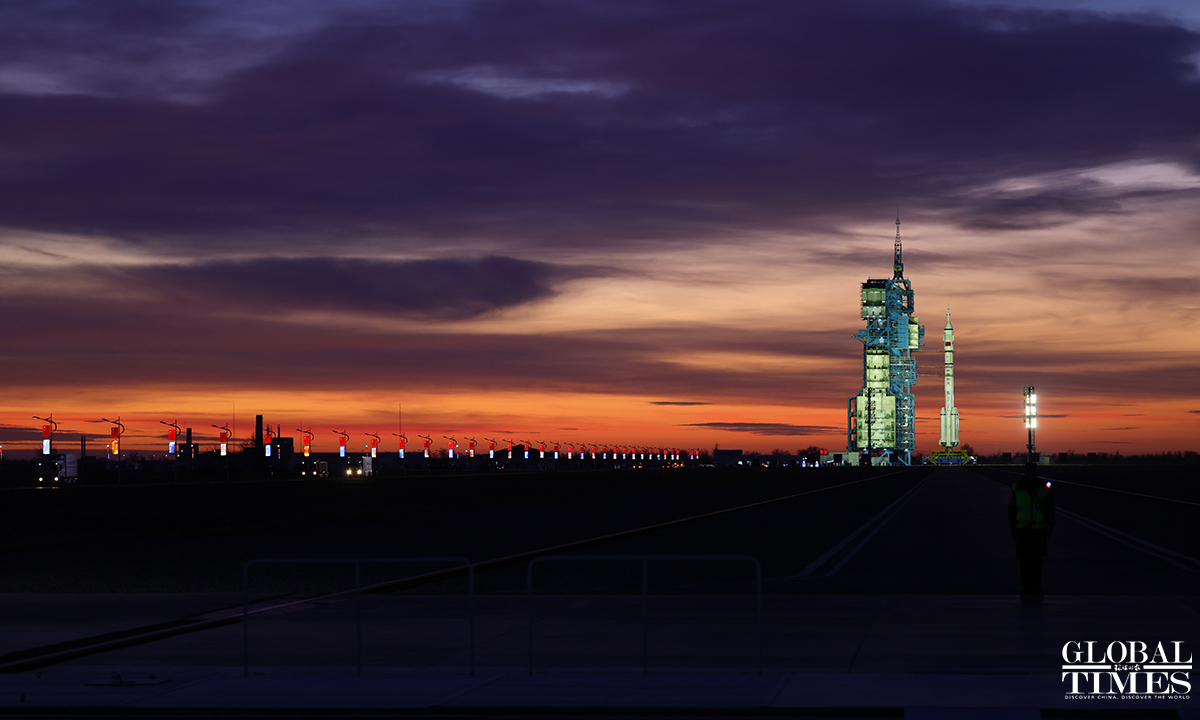
Shenzhou-24 crewed spacecraft ready for launch Photo: Fan Wei /Global Times
History made
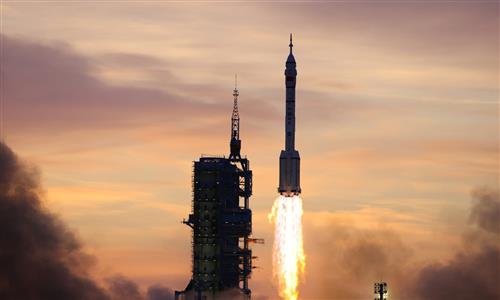
Shenzhou-24 crewed spacecraft and its three-member crew were carried by a Long March-2F Y24 carrier rocket, which lifted off at 8:18 am on Wednesday from Jiuquan Satellite Launch Center in Northwest China's Gobi Desert.
After entering orbit, the Shenzhou-24 crewed spacecraft successfully docked with the forward port of the space station's Tianhe core module at 11:56 am Beijing time on Wednesday. The Shenzhou-23 crew in orbit opened the hatch of the space station at 2:35 pm and welcomed the new arrivals.
The entire docking process took approximately 3.5 hours, according to the China Manned Space Agency (CMSA).
The two crews then took group pictures of the ninth space get-together in China's aerospace history. They will now start a new in-orbit handover round.
After completing a short-term joint flight, Ali will return to Earth aboard the Shenzhou-23 spacecraft alongside two Shenzhou-23 crew members. The other two Shenzhou-24 astronauts will stay in orbit for roughly six months along with Shenzhou-23 astronaut Zhu Yangzhu, who has already spent six months in orbit and will remain aboard Tiangong to complete a year-long stay experiment.
This was the 8th crewed launch mission since the implementation of the China Space Station application and development program, and the 41st flight mission of China's manned space program. The Long March-2F carrier rocket maintained its stable condition for the high-profile mission.
"Although the overall mission plan remained largely unchanged, the rocket team completed 12 technical improvements to further strengthen safety for the flight," Li Wenqing, a technical expert with China Aerospace Science and Technology Corporation (CASC), told the Global Times. The improvements covered both rocket and ground systems, focusing on reliability, safety redundancy and more efficient launch-site operations.
The team optimized the structure and rubber compound formulation of seals in the rocket's pressurization and propellant feed system, while tightening acceptance standards. These improvements enhanced the system's sealing performance, reliability and safety redundancy, Li said.
The rocket team also added a manual forced-separation control channel between the rocket and launch tower as a backup for the automatic system, while increasing redundancy in separation signals between systems to improve launch reliability.
The movable launch platform also underwent considerable upgrades, including improved displays and human-machine interaction, automatic rotation and speed adjustment, and an upgraded health monitoring system. These changes improved its automation, reliability and operational safety, Li said.
He Pengju, overall technical lead for launch and tracking operations, told the Global Times that strong winds and sandstorms were more likely during the seasonal transition. The center implemented zoned temperature and humidity controls in the launch area.
After the launch, the Long March-2F Y25 carrier rocket will enter emergency rescue standby under the program's rolling backup plan, continuing to support space station missions, the Global Times learned from the launch center.
Rapid docking
The mission marked the first time a Shenzhou crewed spacecraft carried a foreign astronaut on trip between Earth and space, as well as the first joint flight involving Chinese and foreign astronauts in China's manned space program. The mission represents a major step forward in international cooperation at the China Space Station.
Pakistani Prime Minister Shehbaz Sharif described Pakistan's participation in the mission as a reflection of living proof of the ironclad friendship, thanking China for making Pakistan part of this historic mission, the prime minister's office said in a X post on Wednesday.
Ali, the first foreign astronaut to participate in a Chinese crewed space mission, learned to speak Chinese. Before his departure, he quoted a line from a Chinese poem: "Someday the roc will ride the wind and mount ninety thousand li into the sky." The "roc" refers to an ancient mythical bird and the unit of distance known as a li is equivalent to half a kilometer.
Pakistan's Ambassador to China Syed Ali Asad Gillani said in an interview with CCTV News that he was pleasantly surprised by the Pakistani astronaut's proficiency in Chinese. He said Chinese has now become an international language in space. "Learn Chinese well - you never know, it might take you all the way to space!"
Li Zhe, an expert at CASC, told the Global Times that the spacecraft and space station teams coordinated closely and made detailed preparations for the Pakistani astronaut's flight.
The development team conducted multiple rounds of integrated crew-spacecraft tests involving the primary and backup Shenzhou-24 crews, including the Pakistani astronaut. After arriving at the Jiuquan launch site, the crew took part in spacecraft familiarization and a full-system launch rehearsal, while the space station team provided training on in-orbit living arrangements, equipment operations, experiments and emergency procedures, Li said.
The Pakistani astronaut experienced the spacecraft's rapid rendezvous and docking capability. After liftoff, Shenzhou-24 used an autonomous rapid rendezvous and docking mode lasting only about 3.5 hours and successfully docked with the forward port of the space station's Tianhe core module. This marked the fourth time a Shenzhou spacecraft had used the 3.5-hour docking mode.
"Unlike radial rendezvous and docking, which requires continuous dynamic adjustments, front-port docking has a stable parking point and is relatively less demanding in terms of flight control," Li said. The 3.5-hour mode is the standard plan, but ground controllers can switch to a five hour or longer docking plan if necessary to ensure the safety of the astronauts, spacecraft and space station.
"The value of 3.5-hour rapid rendezvous and docking goes beyond speed," Li said. Early Shenzhou missions took two days and dozens of orbits to complete rendezvous and docking. The faster mode reduces astronauts' physical fatigue and psychological stress during the journey to orbit, while improving the space station's ability to conduct emergency rescue and evacuation.
The joint flight with a foreign astronaut and the use of mature rapid rendezvous and docking technology highlight the China Space Station's openness to international cooperation and the continued development of China's manned spaceflight capabilities.
Joint space experiments
The mission will also feature four scientific experiments carried out by both Chinese and Pakistani astronauts aboard the China Space Station, covering biology, crops and advanced materials. The Pakistani astronaut will operate the experiments in orbit, collecting data for joint research in space.
The four experiments focus on cyanobacteria, quinoa, graphene hybrid composites and self-healing carbon fiber composites. Some will be conducted in the life-ecology experiment cabinet in the Wentian lab module, while others will expose materials to the vacuum, radiation and extreme temperature changes outside the space station.
"The cyanobacteria experiment aims to explore a potential 'green microfactory' for future deep-space missions," Huang Kun, an expert with the China Space Station's space application system, told the Global Times.
Proposed by Pakistan's Space and Upper Atmosphere Research Commission (SUPARCO), the experiment will examine how microgravity and space radiation affect cyanobacteria's photosynthesis, growth and carbon-fixation capacity. The findings could support research into oxygen regeneration and space-based biomanufacturing, Huang said.
The quinoa experiment focuses on food security in space. Led by the University of Agriculture Faisalabad (UAF), in Pakistan, it will send 32 quinoa seed samples outside the cabin to study how cosmic radiation and microgravity affect their longevity and nutritional properties. The findings could help identify high-quality varieties for space cultivation and provide reference data for crop breeding on Earth, Huang said.
Huang said graphene hybrid composites are lightweight and offer radiation-shielding potential, while self-healing carbon fiber composites are designed to repair microcracks caused by temperature changes, radiation and micrometeoroid impacts, using solar heating outside the cabin to restore their mechanical properties.
Both materials experiments will use the space station's external materials exposure facility. The graphene hybrid material will be exposed alongside an aluminum control sample for one year, with detectors recording particle tracks for later comparison of their shielding, mechanical and thermal properties. The self-healing carbon fiber samples, including pre-cracked and intact controls, will be monitored by imaging in orbit and retrieved after one year to assess crack repair, Huang said.
With the Pakistani astronaut operating the experiments in orbit, China-Pakistan space cooperation will extend beyond joint spaceflight to the joint design and implementation of scientific experiments.
RELATED ARTICLES