Jensen Huang saga to speed China’s AI self-reliance
By Published: Nov 25, 2026 08:37 PM
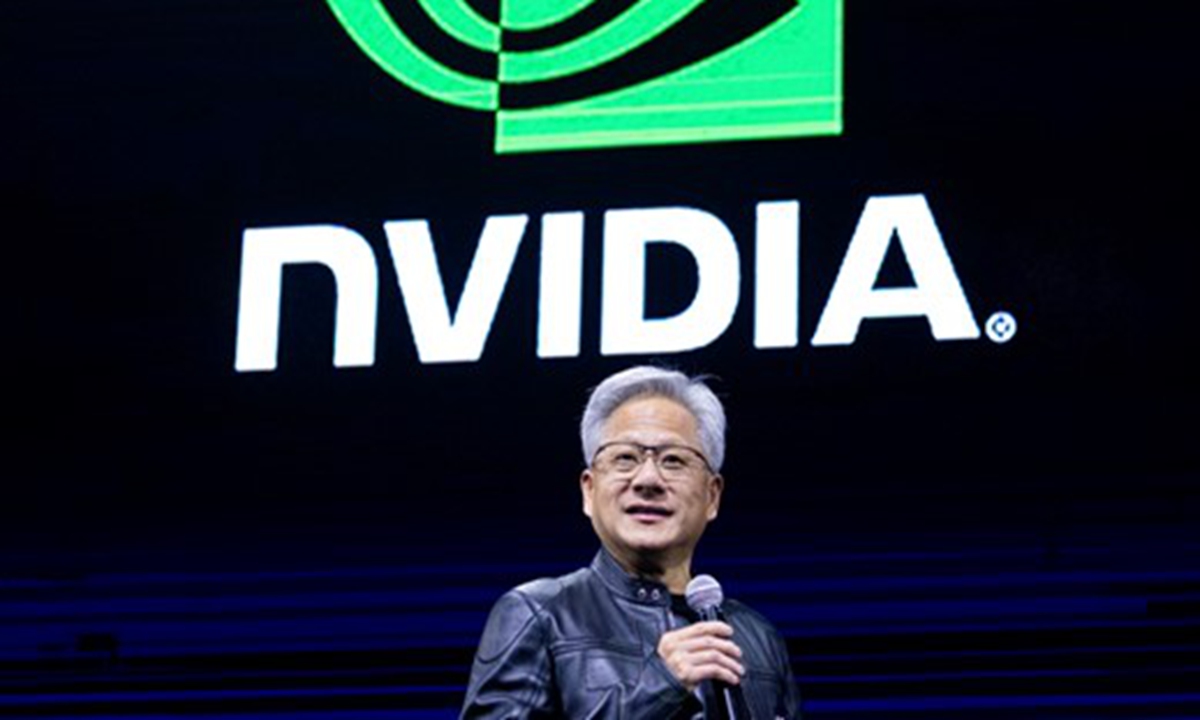
NVIDIA CEO Jensen Huang Photo: VCG
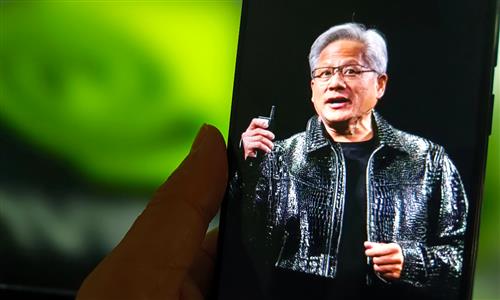
When the news about Jensen Huang broke, most people immediately looked at Nvidia's stock price and its staggering market cap surge. But from Beijing's perspective, the real headline isn't the money, it's the signal that Washington is further tightening its grip on high-end chip exports to China.
Meanwhile, on the other side of the Pacific, another major headline caught the public's attention: On Tuesday, Huawei announced that its self-developed HarmonyOS ecosystem had officially surpassed 100 million connected devices.
These two stories paint a vivid picture of the high-tech standoff between the US and China. Washington is tightening the screws; Beijing is punching through.
Behind the Huang saga is a clear message: A powerful faction in the US Congress and the White House is deeply unhappy with Nvidia continuing to sell chips to China. Over the past year or two, Huang tried to persuade Washington to ease restrictions just a little, and the Trump administration did approve certain categories of chip exports.
But that window is closing. The supply chain's reliability has now fundamentally decoupled from Huang's political maneuvering. Future chip exports to China will be dragged into an even more unpredictable political wrestling match. Corporate compliance, personnel changes, public opinion and especially congressional scrutiny - any single one of these factors, or a sudden new regulation, could snap the supply chain overnight.
When supply chain security becomes an uncontrollable variable, domestic substitution and workarounds stop being part of a "long-term plan" and become an absolute, non-negotiable necessity.
Chinese tech companies saw this coming years ago and have been accelerating their R&D. This latest event guarantees that the pace will pick up even more, pulling in a broader, multi-layered ecosystem of enterprises.
When self-reliance becomes an instinct, its driving force far outweighs any government policy or subsidy. We've seen this model's effectiveness repeatedly over the past few years.
Every time the US tightens restrictions - whether it's choking off high-end GPUs or cutting the supply of advanced manufacturing equipment and toolchains - it doesn't paralyze China's AI sector. It simply forces a different kind of breakthrough.
Take DeepSeek as a prime example. They achieved comparable model performance while requiring significantly less computing power. How did they pull that off? Through clever architecture, efficient training methods and relentless engineering optimization. When hardware is restricted, software and efficiency fill the gap. This proves that substitution isn't just about blindly chasing the leader; it's about finding detours and innovating at different layers of the stack.
This is why we aren't just seeing a breakthrough at a single point, but a multi-front surge that is scaling up. We've seen this play out before: the Beidou satellite system, the space station, domestic operating systems and databases. Every domain that faced severe chokepoints followed the same path of independent innovation. The greater the pressure, the stronger the resolve.
Yes, US containment makes substitution, workarounds and innovation harder. But given the significant progress China has already made across multiple layers, and its deep reserves, future breakthroughs will continue to emerge and create a compounding, integrated effect.
Let's look at this race objectively: The US has not pulled significantly ahead. That's exactly why some in Washington are so anxious.
Think of it as two runners on different tracks with entirely different gears. One has next-generation chips and advanced manufacturing, and essentially controls the aid stations, while the other runs with older equipment, forced to expend extra energy forging its own tools and navigating around severed supply lines. Under such profoundly asymmetrical conditions, the fact that the technology gap hasn't widened into a generational chasm is, in itself, a remarkably powerful conclusion.
The Jensen Huang saga won't derail China's AI ambitions - it will only accelerate them.
The author is a senior editor with the People's Daily. dinggang@globaltimes.com.cn. Follow him on X @dinggangchina
RELATED ARTICLES