IN-DEPTH / IN-DEPTH
A growing number of older adults in China are returning to university for formal degrees, reclaiming long-deferred dreams on their own terms
Back to school
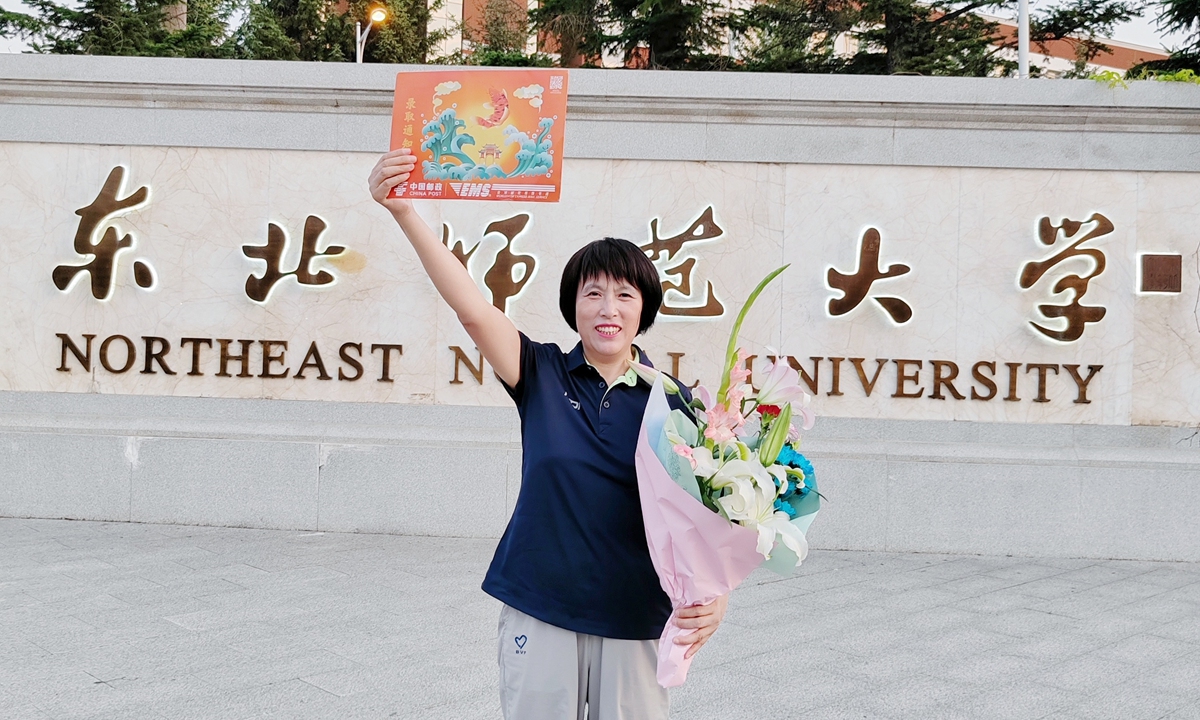
Jiang Nüwu holds up her admission letter and poses for a photo in front of Northeast Normal University in Changchun, Northeast China's Jilin Province, in 2026. Photo: Courtesy of Jiang
Editor's Note:
With China's population of seniors over 60 surpassing 300 million, ensuring a happy and fulfilling life for all seniors has become a pressing issue for both families and the nation. How can the new generation of seniors in China break away from traditional norms and embrace a different lifestyle, supported by AI technology, multiculturalism and an elder-friendly society?
The series "Old Age, New Trends" explores emerging trends in the silver economy, creative social norms among senior citizens and innovative eldercare services. It examines the opportunities and challenges presented by an aging society, highlighting the diverse lifestyles of seniors and the booming eldercare industry in China. Beneath these new trends lies a reflection of Chinese modernization, which aims to provide more secure systems and dignified lives for its senior population.
When 55-year-old Jiang Nüwu finally walked into a postgraduate classroom this autumn, just two months after retiring, she found herself surrounded by classmates mostly in their 20s and 30s.
She was initially nervous. But when her class instructor introduced her to the class as an example of perseverance, her younger classmates broke into applause. The gesture put her at ease.
Her return to university comes at a time when China is seeking to broaden educational opportunities for its ageing population. At a press conference in November, a National Development and Reform Commission official said authorities would implement the national plan for services for the elderly and young children, while expanding channels for elderly education and incorporating new technologies into learning programs to help the elderly bridge the digital divide.
Yet for some older learners, the classroom they seek is not necessarily one designed specifically for their age group. Rather than signing up for courses in calligraphy, music or dancing at a senior university, they are taking entrance examinations, pursuing academic degrees and studying alongside younger generations.
Their choices are still far from the norm among older Chinese people. But the stories have attracted growing attention on social media, where younger users have expressed admiration and even a desire to follow a similar path after retirement. Behind this interest is a changing understanding of what later life can offer.
Dreams postponed, not abandoned
For Jiang, being admitted to university to study a part-time master's program was the realization of a dream she had carried for around 30 years.
After graduating from Jilin University, she once considered pursuing further studies in education at Northeast Normal University. But coming from a financially disadvantaged family in the mountains, she gave up on her dream. In the years that followed, she took on various jobs, including working as a cashier and a tutor.
Her return to academic life was, in an unexpected way, inspired by her daughter. When her daughter began preparing for the postgraduate entrance examination while holding down a job, Jiang wanted to support her through the experience.
"I suddenly had the idea of taking the exam alongside my daughter, to encourage her," she told the Global Times.
Both were not confident about passing the entrance exam. While helping care for her mother, Jiang was also occupied with farm work at her mother's home. Following stomach surgery in November 2025, she used a little over a month of recovery time to review mathematics, English, logic and writing, often watching lectures at double speed.
"I really value this hard-earned time to study," Jiang said.
Jiang and her brother have been looking after their mother. Meanwhile, she has been working toward completing the degree in the shortest possible time. She also plans to explore psychology, a subject she enjoys, through additional courses.
For 56-year-old Zhang Jiling, the decision to return to education was driven by a different kind of unfinished business.
Born in Taiyuan, North China's Shanxi Province, Zhang spent much of her life doing physically demanding and informal work, including housecleaning, childcare and hairdressing. Education, however, had always been central to how she saw herself.
As a young woman, she failed the annual college entrance exam, or gaokao, three times. Severe headaches that had begun during junior middle school, combined with financial pressure and diminishing family confidence, eventually forced her to abandon the pursuit.
After her son entered university in 2019, Zhang began to reconsider her own educational ambitions. She took the gaokao in 2020, missing the admission threshold by just three points, then tried again in 2021. This time, she gained admission to Shanxi Technology and Business University, where she studied preschool education.
"I may not have the same memory as younger people, but I believe my understanding and practical abilities can be stronger," she told the Global Times.
In 2025, she graduated as an outstanding student. At the graduation ceremony, she also managed to secure an impromptu speaking opportunity, telling the graduating students: "Anyone with a dream is remarkable, and with courage, miracles are possible."
After graduation, Zhang has not stopped learning. She now spends time memorizing English texts and exercising, seeing continued self-improvement as part of her everyday life.
Similar stories have emerged elsewhere in China. In Central China's Hubei Province, 56-year-old Zhu Chunfang, a retired engineering professor who had spent decades working in water conservancy, took the gaokao again, earning admission to a college to study traditional Chinese medicine, the Hubei Daily reported in September.
In South China's Guangdong Province, 56-year-old Li Weixin retired in August and, the following month, was accepted into a digital economy master's program. Having worked in financial management for 36 years, she wanted to rebuild her knowledge in the age of artificial intelligence.
The phenomenon has also extended beyond China's borders, with an increasing number of older Chinese adults choosing to pursue academic degrees abroad after retirement. For instance, Wang Xiaoxi received an offer from the University of Athens at the age of 56, one year after retirement, to study ancient Greek archaeology, history, and literature.
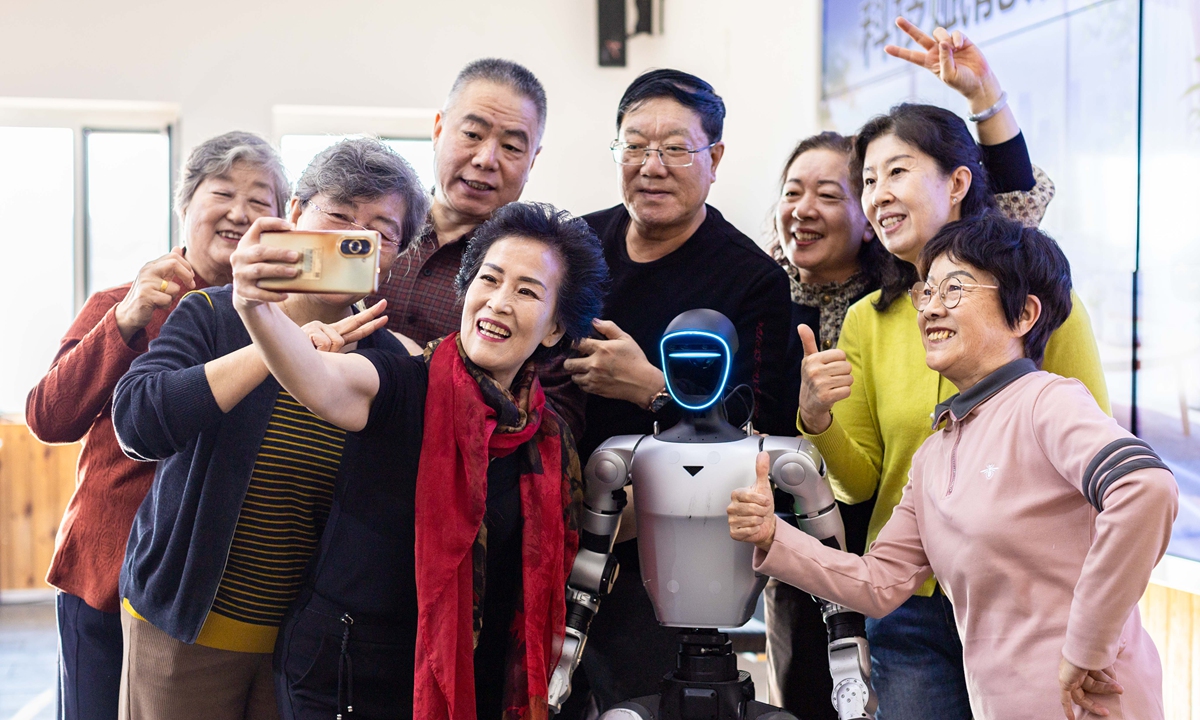
Elderly students take a selfie with a humanoid robot at a community service center in Hohhot, North China's Inner Mongolia Autonomous Region, on November 25, 2026. Photo: VCG
A seat among younger peers
These stories do not suggest that large numbers of older people are abandoning senior universities or rushing back into formal education. Rather, they point to a more diverse set of aspirations emerging among some older adults, for whom retirement can mean an opportunity to revisit choices that earlier circumstances had put beyond reach, Chu Zhaohui, a research fellow at the National Institute of Education Sciences, told the Global Times.
The distinction between formal higher education and senior universities is central to understanding why some older people choose the former, Chu said.
Chu said that traditional senior education programs had often been designed around an assumption that retirement meant a transition toward leisure.
Courses in painting, calligraphy, singing and similar activities have served important purposes, but this approach does not necessarily reflect the full range of aspirations among today's older learners, Chu said. Some want more systematic academic learning and opportunities to interact with younger generations.
Even the introduction of AI and digital technology courses at senior universities may not fully address these demands. The content, teaching methods and broader learning environment can differ considerably between institutions. For some older people, the appeal of a regular university lies not simply in what is taught, but also in the company of younger classmates and the atmosphere of a conventional campus, the expert said.
Stories of older people returning to university have struck a chord with some young social media users, who see the choice as an appealing vision of life after retirement. Wang Long, a 26-year-old employee at an internet company in Beijing, is one of them.
Some of their experience reminded Wang of the pressures of corporate life: meetings, weekly reports and performance targets. Watching someone who had spent decades in the professional world choose an entirely new academic direction felt, in her words, like someone was finally giving working people a reason to look forward to life beyond their careers.
Wang hopes to study philosophy or sociology after retirement. For now, however, she believes she cannot afford to do so. Leaving her job for a postgraduate program would mean sacrificing her income and taking on considerable tuition and living expenses. "Retirement could change that calculation. With a pension, savings and grown-up children, education could become a form of consumption rather than an investment," Wang told the Global Times.
'Keep learning for as long as I live'
How open are China's regular universities to people who have already reached retirement age? According to Chu, the current mainstream admissions framework for regular higher education does not impose a blanket upper age limit. In principle, older people can enter the system through the relevant entrance examinations, provided they meet the academic requirements.
In practice, examination scores remain the main hurdle. While admission to highly selective universities may be difficult for older applicants, local and less selective institutions can offer more realistic opportunities.
The expert also believes that changing demographics could create new opportunities for universities. Opening more programs to older learners could offer institutions another source of demand and support their long-term development, he said.
However, expanding access is not simply a matter of removing age restrictions. The circumstances of older students can differ considerably from those of their younger classmates, and their ability to pursue education often depends on factors beyond academic performance. Family responsibilities are one such constraint. Financial security is another consideration.
For universities, the challenge will also be to develop arrangements that accommodate different stages of life without lowering academic standards. Flexible timetables, part-time programs and concentrated teaching schedules could help some older students balance education with family responsibilities. Questions surrounding student services, campus accommodation and the integration of students from widely different age groups will also require attention as universities explore broader participation, according to the expert.
Ultimately, Chu said, the choice need not be between senior universities and conventional higher education. Recreational courses, community-based learning, digital skills programs and formal academic degrees can serve different people at different stages of life. What matters is whether older adults have meaningful opportunities to choose the kind of education they want, rather than having their needs defined solely by their age.
For Jiang, returning to university has already opened up new possibilities beyond the degree itself. She hopes to continue studying psychology, improve her English and eventually write a memoir about her life.
She also has a message for younger people who see retirement as a time when their ambitions can still grow.
"Even with a 60-year-old body, being in that kind of environment can give you the heartbeat of a 20-year-old," she said. "As long as I am healthy, I will keep learning for as long as I live."
Zhu Xuanlin contributed to this story.
RELATED ARTICLES