Chinese envoy makes case for Xiamen to host BBNJ Secretariat, questions Belgium-Chile bid
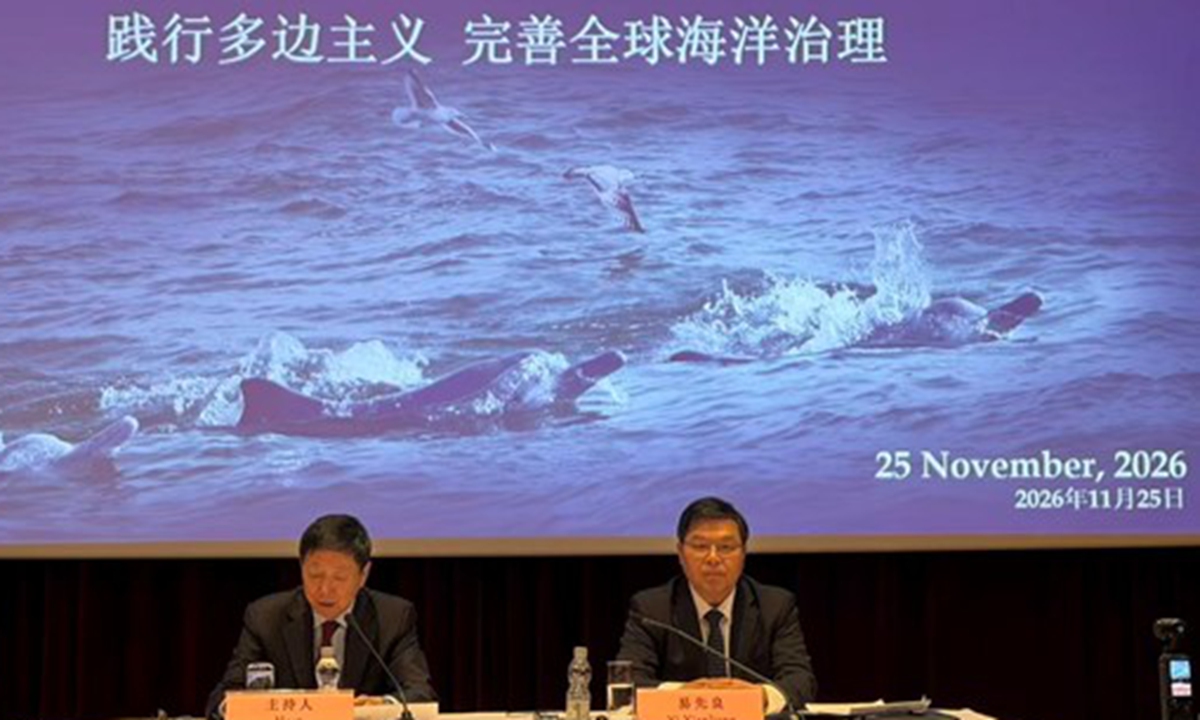
The China Public Diplomacy Association holds a "Linjia No. 7 Salon" themed "Upholding Multilateralism and Improving Global Ocean Governance" on November 25, 2026. Photo: Shen Sheng/Global Times
The China Public Diplomacy Association held the "Linjia No. 7 Salon" on Wednesday under the theme "Upholding Multilateralism and Improving Global Ocean Governance," where Yi Xianliang, special envoy for the Biodiversity Beyond National Jurisdiction (BBNJ) Secretariat Affairs of the Ministry of Foreign Affairs, outlined China's bid to host the Secretariat of the BBNJ Agreement in Xiamen, East China's Fujian Province, and exchanged views with Chinese and foreign journalists on the selection process, including the joint proposal by Belgium and Chile and the US' position.
China has decided to present the candidate of Xiamen city to host the Secretariat of the BBNJ Agreement, and has informed the United Nations Secretary-General of the relevant decision on January 16, according to the Xinhua News Agency.
Yi said China's decision to nominate Xiamen reflects its firm support for multilateralism, the United Nations and global ocean governance. China's bid, submitted in January this year, received support from a majority of the agreement's parties within a relatively short period, he said.
Yi outlined eight aspects of China's strengths, including its historical contribution to international maritime law and ocean governance, support for major international ocean institutions, and assistance to developing countries in building their marine-related capacities.
He noted that China had participated actively in the negotiations that led to the UN Convention on the Law of the Sea and supported principles such as the common heritage of mankind and the international seabed regime, which helped safeguard the interests of developing countries, particularly island states. China has also continued to support the development of international maritime rules and institutions.
China has also provided developing countries with financial, technical and capacity building programs in the marine sector. Yi said China had trained around 100,000 marine-related professionals for nearly 60 countries. He also highlighted China's experience in marine conservation and governance, saying that the country's marine economy had expanded substantially over the past three decades while marine pollution had been brought under control and the marine ecological environment improved.
On the practical arrangements for hosting the secretariat, Yi said China is prepared to provide office premises and supporting facilities in Xiamen free of charge over the long term. The proposed premises include a 15-story office building and two auxiliary buildings, with a combined floor area of more than 10,000 square meters. China would also provide meeting facilities and financial support, including a contribution to the agreement's voluntary trust fund to help developing countries participate in its meetings.
Yi described Xiamen as a strong candidate, citing its marine economy, research capacity and international connectivity. The city's marine economy accounts for around 30 percent of its GDP, and it has more than 30 marine-related research and cooperation platforms, he said. Xiamen also has extensive experience in international marine exchanges and cooperation, as well as direct air links with more than 30 countries.
He added that locating the secretariat in Asia would help address the imbalance in the geographical distribution of international institutions. While major ocean-related institutions are based in places such as Kingston, Jamaica, and Hamburg, Germany, Asia, despite its extensive maritime areas and growing role in the global ocean economy, has no comparable global ocean governance institution, Yi said. Establishing the secretariat in Xiamen would better reflect the principle of equitable geographical distribution within the UN system.
Asked about the joint bid announced by Belgium and Chile, under which the secretariat would be based in Valparaiso, Chile, while the agreement's information-exchange mechanism would be based in Brussels, Belgium, Yi said the proposal raises fundamental concerns. He argued that the secretariat and its information-exchange mechanism were closely linked and that separating them across two countries would be neither practical nor consistent with established international practice.
Yi stressed that decisions on the secretariat's location and related institutional arrangements should be made collectively by the agreement's parties through the COP, rather than being unilaterally determined by individual countries. The proposed arrangement, he said, risked politicizing the selection process, creating unnecessary complications and undermining the agreement's future development. China is willing to work with all parties through fair competition and in accordance with the agreement's rules, he said.
A journalist asked Yi about the US State Department's statement claiming that it welcomes the Belgium-Chile joint offer. Yi questioned Washington's role, noting that the US is neither a party to the UN Convention on the Law of the Sea nor a party to the BBNJ Agreement. The selection of the secretariat's location is a matter for the agreement's parties, he said, adding that countries should avoid politicizing the process.
Earlier on Wednesday, Chinese Foreign Ministry spokesperson Guo Jiakun also responded to the US statement, saying that the US has no say on the selection of the BBNJ Secretariat seat. "We call on all parties to stay vigilant against attempts to politicize the bidding and create confrontation in the process," Guo added.
RELATED ARTICLES