US tariff plan targeting China, other economies risks offsetting trade negotiation gains, business confidence: experts
By Yin Yeping and Published: Nov 25, 2026 11:45 PM Updated: Nov 26, 2026 12:40 AM

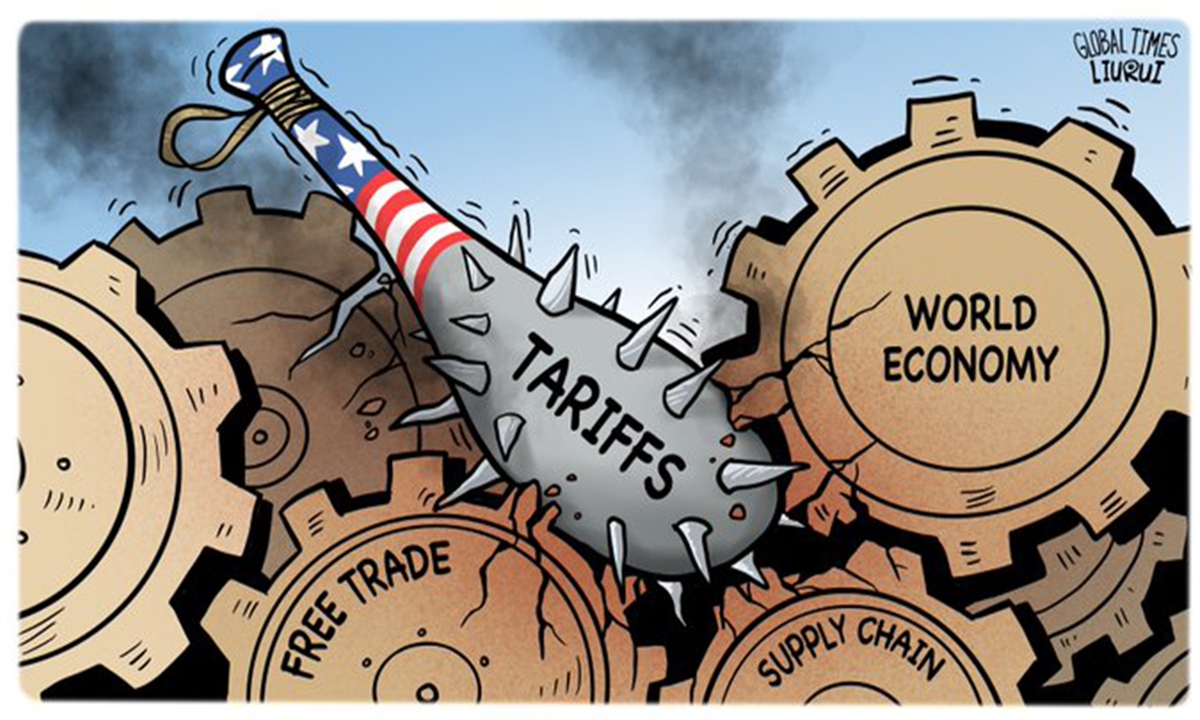
US tariff Illustration: Liu Rui/GT
The Trump administration proposed to raise tariffs on 14 economies including China and the EU following a months-long investigation into industrial subsidies and so-called overcapacity, even as concerns over the cost of living and public opposition to tariffs continue to mount in the US.
Washington's tariff plans, which include China as well as some of its closest allies, reflect an attempt to reshape global industrial competition and reinforce US dominance over global industrial supply chains through unilateral trade restrictions, Chinese experts said.
However, the proposed tariff hikes could reignite trade tensions that have only recently eased, potentially undoing gains from previous negotiations and "reopening wounds that have yet to heal," the experts said.
If the tariff hikes were implemented, it will also weaken business confidence, disrupt global supply chains and increase costs for consumers, the experts warned.
Widening tariff targets
US President Donald Trump reignited global trade tensions on Wednesday by proposing new tariffs on major trading powers including China, on ground of what it calls structural excess industrial capacity, Reuters reported on Wednesday.
The proposed rate of up to 20 percent would apply to China, which Washington blames for flooding world markets with cheap exports of everything from steel to electric vehicles and solar products, per Reuters.
The proposed duties will be subject to a public notice and comment period, which a US official said could push implementation into January, according to the report.
Chinese Foreign Ministry spokesperson Guo Jiakun said on Wednesday that tariff wars and trade wars serve no one's interests. Relevant issues should be resolved through consultation on the basis of equality, mutual respect and mutual benefit.
The so-called issue of "industrial overcapacity" does not really exist and should not be used as a pretext for political manipulation. China and the US need to jointly deliver on the important common understandings between the two presidents, and maintain the steady growth momentum of China-US economic and trade ties, Guo said at a regular press conference on Wednesday.
The US' trade probe dates back to March 11, when the USTR launched Section 301 investigations into 16 economies over alleged structural excess capacity and production in manufacturing sectors, less than a month after the US Supreme Court struck down the sweeping tariffs announced by the Trump administration in April 2025.
By targeting China and some of the US closest allies including the EU, Japan and South Korea in its investigation into alleged "industrial overcapacity," Washington aims to reshape global industrial competition and reinforce its dominance over global industrial supply chains, Peng Bo, a research fellow at the Chinese Academy of International Trade and Economic Cooperation under the Ministry of Commerce, told the Global Times on Wednesday.
Peng argued that there is no inherent link between industrial subsidies and overcapacity, and that Washington should not attribute other economies' competitive advantages solely to government subsidies while overlooking technological innovation, market competition and well-developed industrial and supply chains.
Such a unilateral approach risks reigniting trade frictions that have only recently subsided, eroding the benefits of earlier agreements and weakening trading partners' confidence in future negotiations with Washington, the expert said, noting that repeated tariff threats could further fragment the global trading system.
The renewed tariff push comes as the US economy continues to face domestic challenges, including persistent inflation and uncertainties surrounding economic growth.
Data from the US Bureau of Labor Statistics showed that the US consumer price index rose 0.4 percent month-on-month in October, following a 0.6 percent increase in September. Food prices rose 0.5 percent in October, while gasoline prices were 37.4 percent higher than a year earlier.
Bloomberg reported on Tuesday that fresh tariffs could further anger Americans amid growing frustration over the cost of living.
A Reuters/Ipsos opinion poll conducted recently showed that 62 percent of respondents would support efforts to repeal the tariffs, Reuters reported on Wednesday.
The recent poll once again reflects a widening gap between Washington's tariff agenda and the economic interests of many ordinary Americans, Zhou Mi, a senior research fellow at the Chinese Academy of International Trade and Economic Cooperation, told the Global Times.
"Higher tariffs will further increase the cost of imported intermediate goods for American manufacturers, squeezing their profit margins and weighing on employment while making inflation more persistent," said Zhou.
Undermining US credibility
The proposed tariff plans come as China and the US continue economic and trade consultations.
On Wednesday, China's Ministry of Commerce (MOFCOM) said China and the US held the first meeting of their agricultural working group under the China-US Board of Trade in Beijing from Monday to Tuesday.
Guided by the important consensus reached by the two heads of state, the two sides held candid, in-depth and constructive discussions on issues including agricultural product regulation, market access and agricultural trade, according to the MOFCOM.
The ministry said both sides will strengthen communication through the working group and work toward addressing each other's concerns in the agricultural sector to promote sound, stable and sustainable development of China-US economic and trade relations.
The two-day meeting also followed the first meeting of the trade council under the China-US economic and trade consultation mechanism via video link on November 14.
Meanwhile, China has taken concrete steps to facilitate bilateral trade, including extending the suspension of certain export control measures on US-bound dual-use items. Chinese companies have also continued commercial cooperation with US businesses, as reflected in Xiamen Airlines' recent reported agreement to purchase 50 Boeing aircraft, demonstrating China's efforts to advance economic and trade cooperation with the US.
China and the US also are maintaining close communication on implementing reciprocal tariff cuts covering around $30 billion worth of imports on each side.
Reuters reported that the tariffs would also not apply to about $30 billion worth of Chinese imports that the US is considering for tariff reductions under a bilateral process, an official said. However, they would add to the tariffs on China put in place during Trump's first term, which amounted to roughly 25 percent.
Washington's approach of negotiating tariff reductions while preparing new hikes risks undermining US credibility within the China-US Trade Council mechanism, weakening business confidence and disrupting investment decisions and supply chains, Peng said.
Bao Jianyun, dean and professor of the Department of International Politics at the School of International Studies at Renmin University of China, also noted that the benefits of negotiated tariff reductions could potentially be offset by new duties.
Such policy uncertainty could also discourage cross-border investment, complicate production planning and make companies more reluctant to commit to long-term orders, the expert said.
Should Washington proceed with further tariff hikes on Chinese goods, China could respond with firm countermeasures, Bao said. Meanwhile, China's increasingly diversified trade partnerships are providing greater room for Chinese businesses to navigate changes in US trade policy, he said.
RELATED ARTICLES