US entrepreneurs flocking to Shenzhen does not mean Silicon Valley has 'lost': Global Times editorial
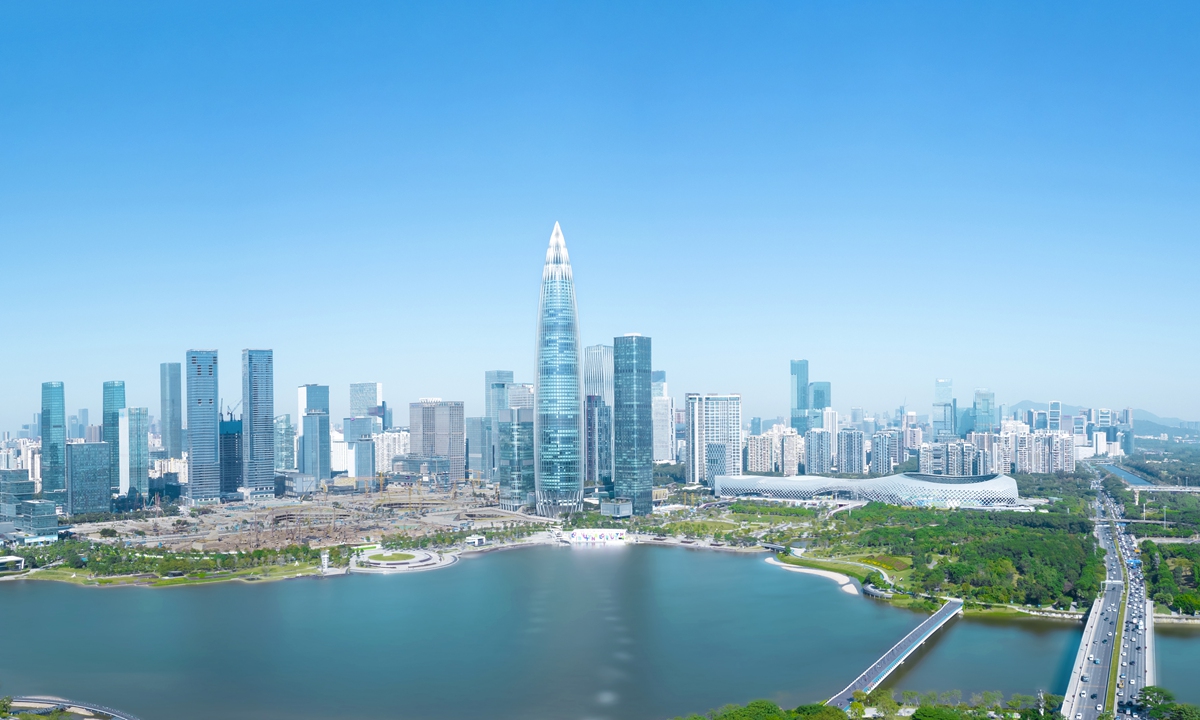
Skyline of Qianhai area in Shenzhen, South China's Guangdong Province Photo: VCG
US entrepreneurs flocking to Shenzhen demonstrates that the natural flow of talent, capital and creative ideas, along with the willingness of the industrial sectors in both China and the US to strengthen cooperation, cannot ultimately be contained, just as the splendor of spring cannot be confined within garden walls.NBC News recently spotlighted an emerging trend in the tech world: a growing number of US tech startups are shifting from Silicon Valley to Shenzhen. According to the report, despite official narratives from Washington deliberately playing up supposed "anxiety" among American companies over China's business environment, US developers, suppliers, and investors are increasingly putting down roots in Shenzhen. There, they are experiencing firsthand the "Shenzhen speed" - where drawings finished at 1 am become physical prototypes by 7 am - alongside a citywide entrepreneurial ethos defined by a readiness to collaborate. Similarly, a Bloomberg video released around the APEC meeting in Shenzhen, which focused on how the city "draws wave of innovators", also drew widespread attention and sparked heated discussion on international social media.
The spotlight cast on Shenzhen by international outlets such as NBC and Bloomberg is a microcosm of global media focus on the city around the APEC meeting, and a vivid reflection of how global audiences are seeing and falling in love with Shenzhen through the APEC lens. In truth, these outlets are "late" to the story. They did not "discover" Shenzhen today; rather, Shenzhen has long been shining on the global stage of development and innovation.
Where does Shenzhen's magnetic pull come from? By one count, within a two-kilometer radius of Huaqiangbei, known as "China's No. 1 electronics street", there are more than 20 printed circuit board factories, over 10 injection-molding plants, and more than 30 component distributors. With blueprints in hand, a designer can source every necessary component within "a taxi ride's distance" and complete prototyping and testing the very same day. This "Shenzhen cycle" - design in the morning, prototype in the afternoon, mass-produce the next day, and ship globally within a week - never fails to amaze overseas entrepreneurs.
A European engineer once completed four iterations of a motor control board prototype in Shenzhen within a single week at a total cost of under $1,000, whereas comparable revisions in Europe would have cost tens of thousands of dollars and taken nearly two months. Locational advantages and industrial clustering dramatically boost R&D efficiency, while supportive policies and a sound business environment provide solid backing. Together, these factors make Shenzhen an ideal habitat for global innovators and entrepreneurs.
Shenzhen serves as an important window into China's openness and innovation, and behind Shenzhen stands a dynamic and captivating China. What underpins the "Shenzhen speed" is the seamless flow of production factors across the Guangdong-Hong Kong-Macao Greater Bay Area, supply chain synergy in the Yangtze River Delta, concentrated research resources in the Beijing-Tianjin-Hebei region, industrial support from the Chengdu-Chongqing economic zone, and cost-competitive responsiveness from central China. This cross-regional coordination creates a systemic efficiency for "Created in China" that is nearly impossible to replicate. Across its vast expanse, China operates as a massive innovation matrix, with every node brimming with boundless possibilities.
For global entrepreneurs, choosing China means choosing an innovation ecosystem where ideas become reality at maximum speed. Here, they enjoy not only the dual advantages of speed and cost, but also the certainty of turning dreams into tangible products. That certainty stems from the strategic depth of China's super-sized market, the resilience and agility of its industrial and supply chains, and a major open economy that keeps its doors wide open to the world.
We have also seen a note of self-reflection in US media coverage of Shenzhen, with some reports suggesting that Silicon Valley has invested too heavily in AI and software while losing patience with hardware, leading to an outflow of talent and capital. These are pragmatic observations.
However, focusing solely on what Silicon Valley has lost would be somewhat narrow-minded. Shenzhen's appeal lies not in taking something away from others in a zero-sum game, but in opening a window through which innovative ideas from around the world can be translated into reality at lower costs and greater speed before reaching global markets.
However, some US politicians and media voices continue to advocate strengthening technological barriers and tightening scrutiny and restrictions on the transfer of technology and products from American companies to China. Such practices create artificial obstacles and erect barriers to their own development. US entrepreneurs flocking to Shenzhen demonstrates that the natural flow of talent, capital and creative ideas, along with the willingness of the industrial sectors in both China and the US to strengthen cooperation, cannot ultimately be contained, just as the splendor of spring cannot be confined within garden walls.
Viewed against the broader backdrop of the global economy, Shenzhen's appeal reflects the growing need for innovation resources to flow more freely and be allocated more efficiently worldwide. The International Monetary Fund's latest World Economic Outlook projects that global economic growth will slow to 3.1 percent this year, while global headline inflation will rise to 4.7 percent, with growth forecasts downgraded for nearly half of the world's economies. Sluggish economic growth and mounting business difficulties are increasingly becoming global challenges. At this critical juncture, innovation capacity and industrial momentum are precisely what the world needs most. Behind the sentiment of "I hope my country has its own Shenzhen" lies a desire for more of the spirit of openness and innovation that Shenzhen embodies. China's high-standard opening-up and favorable innovation environment are offering the world precious opportunities and much-needed certainty.
Shenzhen's remarkable transformation from a remote fishing village to an international hub of innovation is a vivid microcosm of China's reform and opening-up. Facts have repeatedly demonstrated that decoupling and severing supply chains run counter to popular sentiment and are doomed to fail, while cooperation and development remain the prevailing trends of our times. China will always keep its doors open, offering more opportunities for dreamers around the world to make their dreams come true. Those who choose to embrace this fertile ground for innovation are embracing the future.
RELATED ARTICLES