Multiple Nobel laureates, over 50 academicians gather in Guangzhou for key life sciences conference
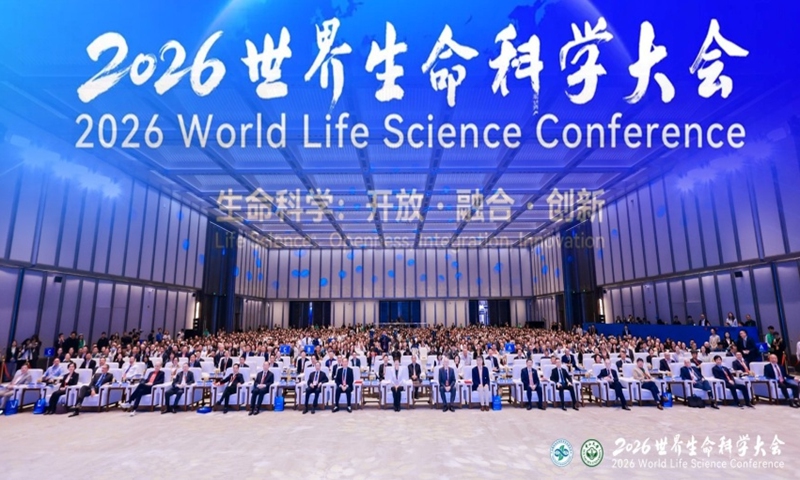
The 2026 World Life Science Conference opens in Guangzhou, South China's Guangdong Province on November 28, 2026. Photo: Courtesy of conference organizing committee
The 2026 World Life Science Conference opened at the Guangzhou Baiyun International Convention Center on Saturday, bringing together more than 2,000 delegates, including several Nobel laureates, Lasker Award winners, more than 50 Chinese and foreign academicians, and over 200 scientists.
The conference is one of China's highest-level, most extensive and influential international academic events in life sciences.
Why is the conference set at such a high level?
In his address speech at the opening ceremony, Ni Zhiyu, member of the Party Leadership Group and secretary of the Secretariat of the China Association for Science and Technology (CAST), stated that life sciences constitute a core force for unlocking the mysteries of life, safeguarding human health and advancing sustainable development.
At present, research paradigms and industrial models in life sciences are undergoing profound transformation, offering new solutions to global challenges including the prevention and treatment of major diseases, food security and ecological governance.
Ni called for commitment to openness to enable efficient sharing of research data, experimental platforms and clinical resources; commitment to interdisciplinary integration to link the whole chain of basic research, clinical applications and industrial translation; and commitment to innovation rooted in sound principles to improve ethical governance for life sciences, ensuring that innovation always serves humanity's well-being.
Academician Zhong Kang, co-chair of the conference organizing committee, said that life sciences help humanity decipher the essence of life and safeguard human health, while offering critical support for tackling global challenges in health, food security, environment and energy.
Zhong, also rotating chairman of the Union of Life Science Societies of the CAST and president of the Botanical Society of China, expressed his hope that the conference will bring together peers worldwide to explore frontiers in life sciences, advance open cooperation, enable research outcomes to protect human health, and ensure science benefits people across the world.
Tang Hongwu, president of Sun Yat-sen University and academician of the Chinese Academy of Engineering, said in his address that the accelerated translation of innovative life science achievements has generated strong momentum for fostering new quality productive forces and safeguarding people's lives and health. This year marks the 160th anniversary of medical education at Sun Yat-sen University.
The university stands ready to deepen exchanges and cooperation with global counterparts, jointly advance basic research and research on core technologies in life sciences, and promote in-depth integration of scientific and technological innovation with industrial innovation, Tang said.
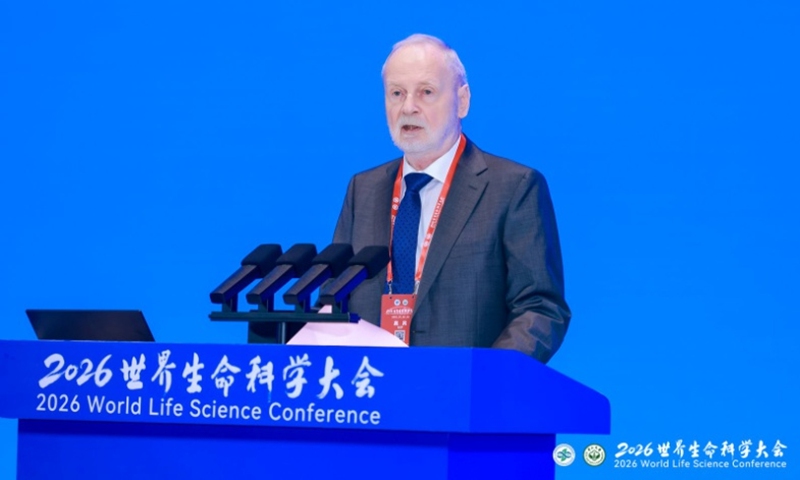
Hartmut Michel, the 1988 Nobel laureate in chemistry and international chair of the 2026 World Life Science Conference, delivers a speech at the event in Guangzhou, South China's Guangdong Province, on November 28, 2026. Photo: Courtesy of conference organizing committee
Professor Hartmut Michel, the 1988 Nobel laureate in chemistry and international chair of the conference, shared his research experience in the address and elaborated on the structural analysis of membrane proteins and its great significance for drug development. He pointed out that basic research lays a vital foundation for advances in medicine and biotechnology.
Fully understanding the structure and functions of the human body, especially the brain, represents a major challenge for life sciences. Breakthroughs will rely on methodological innovation and international collaboration, Michel said.
Following the opening ceremony, Thomas Südhof and Randy Schekman, laureates of the 2013 Nobel Prize in physiology or medicine, Napoleone Ferrara, winner of the 2010 Lasker Award for clinical medical research, and Academician He Fuchu from the Chinese Academy of Sciences (CAS) delivered keynote speeches in succession, sharing cutting-edge research findings and academic insights in life sciences.
During the conference, leading Chinese scholars including Zhong Nanshan, recipient of the Medal of the Republic and member of the Chinese Academy of Engineering, as well as CAS Academicians Huang Sanwen and Ma Jun, shared frontier ideas and China's practices in respiratory health, plant genomics and crop genetic breeding, and cancer prevention and treatment.
The conference is co-hosted by the Union of Life Science Societies of the CAST and Sun Yat-sen University. The three-day conference, themed "Life Sciences: Openness, Integration and Innovation," features 11 high-profile keynote presentations, alongside 37 parallel and special forums.
The Guangdong-Hong Kong-Macao Greater Bay Area (GBA) boasts a solid life science industrial base and an open network connecting the globe. It has ranked first among the world's top 100 innovation clusters in the Global Innovation Index for two consecutive years. To translate the outcomes from the conference into tangible progress in Guangzhou, the Union of Life Science Societies of the CAST will set up its Greater Bay Area Service Headquarters in the city. The headquarters will be built and operated with resources from member societies including the Botanical Society of China, so that the outcomes of high-level international academic conferences can deliver long-term benefits to the Greater Bay Area.
During the conference, the Global Times, the Guangdong Zhong Nanshan Medical Foundation and the Guangzhou City Brand Promotion Association signed a strategic cooperation agreement. The three parties will join hands to advance the in-depth integration of medical and humanities exchanges together with city brand development, contributing a "city model" to the international communication of building a Healthy China.
Participants said the successful convening of the conference will leave a distinctive "Guangzhou imprint" for the inclusive development, integrated innovation and shared progress of global life sciences.
Global Times
RELATED ARTICLES