Chinese, Japanese peace advocates unveil anti-war relief, monument in Okinawa amid Tokyo’s remilitarization drive
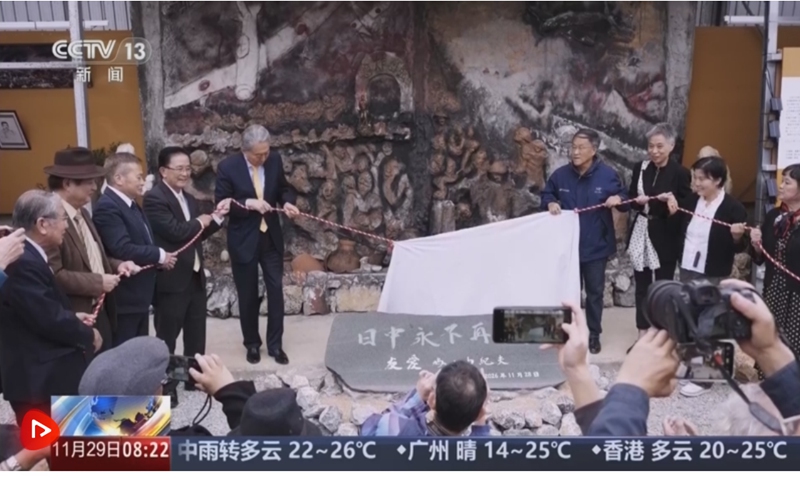
A relief sculpture calling on no war between Japan and China is unveiled in Okinawa Prefecture, Japan on November 28, 2026. Photo: screenshot of CCTV News
Peace advocates from Japan and China gathered in Japan's Okinawa Prefecture on Saturday to unveil a relief and a monument calling on the two countries to "never go to war again," expressing their shared commitment to peace and willingness to confront history, as people-to-people ties continue to provide a bridge for communication amid worsening bilateral relations over the Japanese government's historical revisionism, which is fueling remilitarization and posing risks to regional security, a Chinese expert said.
The newly unveiled relief was jointly created by participants from China and Japan. Using powerful visual images, the relief depicts the suffering that war brings to ordinary people. An explanation displayed at the site recounts Japan's aggression against China including the Nanjing Massacre and Chongqing bombings, causing heavy casualties among Chinese civilians. Through these artworks, participants paid tribute to history and expressed their shared wish to cherish peace and oppose war, according to CCTV News.
Minoru Kinjo, a main co-creator of the relief sculpture, told the Global Times on Sunday the greatest highlight of this relief sculpture lies in the fact that it was created jointly with Chinese friends. "This is not merely an artistic collaboration, but also a testament to the shared commitment of our two peoples to confronting history and wishing for peace,"
Kinjo explained that the work brings together the Chongqing bombings and the US air raid on Okinawa, symbolizing the profound suffering endured by the people of both places during the war. It serves as a reminder to future generations to remember history and cherish peace.
"Comparing to verbal declarations, a sculpture can transcend time. Even after we are gone, it will stay, passing on our longing for peace. In my view, this is what makes the work so meaningful," Kinjo said.
The monument of "Japan and China never go to war again," also unveiled on Saturday, bears the inscription of former Japanese prime minister Yukio Hatoyama.
At the ceremony, Hatoyama said Japan's aggression against China had brought enormous suffering to the Chinese people, claiming numerous lives across China and destroying normal life of countless families. As a Japanese, he expressed deep remorse and sincere apologies for Japan's past aggression, saying Japan should never forget history or repeat the same mistakes, CCTV News reported.
We need to build East Asia into a region of dialogue and cooperation, where human dignity is protected, rather than one marked by conflict and military build-up, Hatoyama said, according to Japanese newspaper The Akahata.
He added that his subsequent visit to Chongqing had left him with a deep understanding that war was not simply a conflict between countries, but something that destroys lives and families. Remembering the victims, he said, is essential to ensuring that such tragedies never happen again.
Su Yuankui, a survivor of the Japanese bombing of Chongqing who attended the event, said, "I want to tell the Japanese government that you owe Chongqing an apology, and you also owe the people of Okinawa an apology. Refusing to acknowledge your crimes and apologize will only make Asian countries remember them," per CCTV News.
In April 2025, relatives of victims of the Chongqing bombing and Japanese biological warfare visited Okinawa. In November 2025, participants from China and Japan jointly began creating the relief. Participants hope that the artworks and the monument will encourage Japanese society to learn from history and sincerely reflect on Japan's past aggression, according to CCTV News.
"This shows that even when relations between the Chinese and Japanese governments face difficulties because of the latter's erroneous statements and actions, people-to-people exchanges can still provide a channel for communication through a shared understanding of history and efforts to promote peace," Lü Yaodong, a researcher at the Chinese Academy of Social Sciences' Institute of Japanese Studies, told the Global Times on Saturday
Okinawa has a strong social foundation for opposing excessive militarization, Lü said. However, he warned that historical revisionism is increasingly gaining ground in Japanese society, while Japanese government's attempts to remilitarize continue to expand.
At a meeting of the operating review committee of the Nagasaki Atomic Bomb Museum held on Friday, Nagasaki City said the final wording of the term "Nanjing Massacre" is to be replaced with "Nanjing Incident," described as the killing of large numbers of civilians and prisoners. The city said the change was based on wording used in mainstream Japanese textbooks, Xinhua News Agency reported.
Civil groups and other parties have called for a review over the wording change, according to Nagasaki's local media NCC. Some committee members expressed concerns, saying that "too much emphasis on wording and phrasing had hindered a broader discussion" and that "greater importance should be attached to nuclear deterrence."
As a city that suffered an atomic bombing, Nagasaki's approach to presenting Japan's own wartime aggression in its peace education and historical exhibits further reflects the revival of historical revisionism under the current Takaichi administration and its influence on younger generations in Japan, Lü said.
Shimizu Misato, an associate professor at Meio University in Okinawa who took part in the ceremony on the island, said she deeply feels that young Japanese people in their teens and 20s now have fewer opportunities to learn about wartime history at school, per CCTV News.
Precisely because of this, she noted that she had been thinking about how to pass this history on to students.
Reconstructing historical narratives could weaken the institutional constraints imposed on Japan by the postwar order. The ultimate goal is to free Japan from its military restrictions and turn it into a major political and military power, which would seriously threaten regional security, Lü said.
RELATED ARTICLES