Chinese expert slams Philippine wrongful claims over Chinese research vessel's activities in South China Sea
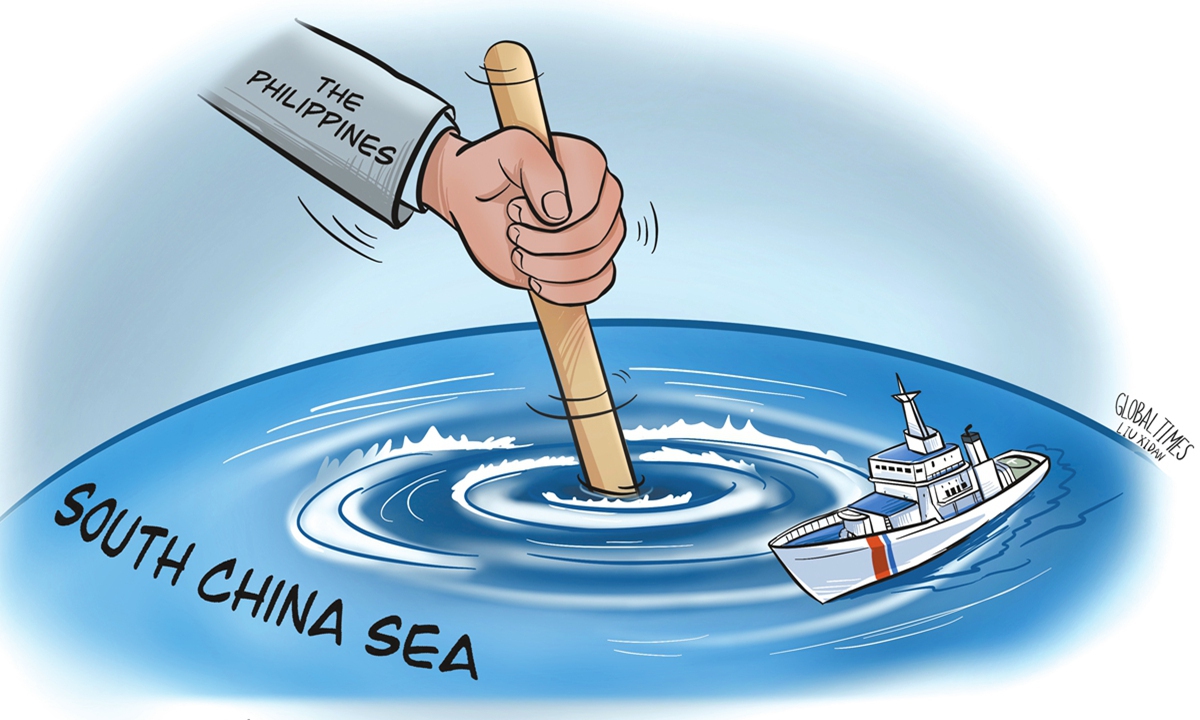
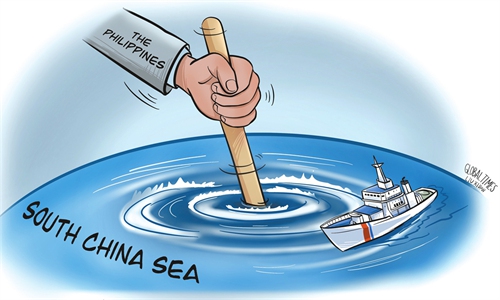
Philippines South China Sea Illustration: Liu Xidan/Global Times
Following the Philippine Coast Guard's (PCG) latest claims about a Chinese research vessel conducting so-called unauthorized marine scientific research in the South China Sea, a Chinese expert on Sunday stressed that China's research activities in waters under its jurisdiction are fully consistent with international law and Chinese domestic laws.
PCG spokesperson Jay Tarriela accused the Chinese research vessel Tan Suo Er Hao of conducting marine scientific research without Philippine authorization in waters Manila claims to be within its so-called exclusive economic zone (EEZ).
In a post on social media, Tarriela said the PCG deployed an aircraft on Sunday to "challenge" the Chinese vessel. He claimed the vessel's movements were consistent with survey operations rather than transit, and alleged that it had no authorization from the Philippine government.
Chen Xidi, an expert at the China Institute for Marine Affairs under the Ministry of Natural Resources, told the Global Times that China's marine scientific research activities in waters under its jurisdiction are fully in line with international law and Chinese domestic laws. The latest incident is another example of the Philippines stepping up maritime interference and provocations in an attempt to lend legitimacy to its unlawful maritime claims, Chen said.
The latest claim is part of a series of Philippine attempts to smear China's normal scientific research activities in the South China Sea, the expert noted.
On October 11, the Chinese Embassy in Manila rejected Philippine claims concerning Chinese scientific research activities in the South China Sea, stating that the activities are legitimate, lawful and entirely aboveboard.
"The Philippine Coast Guard, invoking its unilateral claims, interfered with the Chinese research vessel that was engaged in normal operations, infringing upon China's sovereign rights and jurisdiction in the relevant waters and violating international law and the norms governing international relations," the embassy said.
The embassy also highlighted the international benefits of the research, saying that some of these research expeditions are open to the participation of foreign scientists, and their findings serve marine research, ecological conservation, disaster prevention and mitigation, and other purposes, providing a wealth of international public goods from which the Philippines has also benefited.
The embassy also said PCG spokesperson Jay Tarriela "ignores these facts and has fallen into a state of 'persecution delusion', seeking to attack and smear China by sensationalizing China's normal scientific research activities." "Such attempts will not succeed," the embassy said.
Chen noted that China's marine research activities will not be interrupted by the Philippines' actions, and that China will continue to exercise its sovereignty, sovereign rights and jurisdiction under international law, including the United Nations Convention on the Law of the Sea (UNCLOS), and resolutely safeguard its maritime rights and interests.
RELATED ARTICLES