China's gross preschool enrollment rate stands at 92%, basic education reaches average level of high-income countries: Minister
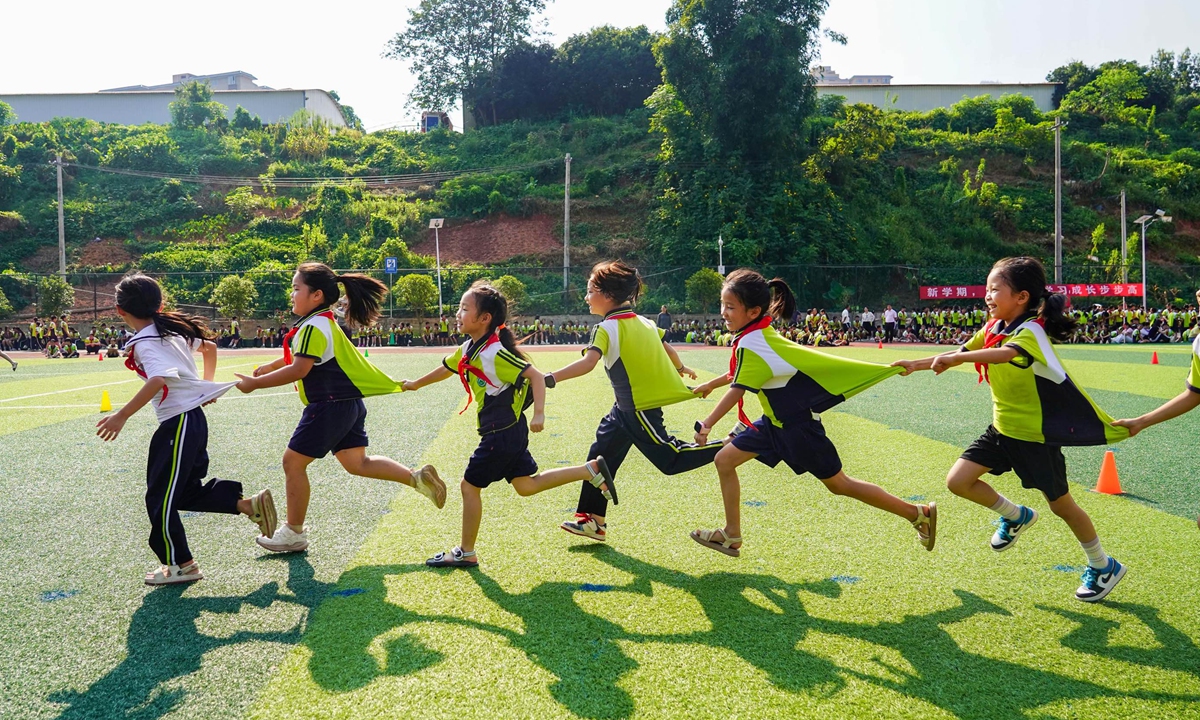
Students take part in a "two days of fun at the beginning of the school year" activity at Chengguan No.1 Primary School in Congjiang, Southwest China's Guizhou Province, on September 2, 2025. The event aims to further enhance students' sense of belonging to the school, promote emotional communication between teachers and students as well as among students themselves, and improve students' teamwork and self-presentation. Photo: VCG
All the goals and tasks in the field of education set out in the 14th Five-Year Plan period (2021-25) have been fully accomplished with high-quality, and basic education in China has reached the average level of high-income countries globally, Minister of Education Huai Jinpeng introduced at the State Council Information Office's press conference on the high-quality completion of the 14th Five-Year Plan on Tuesday.Meanwhile, higher education has cumulatively supplied 55 million professionals to society, while vocational education has provided over 70 percent of the new high-quality, skilled talent for modern industries, the minister said.
China has established the world's largest vocational education system, Vice Minister of Education Xiong Sihao said at the themed press conference. China's vocational education system currently comprises three levels: secondary vocational schools, higher vocational institutions, and vocational undergraduate programs. There are 9,302 secondary vocational schools, 1,562 higher vocational institutions, and 87 vocational undergraduate colleges, with a total enrollment of 34 million students.
China's gross preschool enrollment rate stands at 92 percent, with over 12 million children benefiting from free one-year preschool education this year, according to Huai.
Its basic education has reached the average level of high-income countries globally, and higher education has entered the universal stage with a 60.8 percent gross enrollment rate, Huai said during the press conference.
Meanwhile, Vice Minister Wang Jiayi said that during the 14th Five-Year Plan period, the Ministry of Education implemented the student physical fitness enhancement plan, promoting increased physical education classes, after-school sports services, and extended recess activities across regions.
Initiatives included introducing 15-minute breaks between classes, ensuring primary and secondary school students meet the requirement of two hours of daily comprehensive physical activity and widely organizing inter-class sports leagues. Monitoring results indicate that the physical health levels of Chinese students have generally stabilized with an upward trend, Wang said.
On the quality of meals in primary and secondary schools, Wang said the ministry has collaborated with relevant departments to carry out specialized campaigns to improve the quality of meals in primary and secondary schools.
Efforts have included issuing guidelines on campus food safety, organizing training for catering staff, upgrading canteen facilities, and promoting the establishment of parent committees for meal supervision in schools, he said, adding that a number of campus food safety incidents have been seriously addressed.
While some localities have recently continued to experience food safety issues in schools, the ministry will maintain persistent efforts, strengthen accountability, and resolutely safeguard the "safety on the tip of the tongue" for children, the official added.
Global Times
RELATED ARTICLES