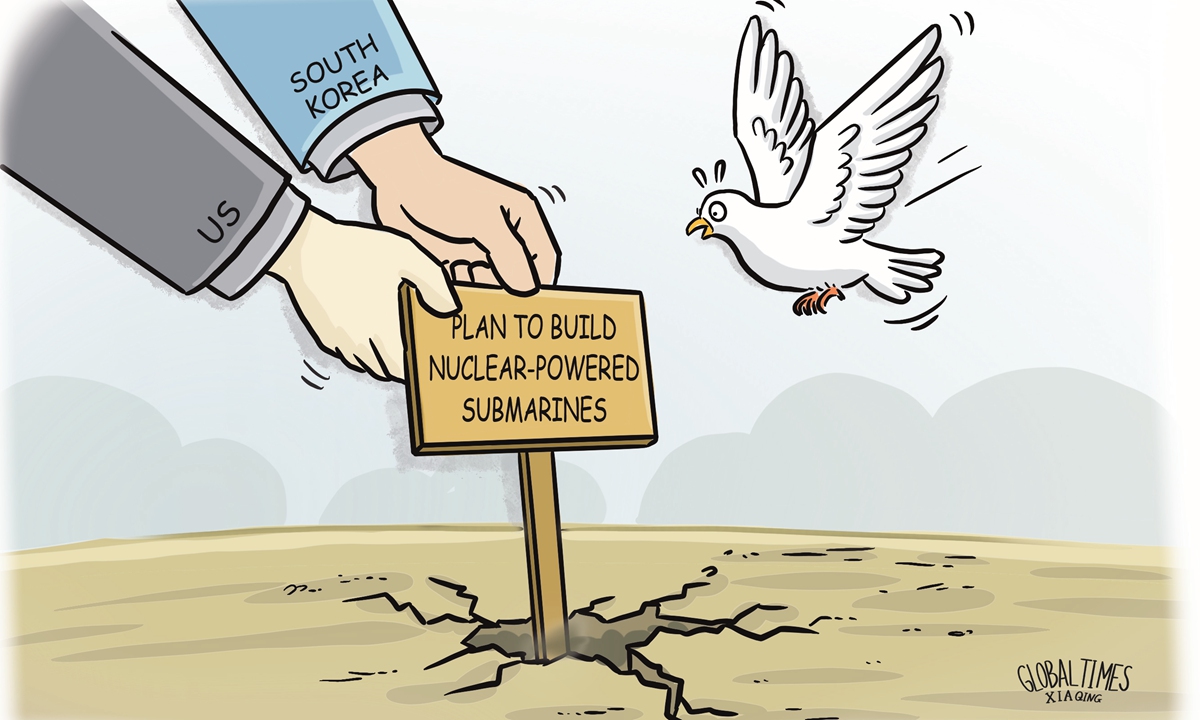
Illustration: Xia Qing/GT
Recently, the South Korean government announced that it has finalized an agreement to build nuclear-powered submarines in partnership with the US. US Chief of Naval Operations Admiral Daryl Caudle on Friday claimed that the US would expect it to play a role in its broader plan to counter China once South Korea fields a nuclear-powered attack submarine. The US-South Korea push for nuclear submarine cooperation is tantamount to lighting a new fuse in Northeast Asia. This development will not only undermine the international nuclear non-proliferation system but also increase the difficulty of denuclearizing the Korean Peninsula, triggering a chain reaction of military competition and strategic instability in the region.
The biggest hidden danger is that the US and South Korea, which have long advocated denuclearization, are now taking the lead in breaking through the bottom line of the nuclear non-proliferation system. Although nuclear-powered submarines are not themselves nuclear weapons, their core operations are based on highly sensitive nuclear fuel and are inherently for military use. Rather than learning from the controversy sparked by AUKUS, Washington has further pushed the boundaries of sensitive nuclear technology exceptions, raising growing doubts about whether it is still willing to bear the responsibility of maintaining the global non-proliferation regime.
What is even more alarming is that US-South Korea nuclear submarine cooperation will also trigger a series of chain reactions in Northeast Asia. Once nuclear submarines are deployed, their stealth capabilities mean that Seoul's maritime activities will inevitably extend beyond the traditional scope of the Peninsula. No matter how South Korea packages it in the future, US-South Korea nuclear submarine cooperation will inevitably be seen as part of the US strategy to contain China in the maritime domain and advance its "Indo-Pacific Strategy." This will further weaken the already fragile strategic mutual trust between China and South Korea, push South Korea to the forefront of US maritime strategy, and heighten tensions in the regional security environment.
The proliferation of such sensitive nuclear technology in Northeast Asia will inevitably spark an arms race. The new Japanese government has publicly called for Tokyo to consider acquiring nuclear-powered submarines and reviewing the country's long-standing Three Non-Nuclear Principles. Once South Korea takes the lead in breaking through, voices in Japan demanding not to fall behind may grow louder. Compared to external chain reactions, the damage caused by US-South Korea nuclear submarine cooperation to the denuclearization of the Korean Peninsula is more direct and far-reaching. This will undoubtedly deal a heavy blow to international efforts for the denuclearization of the Korean Peninsula.
For China, the US-South Korea move directly impacts its security environment. China has consistently worked to promote peace and stability on the Korean Peninsula and opposes any action that heightens regional tensions. China not only supports the Nuclear Non-Proliferation Treaty regime but also firmly opposes the emergence of new bloc confrontations and arms races in the region.
The US-South Korea nuclear submarine cooperation is steering the region in the wrong direction, creating new uncertainties across multiple domains, including maritime security, regional strategy, and nuclear non-proliferation.
In fact, nuclear submarine cooperation could yield long-term negative consequences. For the US, arbitrarily exempting sensitive nuclear technologies from proliferation restrictions not only undermines its own credibility but also encourages other countries to make similar demands, threatening the integrity of the entire nuclear non-proliferation regime. For South Korea, building nuclear submarines would mean being deeply anchored at the forefront of the US "Indo-Pacific Strategy," thereby losing strategic autonomy, which signifies increased risks.
Nuclear submarine cooperation is by no means a symbol of "alliance modernization" to enhance security; rather, it acts as a "strategic amplifier" driving risk proliferation. It brings not balance but imbalance; not deterrence but provocation; not security but an accumulation of arms races and strategic miscalculations.
Northeast Asia is not a stage for reckless nuclear experimentation, nor can it bear the security consequences of further nuclear proliferation. If the US and South Korea genuinely care about the region's future, they must return to the correct path of advancing the denuclearization of the Korean Peninsula and promoting regional peace and stability. History will not forgive the reckless, and Northeast Asia cannot afford the gambles of the adventurous.
The author is director and professor of the Center for Korean Peninsula Studies at the Shanghai University of International Business and Economics. opinion@globaltimes.com.cn
RELATED ARTICLES