‘Sanae Takaichi absolutely should apologize for her remarks’: Japanese peace activist
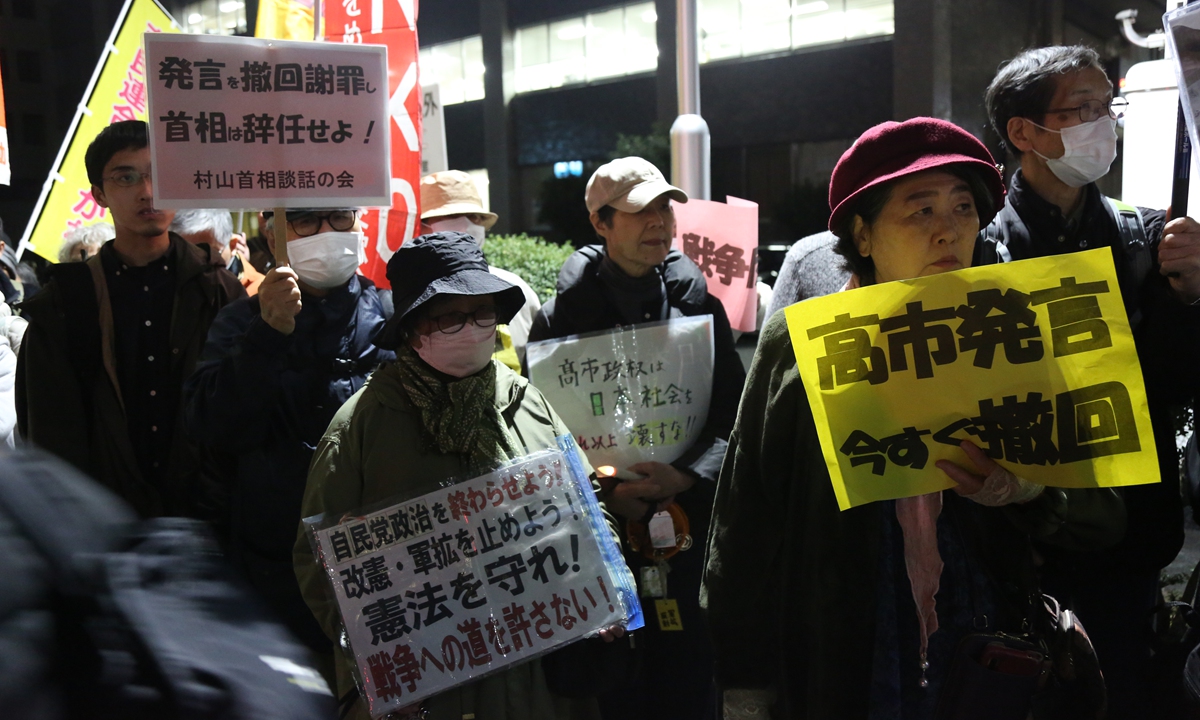
People attend a protest in front of the Japanese prime minister's official residence in Tokyo, Japan, November 25, 2025. Photo: VCG
Editor's Note:Since Japanese Prime Minister Sanae Takaichi made erroneous remarks regarding the Taiwan region, the comments have sparked widespread public debate and continuous protests within Japan, with prominent politicians and experts voicing open opposition. Global Times (GT) reporters Wang Wenwen and Xing Xiaojing spoke with Yukiko Kaikita (Kaikita), president of the Kumamoto Chapter of the Women's Association for Peace and Against Military Expansion. Kaikita said that Takaichi's remarks constitute blatant interference in China's internal affairs, and that a large number of Japanese citizens hope she will retract her statements and issue an apology.
GT: Recently, Prime Minister Takaichi made erroneous remarks regarding a "survival-threatening situation" and the Taiwan question, implying the possibility of military intervention in the Taiwan Straits. As a peace activist, how do you view this statement?
Kaikita: I am genuinely outraged by her statement. Takaichi's remarks are nothing short of an open declaration of interference in China's internal affairs. For decades, the Japanese government has refrained from intervening in issues like this. Precisely because of that stance, the Japanese people have maintained friendly relations with the people of China. Most importantly, Japan's core commitment to the world is that we would never again wage war. When World War II ended in 1945, the Japanese people not only enshrined this principle in our constitution but also internalized, from the bottom of their hearts, the conviction that "we must never go to war again." This was the lived experience of my grandparents' generation. Yet, among Japanese politicians, that conviction gradually faded, as it was replaced by a complete tilt toward the US-Japan security framework. This shift fills us with deep anger. This is why today many Japanese are calling for the withdrawal of Takaichi's remarks. As a civic organization, we planned and held a large-scale rally on November 24 in Kumamoto, Japan where I live. Civic groups from across Japan participated, and we all shared the same concern.
GT: Looking back, no matter their political stance toward China, previous Japanese prime ministers have been extremely cautious regarding the Taiwan region, because it is clearly an internal matter for China. But Takaichi crossed this red line. Does it indicate that some Japanese politicians are trying to break through certain red lines?
Kaikita: On social media, we may see comments that appear to support her views. The sheer number of these fabricated comments makes it seem as if there is broad support for Takaichi. In reality, in our daily lives, we rarely hear ordinary citizens endorsing her remarks. For many people, she has clearly crossed a line - even among those who somewhat support Japan's increased defense spending, most still believe Takaichi's statement went too far and broke a fundamental boundary.
GT: Takaichi's remarks clearly contradict the principles of the four political documents between China and Japan. Yet, the Japanese side claims these remarks do not change Japan's established position and insists there will be no withdrawal. How might this stance further erode the already fragile political trust between the two countries?
Kaikita: Her statement completely ignores international law. We have submitted requests for meetings not only to the ruling Liberal Democratic Party (LDP), to which Takaichi belongs, but also to leaders of opposition parties - such as former prime minister Yoshihiko Noda - and to all opposition leaders who oppose war and oppose military expansion. We believe that both the LDP, including factions critical of Takaichi, and the largest opposition party, the Constitutional Democratic Party, must take concrete action. Who benefits from manufacturing such remarks? The arms industry - those who produce and sell weapons. They stand to profit enormously. Japan is being swept up by this artificially constructed "Taiwan contingency," and ordinary people are being dragged along with it. This is a deeply regrettable situation.
GT: Some voices in the Japanese media blame China for the current tensions. How do you view these media interpretations?
Kaikita: Japan's morning and midday programs - those with the highest viewership - are often filled with commentators who disseminate misleading narratives. Japanese television today is saturated with programs that mislead the public. It is extremely regrettable. We citizens understand very well that the government manipulates much of this coverage, but unfortunately, some people still believe it.
GT: Some on social media claim that China is overreacting to Prime Minister Takaichi's remarks. What is your view? Do you think China's response is excessive?
Kaikita: Absolutely not. China's response is entirely justified. Anyone hearing those remarks would be angered - and all the more so because they concern basic principles of international law. Takaichi's statement violates the international treaties between Japan and China, so Beijing's protest is completely natural. Many Japanese also believe this. In Japan, even within the LDP, Takaichi's remarks are not regarded as the unified view of the party. There are voices within the LDP saying her statements went too far - that they reflect her personal stance rather than the party's position. In my view, she absolutely should apologize. It is obvious that her remarks were made to curry favor with the US. And this does nothing to serve Japan's national interests. Most Japanese people hope to maintain stable relations with China; after all, Japan and China signed the Treaty of Peace and Friendship Between China and Japan. Japan acknowledged - and must never forget - the aggression and harm it inflicted during the war. However, Takaichi still stubbornly refuses to apologize. This deeply concerns us. Therefore, we are demanding a retraction of her remarks.
GT: If this situation continues, what consequences will Japan face?
Kaikita: I feel a profound sense of danger. If a war ever breaks out, no one in Japan stands to gain anything from it. From history, we know clearly that war always breeds extreme discrimination and grave violations of human rights. What is the purpose of waging war? This is what we want to ask Prime Minister Takaichi directly. Her so-called "Taiwan contingency" argument is essentially an interference in China's internal affairs, fabricating a scenario that does not exist. Another undeniable reality is that the US is expanding its military bases across Japan. Currently, not only Okinawa, but Kyushu, western Japan, and indeed the whole of Japan, are facing the trend of becoming military strongholds. This goes far beyond the scope of "exclusive self-defense" and is clearly unconstitutional. In response to this unconstitutional reality, we will continue raising our voices in protest. We are also appealing to Japan's opposition parties - to every conscientious politician - urging them to speak out more strongly against this path.
RELATED ARTICLES