Illustration: Liu Rui/GT
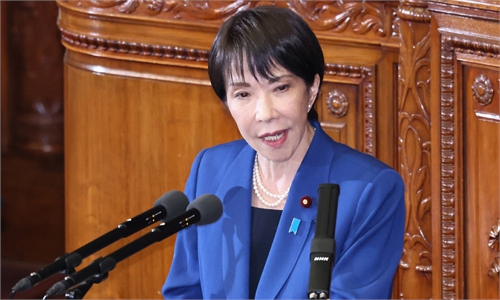
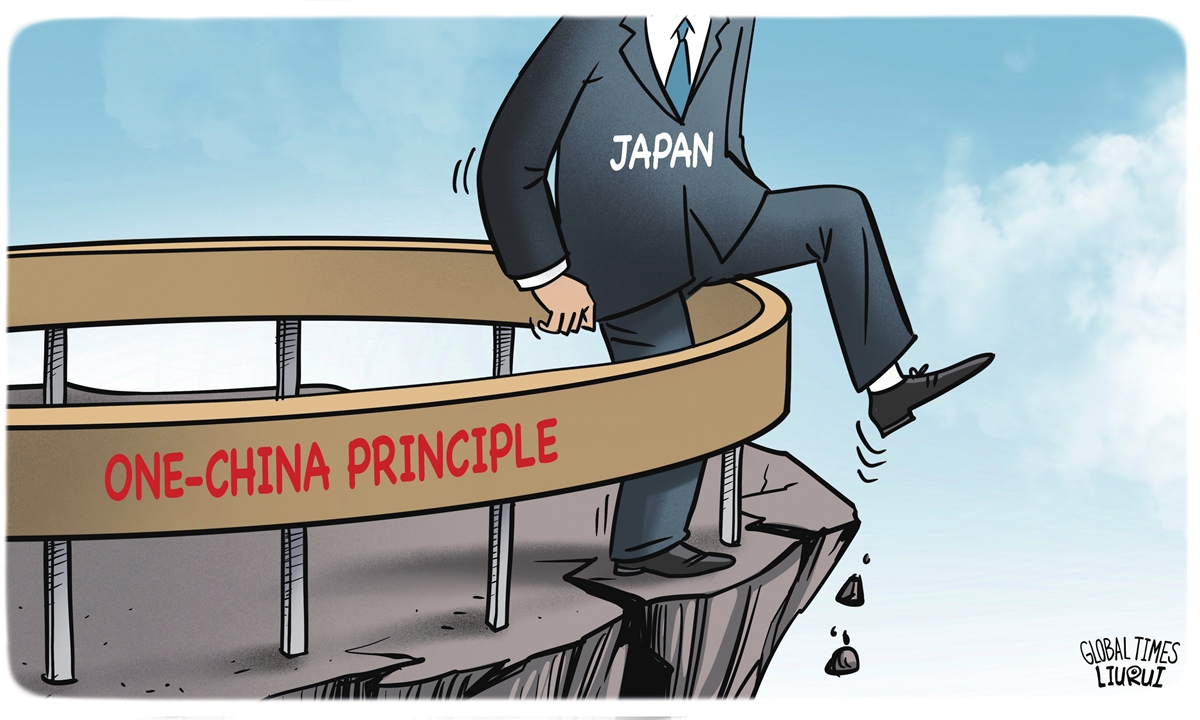
Some may wonder why China has responded so firmly to Japanese Prime Minister Sanae Takaichi's erroneous remarks on Taiwan. To them, it might seem like making a mountain out of a molehill. But such a perception is profoundly mistaken - her remarks are by no means a minor issue.A more relevant question to ask is: Why has Japan kept violating international law and reneging on its own commitments? If Japan continues to ignore its historical responsibilities, evade historical facts, and break its promises, there will be consequences for it to bear.
I. The illegality of Takaichi's remarks
First, Takaichi's remarks violated Japan's special obligations under the postwar international order.
No matter how hard some Japanese politicians have tried to justify Japan's interference in China's Taiwan affairs, two fundamental facts remain unshakable: First, Japan was obligated to return Taiwan to China under relevant international instruments. Second, the question regarding the status of Taiwan has already been resolved once and for all.
Before the First Sino-Japanese War, Taiwan had already been a province of China, a historical fact beyond any dispute. It was from China that Japan seized Taiwan and the Penghu Islands through an unequal treaty, and subsequently imposed a ruthless 50-year-long colonial rule over Taiwan.
The 1943 Cairo Declaration stipulated that all the territories Japan has stolen from the Chinese, such as Manchuria, Formosa (Taiwan), and The Pescadores (The Penghu Islands), shall be restored to China. These terms were reaffirmed by the 1945 Potsdam Proclamation and then accepted by Japan in its Instrument of Surrender in the same year.
These documents are part and parcel of the legal foundation of the postwar international order, and unequivocally confirm China's sovereignty over Taiwan. Taiwan's return to China is therefore an integral part of the global order established after the defeat of fascism.
Second, Takaichi's remarks breached Japan's own commitments made in its bilateral documents with China.
During the discussions on resuming China-Japan diplomatic ties, China made it clear that to normalize relations, Japan must accept the following three principles:
(1) The Government of the People's Republic of China is the sole and legal government representing the Chinese people.
(2) Taiwan is an inalienable part of the territory of the People's Republic of China.
(3) The so-called "Taiwan-Japan Treaty" is illegal and invalid and must be abrogated.
Correspondingly, the 1972 Sino-Japanese Joint Statement that normalized bilateral relations has three places related to Taiwan:
First, the Japanese side "reaffirms its position that it intends to realize the normalization of relations between the two countries from the stand of fully understanding 'the three principles for resuming diplomatic relations' put forward by the Government of the People's Republic of China."
Second, "the Government of Japan recognizes the Government of the People's Republic of China as the sole legal Government of China."
Third, "the Government of the People's Republic of China reiterates that Taiwan is an inalienable part of the territory of the People's Republic of China. The Government of Japan fully understands and respects this stand of the Government of the People's Republic of China, and it firmly maintains its stand under Article 8 of the Potsdam Proclamation."
One fact that was deliberately ignored by some Japanese politicians is that after signing the Sino-Japanese Joint Statement, the then Japanese foreign minister Masayoshi Ohira publicly announced at a press conference that the "Taiwan-Japan Treaty" had lost the reason for its existence and had been terminated.
In 1978, the two countries signed the Treaty of Peace and Friendship, which explicitly stated that the Sino-Japanese Joint Statement "constitutes the basis for relations of peace and friendship between the two countries and that the principles set out in that statement should be strictly observed." Ratified by the legislative bodies of both countries as a legal intergovernmental instrument, the treaty reaffirmed the principles and provisions of the Joint Statement and set out the legal parameters for China-Japan relations.
In 1998, the two sides released the China-Japan Joint Declaration on Building a Partnership of Friendship and Cooperation for Peace and Development, in which Japan undertook to "continue to maintain its stand on the Taiwan question which was set forth in the Sino-Japanese Joint Statement" and "reiterated its understanding that there is one China." It was stated in the document that "Japan will continue to maintain its exchanges of private and regional nature with Taiwan." These provisions ruled out any legal possibility of Japan developing official relations with Taiwan.
In the 2008 China-Japan Joint Statement on All-round Promotion of Strategic Relationship of Mutual Benefit, the Japanese side "reiterated that it will continue to abide by its position on the Taiwan question stated in the Sino-Japanese Joint Statement."
The above is what is laid out in the four political documents between China and Japan regarding the Taiwan question. They are the solemn commitments made by the Japanese government and have a legal effect under international law. There is no room for ambiguity or distortion. What Takaichi said about Taiwan brazenly contradicted Japan's commitments and called into serious question Japan's international credibility.
Third, Takaichi's remarks run counter to basic principles of international law.
The Charter of the United Nations sets out the principles of respect for sovereignty and territorial integrity, and non-interference in the internal affairs of other states. The 1970 Declaration on Principles of International Law also proclaims that "Every State has the duty to refrain in its international relations from the threat or use of force against the territorial integrity or political independence of any State," and that "No State or group of States has the right to intervene, directly or indirectly, for any reason whatever, in the internal or external affairs of any other State."
Yet, when the Taiwan separatist forces push for "Taiwan independence" or advocate the "two-state theory," Japan openly supports them, condoning and even encouraging their separatist activities on its soil. Such actions constitute a violation of China's sovereignty and a breach of the UN Charter and basic principles of international law. This is utterly unacceptable to the Chinese side.
II. The legal means at China's disposal
As a Chinese saying goes, "Laws cannot be effective unless enforced; goodwill cannot stand unless backed by rules." If Japan knowingly breaches international law, it must be held fully accountable for its violations.
According to Article 60 of the Vienna Convention on the Law of Treaties, a material breach of a bilateral treaty by one of the parties entitles the other to invoke the breach as a ground for terminating the treaty or suspending its operation in whole or in part.
In the 1972 Joint Statement, China declared that in the interest of the friendship between the Chinese and the Japanese peoples, it renounced its demand for war reparation from Japan. This act of goodwill was taken on the basis that Japan would reflect on its wartime crimes and abide by the one-China principle. If Japan perversely pursues acts that constitute a material breach of the Joint Statement, China is fully entitled to suspend or terminate the aforesaid document in whole or in part. If Japan does not want peace and friendship with China, then China has no choice but to defend itself with legal actions. Is Japan ready to face a delayed "bill" for its past action of aggression?
According to the UN Charter, "Membership in the United Nations is open to all other peace-loving states which accept the obligations contained in the present Charter." When Japan, a former aggressor, applied for the UN membership, it pledged to abide by the UN Charter. By granting Japan the membership, the world community demonstrated great tolerance and goodwill in the hope that peace and stability would prevail.
Yet in recent years, Japan has been increasing its defense budget, relaxing its arms export restrictions, expanding its offensive military capabilities, and reinterpreted its constitution to allow limited exercise of the right of collective self-defense. It has even attempted to revise the Three Non-Nuclear Principles which have long served as a cornerstone of its nuclear weapon policy.
Such actions represent a complete departure from Japan's postwar "pacifism" and mark a further step toward reviving militarism. How could a country going down such a path expect to become a permanent member of the UN Security Council? That would be nothing but a daydream.
Takaichi's reckless remarks were unprecedented since 1945: It was the first time that a Japanese leader publicly linked a "Taiwan emergency" with Japan's right of collective self-defense and implied the possibility of Japan's armed intervention in the Taiwan Straits. It also marked the first time a defeated nation in World War II openly threatened to use force against a victorious one.
That said, Japan is trying to play the "victim," portraying itself as the one being wronged and refusing to retract its erroneous remarks. The international community should stay clear-eyed and sober-minded, and guard against any attempt by Japan to break free from its constitutional constraints which will severely damage the postwar international order.
China will never allow the right-wing forces in Japan to turn back the wheel of history, never permit external forces to meddle in China's Taiwan region, and never tolerate the resurgence of Japanese militarism. This is a stern warning from China that Japan should take seriously.
Should China ultimately be compelled to take any countermeasures, Japan has no one to blame but itself. Countries upholding the international order will make the right choice.
The author is a commentator on international affairs, writing regularly for Xinhua News, Global Times, China Daily, CGTN etc. opinion@globaltimes.com.cn
RELATED ARTICLES