Exclusive: ‘Obscuring reflection on past wars leads to preparation for next war’: Japanese civic group criticizes children’s version of defense white paper
By Published: Dec 30, 2025 09:01 PM

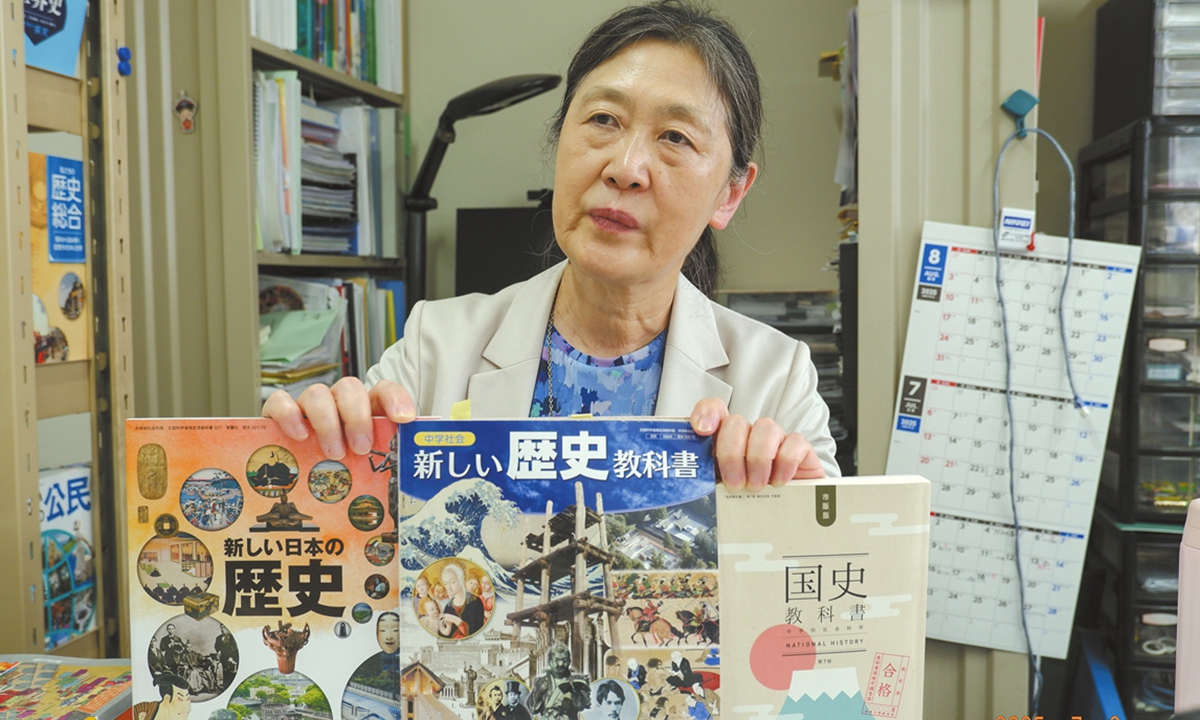
Yoko Kojiya, secretary-general of the Children and Textbooks Japan Network 21, a non-governmental organization, displays various versions of Japanese history textbooks to Global Times reporters on July 2, 2025. Photo: Xu Keyue/GT
The recent online publication of Japan's 2025 children's version of the Defense White Paper and the distribution of the 2024 edition to elementary schools across Japan are problematic and dangerous, said Yoko Kojiya, secretary-general of the NGO Children and Textbooks Japan Network 21, warning that "obscuring reflection on past wars leads to preparation for the next war."
In an exclusive interview with the Global Times on Tuesday, Kojiya addressed multiple concerns: the nationwide distribution of a children's defense white paper to elementary schools, the downplaying or glorification of Japan's history of aggression in textbooks and Prime Minister Sanae Takaichi's recent erroneous remarks on Taiwan, which have strained China-Japan relations, as well as the country's pursuit of dangerous military expansion.
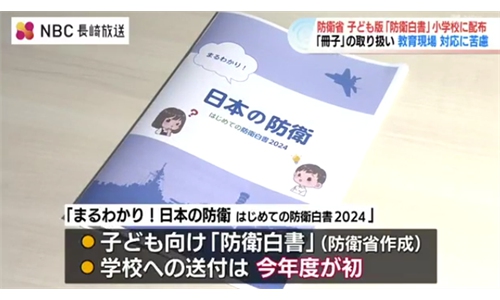
The Mainichi Shimbun reported on Sunday that the 2025 children's version of the Defense White Paper, released by the Japanese Ministry of Defense (MOD) and the Self-Defense Forces (SDF) in July, has 34 pages, 12 more than the 2024 edition, with its cover featuring illustrations representing ground, maritime and air Self-Defense Force personnel..
Although the 2025 edition has not been distributed, it has already been released online and includes more content than before, explaining the various roles within the Self-Defense Forces and the process from application to enlistment, the Tokyo Shimbun reported.
Shimbun Akahata, the newspaper of the Japanese Communist Party, reported in August that as of July, Japan's Ministry of Defense had distributed 6,100 copies of the children's version of the Defense White Paper 2024 to approximately 2,400 elementary schools nationwide.
"I have considered it a problematic booklet since 'My First Defense White Paper' was uploaded to the Ministry of Defense's website in 2021," Kojiya told the Global Times.
She criticized the intention to use cute illustrations to portray SDF personnel as just a regular profession, omitting aspects related to the use of force, aiming to make children admire them. Another issue was the booklet made no mention of reflecting on past wars or the pacifist Constitution, said Kojiya.
"I felt it was a very dangerous publication and should, at the very least, not serve as educational material to children," Kojiya said, adding that "distributing such a booklet to elementary schools is something that should not be done."
In the booklet, there are descriptions that mention specific countries by name, which could foster prejudice and hostility, posing a serious problem also from the perspective of international solidarity, Kojiya said. According to the 2025 edition, the booklet claimed that "The region where Japan is located cannot be considered safe," citing surrounding countries including North Korea, Russia and China. The 2024 edition made similar claims.
Nevertheless, the Japanese MOD sending it unilaterally with requests like 'please place it in the library' or conducting surveys on 'how it was utilized' constitutes undue interference in educational content and is unacceptable, Kojiya criticized.
When commenting on history revisionism in textbooks in Japan, Kojiya, who was a middle school teacher, said that the recent distribution of the children version of the Defense White Paper 2024 to elementary schools might be the "next move" by forces wishing to spread erroneous historical views.
"Obscuring reflection on past wars leads to preparation for the next war. We intend to raise our voices in opposition to each such instance," Kojiya emphasized.
Since Takaichi has made erroneous remarks concerning a "Taiwan contingency," creating tensions in Japan-China relations and the regional situation, Kojiya urged Takaichi to retract her remarks immediately. The origin of the problem lies in Takaichi's remarks. However, as for some voices in Japan who are suggesting that 'those who asked the question are at fault' or that 'those who make it an issue are wrong' - I believe that argument is also mistaken."
Furthermore, within Japan, alongside the significant increase in defense spending, voices have emerged calling for discussion on "nuclear possession" and a review of the "Three Non-Nuclear Principles." Commenting on this, Kojiya warned "These are extremely dangerous developments, and I cannot help but feel that the Takaichi administration is trying to lead us into war."
"The root cause is that historical recognition - clearly acknowledging and reflecting on the responsibility for waging a war of aggression - has not been shared by the entire Japanese nation, particularly not by the government," Kojiya said.
She urged the Japanese public to learn history together with the people of China, South Korea, Southeast Asia and others, and to further amplify the voices calling for peace.
The Global Times conducted a face-to-face interview in Japan on July 2 with Kojiya who displayed various versions of Japanese history textbooks, noting that "Japanese children have a very poor understanding of the past war between Japan and China." She also noted that current textbook content has clearly shifted rightward.
RELATED ARTICLES