S.Korea finds devt synergy in China’s 15th Five-Year Plan
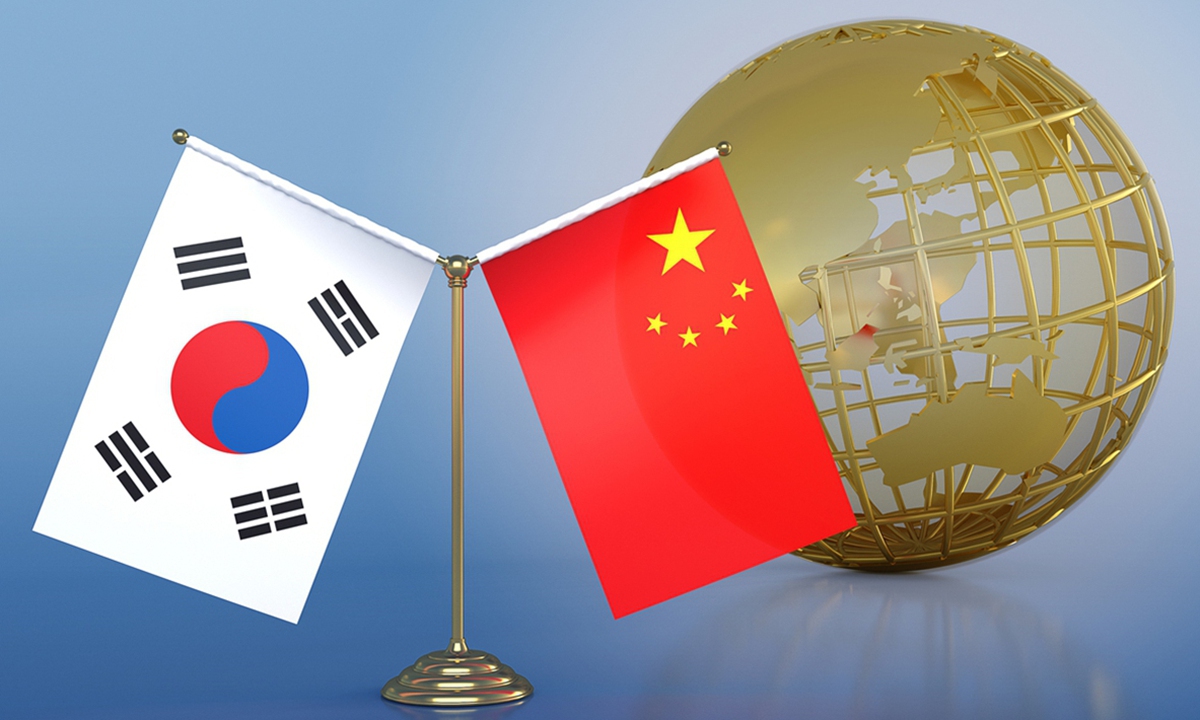
China South Korea Photo:VCG
South Korean President Lee Jae-myung conducted a state visit to China earlier this month. During the visit, he explicitly defined 2026 as the "first year of full-scale restoration" of China-South Korea relations. President Lee also repeatedly emphasized South Korea's eagerness to seize the opportunities brought by China's 15th Five-Year Plan (2026-30) to achieve more results in practical cooperation with China. Immediately upon returning home, he chaired a "2026 Economic Growth Strategy National Briefing."This sequence of actions outlines a clear trajectory: In a highly volatile international environment, South Korea is attempting to find certainty within China's medium-to-long-term development roadmap.
The year 2026 marks the launch of China's 15th Five-Year Plan and serves as a critical juncture for South Korea's strategy of AI transformation of manufacturing industries. The alignment of these two timelines gives this visit a sense of "policy synchronization." From available information, it is expected that the 15th Five-Year Plan will be heavily concentrated on new quality productive forces, modernized industrial systems, supply chain resilience and AI. These keywords represent not only China's policy focus for the next five years, but also the exact areas where South Korea perceives a mix of intense pressure and immense opportunity. Consequently, Lee's emphasis on "seizing the opportunities brought by China's 15th Five-Year Plan" is a policy stance rooted in pragmatic assessment.
For South Korea, the strongest signal released by the 15th Five-Year Plan is the certainty of China's development path. Against a backdrop of sluggish global recovery and rising geopolitical spillovers, China has pivoted toward high-quality development, technological industrialization and domestic demand expansion. This ensures the continued existence of a massive market with policy continuity. Unlike short-term stimulus packages, China's long-term planning provides partners with a predictable policy environment.
Second, there is industrial complementarity between China and South Korea. Whether in AI, advanced manufacturing, new energy or the "silver economy" addressing an aging population, China is pushing for the transition from technological breakthroughs to large-scale application under the 15th Five-Year Plan framework. This provides a "landing zone" for South Korea's economic and industrial transformation strategy. While South Korea maintains an edge in manufacturing foundations, system integration and certain core technologies, China possesses an unparalleled array of application scenarios, industrial clusters and market scale. The relationship is not one of simple displacement. It offers space for "staggered collaboration" in specific segments.
For instance, the aging population is a structural challenge shared by both nations and a potential entry point for cooperation. While China is utilizing technology to empower elderly care, healthcare and public services, South Korea has deep expertise in medical standards, equipment and services. Synergizing standards, technology and markets would not only help both countries to address domestic challenges, but also create a joint force for third-party markets.
Third, China and South Korea face the practical need for supply chain resilience. In recent years, external shocks have become frequent, and global supply chains have been increasingly politicized. China's emphasis on supply chain security and resilience in the 15th Five-Year Plan is not an invitation to isolationism, but rather an effort to enhance shock resistance through diversification and systemic strength. For South Korea, instead of passively reacting to external uncertainties, it is more strategic to find stable industrial anchors through cooperation with China. This is why the South Korean business community continues to prioritize the Chinese market.
Admittedly, competition between China and South Korea is an objective reality. As China accelerates its pace to catch up or even take the lead in various technological fields, South Korea's sense of "intensified competition" has grown. However, competition does not inevitably lead to confrontation. The real question is whether this competition can be confined to the industrial and market levels, avoiding the trap of overstretching the concept of security. President Lee's repeated calls for pragmatic cooperation based on a "more horizontal structure," in essence, is an attempt to secure space for this "controllable competition."
Ultimately, the fundamental proposition of China-South Korea relations is not "whether to compete," but "how to cooperate amid competition." The 15th Five-Year Plan provides a clear directional coordinate for the next five years and a window of observation and alignment for partners like South Korea. Whether they can identify certainty within this window and translate it into cooperative results depends on both China and its partnering countries maintaining rational judgment and pragmatic action. For the China-South Korea relationship, seizing the opportunity of the 15th Five-Year Plan to build a new balance of cooperation amid competition may be the true essence of this "year of full-scale restoration."
The author is director and professor of the Center for Korean Peninsula Studies at the Shanghai University of International Business and Economics. opinion@globaltimes.com.cn
RELATED ARTICLES