Illustration: Liu Rui/GT
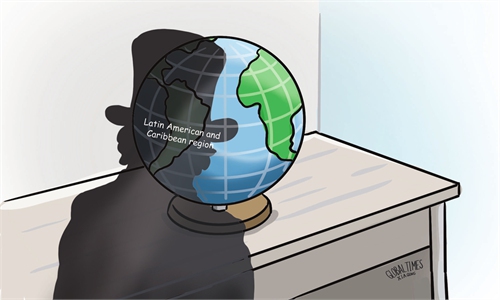
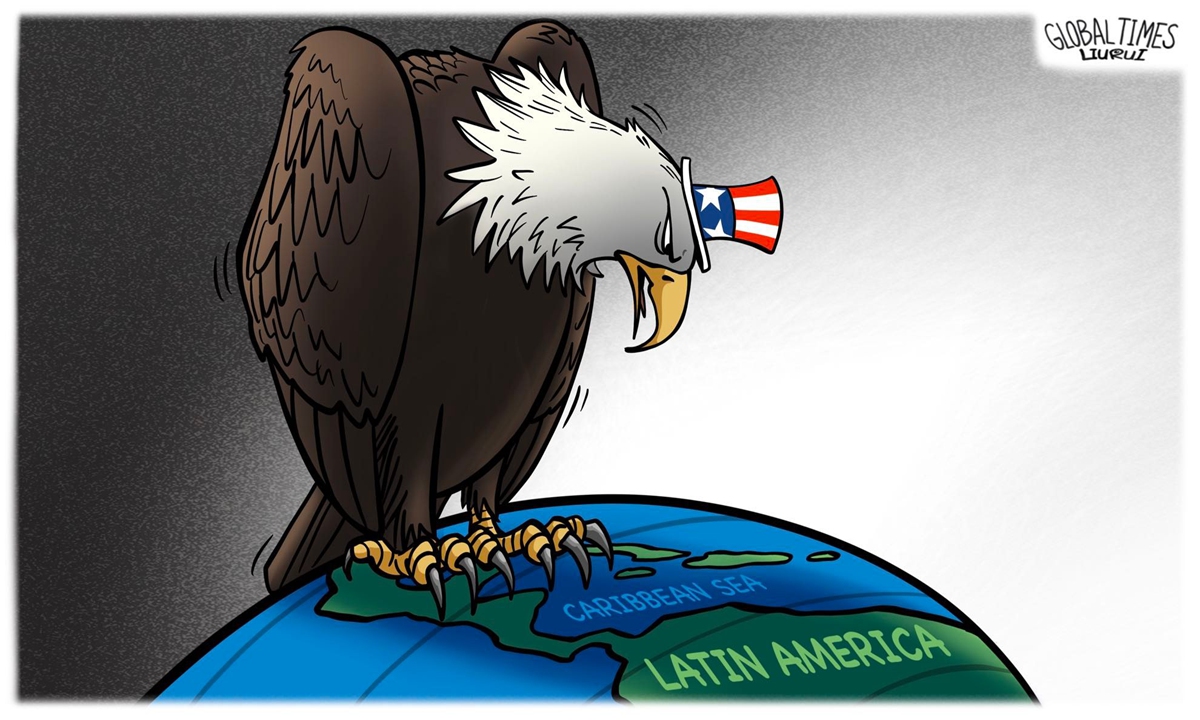
On Sunday, Brazilian President Luiz Inacio Lula da Silva published an op-ed in The New York Times titled "This Hemisphere Belongs to All of Us." In the article, he stressed that the peoples of Latin America and the Caribbean have their own interests and dreams to defend, stating bluntly: "We will not be subservient to hegemonic endeavors." His message was not only a declaration of principle, but also a warning rooted in historical memory and present-day realities.At the beginning of 2026, the world witnesses a grave and defining moment in Latin American history: The US has decided to resurrect the old Monroe Doctrine. What we are experiencing is not just rhetoric; it is a dangerous project disguised as "hemispheric security" and the "fight against drug trafficking" that threatens the autonomy of our entire continent.
The seizure of the Venezuelan president by US forces on January 3, followed by his forced removal to a foreign country to face legal charges, represents an unprecedented act of aggression against a sovereign head of state since the end of World War II. No matter how much it is whitewashed, this action constitutes a flagrant violation of international law and a blatant return to practices that should be a thing of the past.
While US governments have often invoked the Monroe Doctrine, what we see today is a restored and aggressive new Monroe Doctrine version, a reinterpretation that uses military and economic power to impose Washington's will on other countries.
Under this new umbrella, the actions in Venezuela are not an exception but rather the opening of a broader strategy to ensure the fulfillment of objectives on the continent. Beyond the official justifications (security, drug trafficking, institutional chaos), the true logic is to consolidate a power that refuses to accept the emergence of a multipolar world.
Faced with this wave of interventions and threats, Latin American countries are unlikely to succumb one after another to US pressure in quick succession. The political history of our region is far too diverse, full of unique experiences, to fall under a simplistic pattern. The Latin American population - from Mexico to Argentina, Uruguay to Peru - detests the idea of being subjugated by an external power 200 years after declaring independence. Sooner or later, this popular rejection will turn any attempt to impose satellite governments into a political boomerang for Washington.
However, what could be plausible is a "political contagion" in terms of elections and governments in the region. Countries like Colombia and Brazil, with crucial elections scheduled for 2026, are under close scrutiny because when a geopolitical giant decides to intervene in the lives of its neighbors, the danger is not only military: It is economic, media-related and institutional.
At the same time, if we want to understand the extent of US unpredictability, it's not enough to look only to the south. The recent threat by the US president to impose tariffs on countries that do not support his plan on Greenland and the use of national security and rivalry with China as excuses shows that this expansive pattern goes beyond the traditional borders of the hemisphere.
Greenland is not Latin America, but its inclusion in Washington's rhetoric demonstrates a logic that seeks global strategic prerogatives. The message is clear: If you are resource-rich or geo-strategically located, you are a target for intervention, coercion or punishment.
Faced with this scenario, what we must promote is not surrender or isolation, but a reinvention of our international relations from each country. Latin America must reclaim its voice, free itself from tutelage. We must strengthen multilateral institutions and other regional mechanisms to defend sovereignty and build an order based on rules, not on the law of "might is right." History has taught us all too well what it means to be the backyard of a superpower: loss of resources, destruction of social projects and institutional weakening.
Hope lies in international cooperation from a perspective that is diverse, tolerant and respectful of the plurality of political models. Emerging groups such as BRICS and other coalitions of countries willing to challenge unipolarity can offer spaces for a new global diplomacy that is not subordinate to anyone's hegemony.
In this and any other context, Latin America must not be a battleground for empires or a laboratory for experiments. Let no one tell us that the only alternative is to submit to the will of the strongest.
The future we need is one where nations relate to each other under clear rules, mutual respect and cooperation, not under threats, interventions or impositions.
Latin America must continue to be for Latin Americans: a land of dignity, freedom and future, not a satellite of the ambitions of a declining superpower.
The author is the former secretary of state of economical and financial affairs of the Ministry of Economy of Argentina and former undersecretary for economic negotiations of the Ministry of Foreign Affairs in Argentina. opinion@globaltimes.com.cn
RELATED ARTICLES