US ambitions for Greenland ‘because of all the minerals, resources, waters and land that Greenland has’: Inuit activist
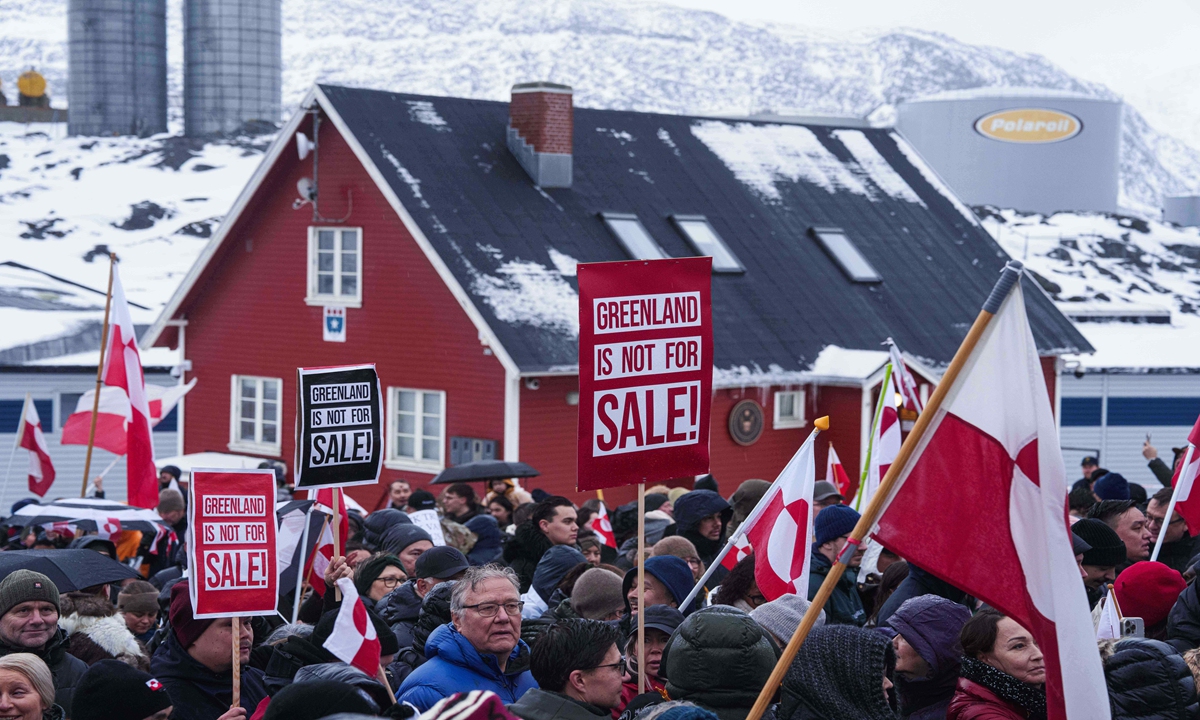
People protest against US policy toward Greenland in front of US consulate in Nuuk, Greenland, on January 17, 2026. Photo: VCG
Editor's Note:
The US repeated threats of taking over Greenland, the largely autonomous Arctic territory and part of the Danish kingdom, are perceived by many as a vestige of colonial-era expansionism and highlight a troubling pattern of geopolitical maneuvering where strategic interests blatantly override respect for the sovereignty of other countries. How do Denmark, Greenland and Europe react to the US moves? What will be the fate of Greenlanders? In her I-Talk show, Global Times (GT) reporter Wang Wenwen talked to Aaju Peter (Peter), a Greenland-born Inuit activist and lawyer, on these issues.
GT: As a Greenlandic Inuit, what was your initial reaction when you heard the US suggest taking over Greenland?
Peter: When I first heard about it about a year ago, I just laughed because it was so absurd. But now, this time around, I'm taking it much more seriously. I'm worried, because if the US does go ahead and take Greenland by force, then that will be the end of the world. All powerful nations are going to think that they can just do whatever they like and take over any anything they want, because this is going to set the example and trash all the laws and agreements that have been made for centuries.
It is a total disregard [for international law] and should not be allowed. Countries have to respect the sovereignty of nations. They can't just do whatever they want. It's unacceptable. If big powers can just use all their might to take over everyone, it is going to be a big mess.
GT: How have local media and the Greenlandic public responded to these statements from the US? Would you say there is a prevailing sense of resistance and concern?
Peter: People are quite worried because they realize there are only 57,000 of them on the island, the biggest island in the world with a very small population. The US already has a base with soldiers in the northern part of Greenland established during World War II, so Greenland has had good relationships with the US, and Greenlanders and Greenlandic politicians would like to keep that good relationship as allies and part of NATO. However, having said that, we also have to prepare for the worst - what will we do if it comes to the worst? It's very unsettling and very nerve-wracking right now. In law, if you're threatening and causing people to be afraid, then that's a crime in itself.
The politicians right now are meeting with the US, and the Danish government is also engaging with other allies. If we cannot depend on an ally that we have had for centuries, then we have to look for other allies who can help us and support us. I don't know what agreements are being talked about right now, but we have survived in the Arctic for thousands of years, and we still remember how to survive in the Arctic. I hope it doesn't come to the worst.
GT: Five parties in Greenland issued a joint statement in response to US threats, saying that Greenlanders "don't want to be Americans." Is this a common sentiment among people across the island?
Peter: We had a good relationship with the US for security, and that was good for Greenland and for North America. But now that our own ally has turned on us and wants to take us over. That is not a comfortable place to be in right now.
85 percent of Greenlanders have stated that they do not want to be part of the US. They do not like how the US president is acting. We are also listening to senators and Republicans who support Greenlanders and oppose what their own president is doing. So there is hope, and we can see support for Greenland and Denmark from the rest of the world.
GT: In your view, what are the underlying strategic motives behind the US interest in Greenland?
Peter: We don't have our own military in Greenland. We have a very small population. We don't have the means to attack anybody. We are not a threat to the US. We would like to understand why the US wants to take over Greenland. It claims that it is because of security. But I think it's also because of all the minerals, resources, waters and land that Greenland has.
Greenlanders - the politicians and the people - are trying to stay very calm. They want to go back to how things were before threats started. They want to work together with the US. If it is security that the US wants, then Greenland is ready and willing to talk and set up a secure Arctic. But using arms and threats is not the proper way to come to an agreement.
GT: On Wednesday, US President Donald Trump said he and NATO secretary general have "formed the framework of a future deal with respect to Greenland" and he would no longer impose punitive tariffs on some European countries as he previously claimed. Some observers argue that the US stance on Greenland exposes growing strains in transatlantic relations. One US media outlet even commented that it is European cowardice that is empowering the US new imperialism. How would you respond to that interpretation?
Peter: I think it's very difficult for European countries or other nations to try to protect Greenland or Denmark when they are not being listened to. The US president doesn't want to sit down and have a productive conversation with the people that are being affected. The people of the US and their elected representatives need to put a stop to this, because it doesn't make sense. It goes against all legislation and agreements that have been made. I don't know how prepared Europe is to take on the US.
RELATED ARTICLES