Europe remains wary as Trump cancels Greenland tariff threat
‘Trust gap with US widens’ as allies brace for tougher transatlantic ties
By Feng Fan and Published: Jan 22, 2026 11:47 PM

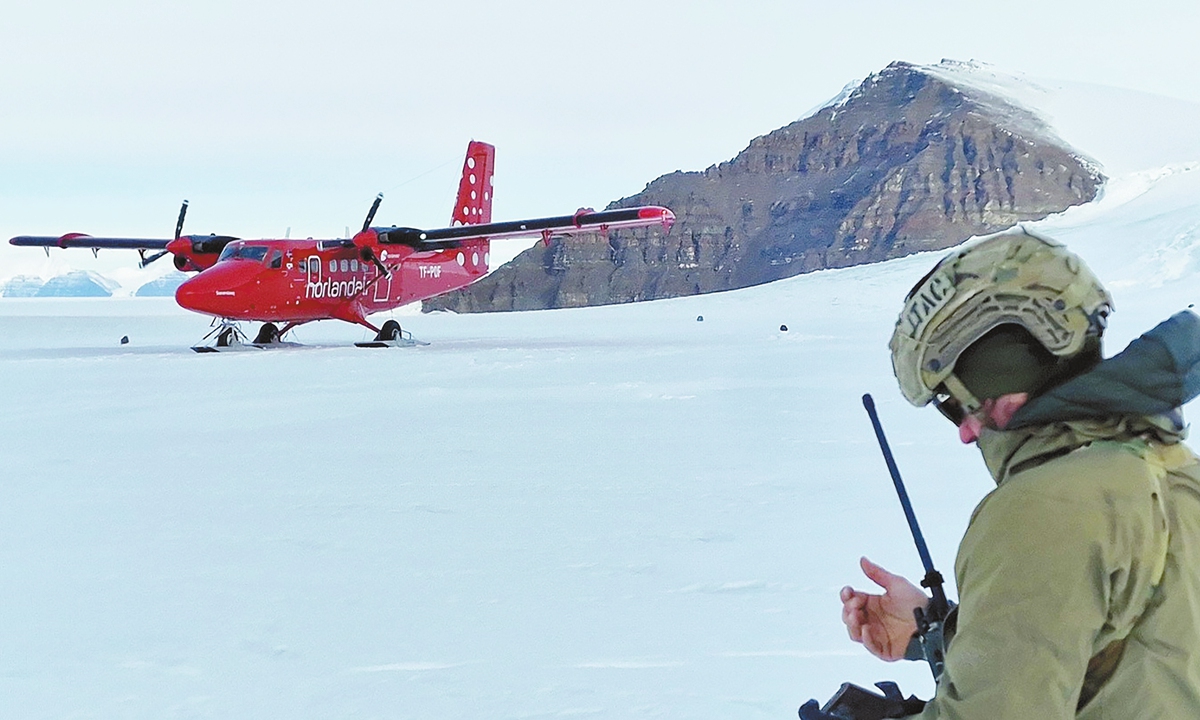
Members of the Arctic Operations Specialist (AOS) unit from the Danish Army's J?gerkorpset (Special Forces) arrive in some of Greenland's most extreme terrain at the Blosseville Coast in Greenland, on local time January 21, 2026. Photo: VCG
Though US President Donald Trump walked back threatened tariffs on eight European countries, claiming that a "framework for a future deal" on Greenland had been reached and that Washington would not use force over the island, European allies remained wary. An emergency summit of leaders of the EU's 27 member states is set to convene in Brussels late Thursday, according to multiple media reports.
Chinese experts said the US has not abandoned its objective of acquiring Greenland, and that after years of long-term pressure and policy flip-flops from Washington, Europe finds its trust gap with the US had greatly widened. But whether Europe can ultimately unite to confront US pressure remains to be seen, they noted.
US President Donald Trump has claimed that he would not impose tariffs he had threatened to impose on eight European nations that had been set to take effect on February 1 unless those nations allowed the US to take control of Greenland, according to multiple media reports.
In a social media post on Wednesday, Trump claimed that based upon a meeting he had with Mark Rutte, Secretary General of NATO, they have "formed the framework of a future deal with respect to Greenland and, in fact, the entire Arctic Region." He added that "based upon this understanding, I will not be imposing the Tariffs that were scheduled to go into effect on February 1st."
Much about the potential deal remained unclear on Thursday, though Trump claimed in a Fox Business interview that the US is going to have total access to Greenland, including all the military access the US wants, Washington Times reported.
Trump claimed the deal, if completed, will also allow for the US to install an element of his "Golden Dome," part of a multibillion dollar missile defense system, in Greenland.
Notably, hours before Trump's announcement, the European Union's parliament halted final approval of a critical trade deal that Trump reached with the bloc last summer.
Trump's threat to put tariffs on European countries over Greenland was likely a negotiating tactic and a form of leverage against Europe, and the decision to withdraw the tariffs may have reflected a calculation that such measures would do more harm than good to the US, Li Haidong, a professor at China Foreign Affairs University, told the Global Times on Thursday. "But even with the tariffs shelved, Europe has already been thoroughly disappointed with the US," Li noted.
Divided responses
European countries showed divergent reactions to Trump's claims. Danish Prime Minister Mette Frederiksen welcomed talks between Trump and Rutte that led to the "framework for a future deal" on Greenland, but stressed that the island's sovereignty was non-negotiable, according to Politico.eu.
"NATO is fully aware of the Kingdom of Denmark's position. We can negotiate about everything politically - security, investments, the economy. But we cannot negotiate about our sovereignty," Frederiksen said in a statement published Thursday morning, Politico.eu reported.
Danish Defence Minister Troels Lund Poulsen said on social media that Rutte "cannot negotiate an agreement on behalf of Denmark or Greenland," France 24 reported, "We have a clear red line," he added. "We will not cede sovereignty over parts of the kingdom."
French Finance Minister Roland Lescure welcomed Trump's decision to drop the tariff threat, calling it "a first positive sign that is moving in the right direction," but said he remained "vigilant," according to France 24.
German Chancellor Friedrich Merz also welcomed Trump's shift and urged Europeans not to rush to write off the transatlantic partnership. "Despite all the frustration and anger of recent months, let us not be too quick to write off the transatlantic partnership," he said, according to France 24. At the same time, Merz warned that "a world where only power counts is a dangerous place," noting that the US is "radically reshaping its foreign and security policy," the report said.
Speaking at a press conference in Davos, Swedish Prime Minister Ulf Kristersson said that while he welcomed Trump's public statement ruling out military force over Greenland, he remained disappointed by the overall tone and substance of the remarks, Xinhua reported on Thursday.
Trump's recent moves in Europe - including his Davos speech and statements on Greenland - have failed to elicit a swift positive response largely because he has not abandoned demands over Greenland's sovereignty, while continuing to criticize Europe politically and shift policies frequently, keeping transatlantic ties tense, Cui Hongjian, a professor at the Academy of Regional and Global Governance at Beijing Foreign Studies University, told the Global Times on Thursday.
"For Europe, this is no longer simply about trust, but about vigilance and precaution," Cui said, adding that Europeans are preparing for the possibility that the US could sideline Europe or even NATO, forcing Europe to rely more on itself.
Despite Trump's apparent partial retreat on Greenland, European allies remain unconvinced - a sentiment reflected in European media commentary and in the muted reception to Trump's "Board of Peace" signing ceremony in Davos.
Politico.eu reported Thursday that "Trump steps back from the brink on Greenland. But the damage has been done," adding that "the president's effort to acquire Greenland, even with the threat of force off the table, has changed the way allies see the US."
"European governments have reached a difficult conclusion: The Americans are the baddies now," wrote Politico.eu., in another report, adding that as leaders of the EU's 27 countries assemble in Brussels for an emergency summit Thursday, that assessment is "predominant across almost all capitals in Europe," citing to nine EU diplomats.
The BBC reported that US allies "won't forget" the Greenland crisis, noting that while details of the Rutte-Trump deal may soon emerge, the fact that Trump triggered weeks of high drama and a sense of existential crisis within NATO "will not easily be forgotten."
Trump held a signing ceremony Thursday in Davos for his new "Board of Peace." According to CNN, the event featured representatives from fewer than 20 countries - and few of the US' European allies.
The total number of attendees is fewer than the roughly 35 that a senior administration official predicted to reporters earlier this week. And it did not include any Western European nations, CNN said.
The Greenland episode may have touched a psychological red line for many European countries, Cui added, as there were genuine fears that US-EU disputes could escalate from interest-based differences to the use of force. "For Europe, this may mark a definitive shift," he said.
RELATED ARTICLES