Nvidia CEO Jensen Huang is reportedly visiting China; repeated visits highlight crucial China market: analyst
By Published: Jan 23, 2026 09:42 PM

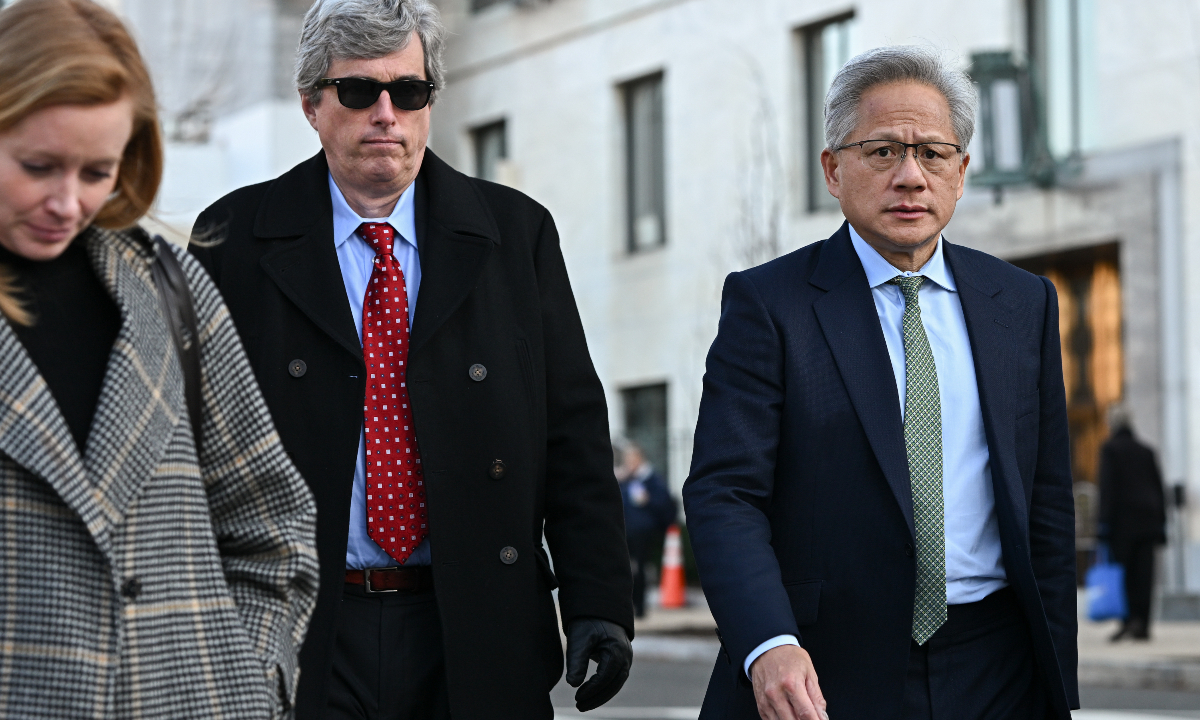
Jensen Huang, CEO of Nvidia Corp, departs following a meeting with members of the Senate Banking, Housing, and Urban Affairs Committee in Washington, DC, US, on December 3, 2025. Photo: VCG
Nvidia CEO Jensen Huang is reportedly visiting China, ahead of the Chinese New Year in mid-February, domestic news outlet QQ News reported on Friday.
Huang's trip is one of the important trips in the CEO's itinerary as the company's chip sales to China have stalled. His decision to visit in person is a "vote with the feet" underlining the importance the company has attached to the vast Chinese market, a Chinese expert noted on Friday.
Huang is in Shanghai on Friday, visiting the company's new office building, and had an exchange with employees and reviewed the major events of the company in 2025, according to the QQ News report. The report noted that Huang's visit could be part of efforts to sell the H200 chips in the Chinese market.
According to a separate report by US media outlet CNBC on Friday, Huang is expected to attend an Nvidia company event in Beijing on Monday, citing people familiar with the matter.
Lü Xiang, a research fellow at the Chinese Academy of Social Sciences, told the Global Times on Friday that repeated visits by Huang to China have shown his eagerness to maintain Nvidia's presence in the vital, fast-growing market that is experiencing an artificial intelligence boom, even as US policy uncertainty has driven the company's chip sales to China close to zero.
Huang visited the Chinese mainland at least three times last year, CNBC reported.
In January 2025, Huang was in Beijing for a Chinese New Year celebration hosted by the company's local subsidiary, according to domestic news portal yicaiglobal.com.
In July, Huang was in Beijing again, attending the 3rd China International Supply Chain Expo. During the visit, he praised China's tech companies and vast market potential, expressing optimism about the country's advances in AI, robotics and smart manufacturing, as well as the country's growing role in global innovation.
The US administration in January cleared sales of Nvidia's H200 chips, one of its most advanced products, while taking a 25 percent government cut from those sales, according to the BBC.
The reported visit comes after months of lobbying by Nvidia, which has argued the importance of maintaining access to the Chinese market.
However, due to the deeply rooted anxiety held by some US politicians about China's progress in high-tech sectors, the US has displayed a contradictory approach toward exports of high-end chips to China.
On Wednesday, a US House committee focused on foreign affairs approved bipartisan legislation calling for arms-sale-style congressional oversight of advanced AI chip exports, Bloomberg reported.
According to Bloomberg, under the legislation, named the ''AI OVERWATCH Act," the administration would be required to notify Congress of advanced AI chip sales before they are approved, giving lawmakers the power to review and block export licenses to China, Russia, Iran, and other so-called adversaries through a joint resolution.
White House AI czar David Sacks has publicly criticized the bill. Sacks and other Trump administration officials have argued that continued sales in China would encourage foreign companies to become reliant on American technology, thereby boosting US leadership, Bloomberg reported.
Chinese analysts said some US politicians' pursuit of a technological containment and blockade strategy against China has greatly undermined the market appeal of Nvidia chips, despite continued demand. Meanwhile, Chinese homegrown chips are making rapid progress, reducing domestic users' reliance on foreign suppliers.
Lü said the US' erratic response to high-tech exports to China has inevitably raised doubts among Chinese customers over the reliability of Nvidia's supply. Also, the company must prove that its products pose no security risks.
While China's semiconductor industry welcomes positive China-US exchanges in technological innovation and industrial development in line with both sides' regulations, it must remain highly vigilant regarding the US' erratic stance on exports of high-end chips, Wei Shaojun, a deputy head of the China Semiconductor Industry Association (CSIA), told the Global Times in a recent exclusive interview.
Wei pointed out that the US' erratic stance - alternately easing restrictions and applying pressure on high-end chips - makes it difficult to discern Washington's true strategic intentions: Is the recent so-called "relaxation" a genuine signal to promote positive interaction, or is it a new tactic aimed at disrupting Chinese industry's development pace and lulling it into complacency?
"China's semiconductor industry must remain highly vigilant toward this, resolutely refuse to be deceived by superficial appearances, and, even more importantly, must not waver in its confidence and determination to persist on the path of indigenous development in advanced technologies and other key areas," Wei said.
According to Lü, there is another reading of Huang's reported visit to China: "deep down, the CEO of the world's most valuable chip company could be concerned about his company's advanced chips becoming not so advanced in the Chinese market in just two to three years' time."
On January 15, in response to a question on the Trump administration's announcement to approve sales to China of Nvidia's H200 AI chip but also takes 25 percent of sales, Chinese Foreign Ministry spokesperson Mao Ning said that on US chip exports to China and related tariff issues, China has stated its position clearly on multiple occasions.
On December 9,Chinese Foreign Ministry spokesperson Guo Jiakun said China always advocates that China and the US achieve mutual benefit through cooperation.
RELATED ARTICLES